Pronunciation: /kyoo-bik yahrd/
Symbol: yd³, cu. yd., CY
Domain: Civil Engineering, Construction, Landscaping, Waste Management
Definition
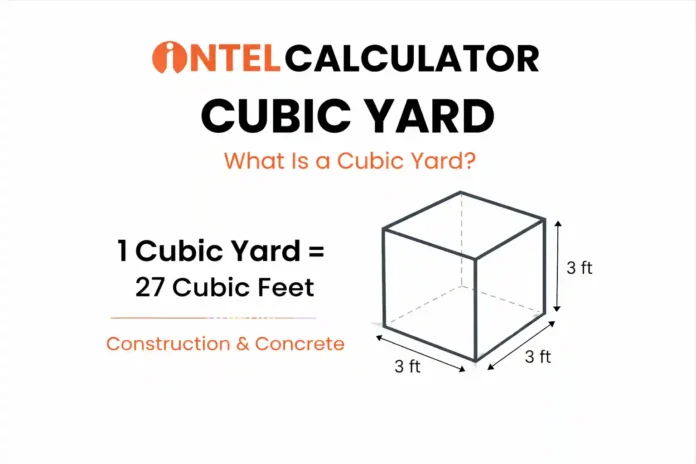
A cubic yard is an Imperial and US Customary unit of volume equal to the space occupied by a cube measuring one yard (3 feet) on each side. It is the primary measurement standard in the United States for bulk materials including concrete, soil, aggregate, mulch, and construction waste.
Why it matters: Misunderstanding cubic yards versus square yards or cubic feet is one of the most common—and expensive—ordering errors in construction. The difference between calculating in square yards versus cubic yards can result in ordering 300% more material than needed.
Need to calculate cubic yards then click on button for calculator
Calculate Cubic Yards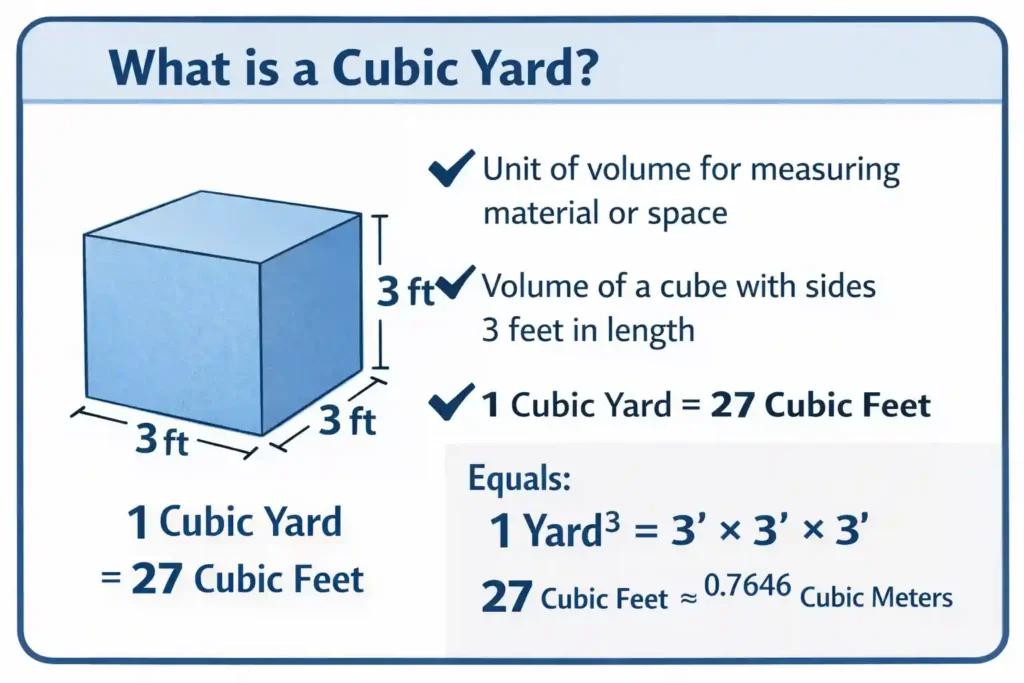
Quick Reference
| Conversion | Value |
| 1 cubic yard = | 27 cubic feet |
| 1 cubic yard = | 0.7646 cubic meters |
| 1 cubic yard = | 46,656 cubic inches |
Visual Scale
A single cubic yard is roughly the size of:
- A standard washing machine
- A dishwasher
- A 3′ × 3′ × 3′ box
The Rule of 27
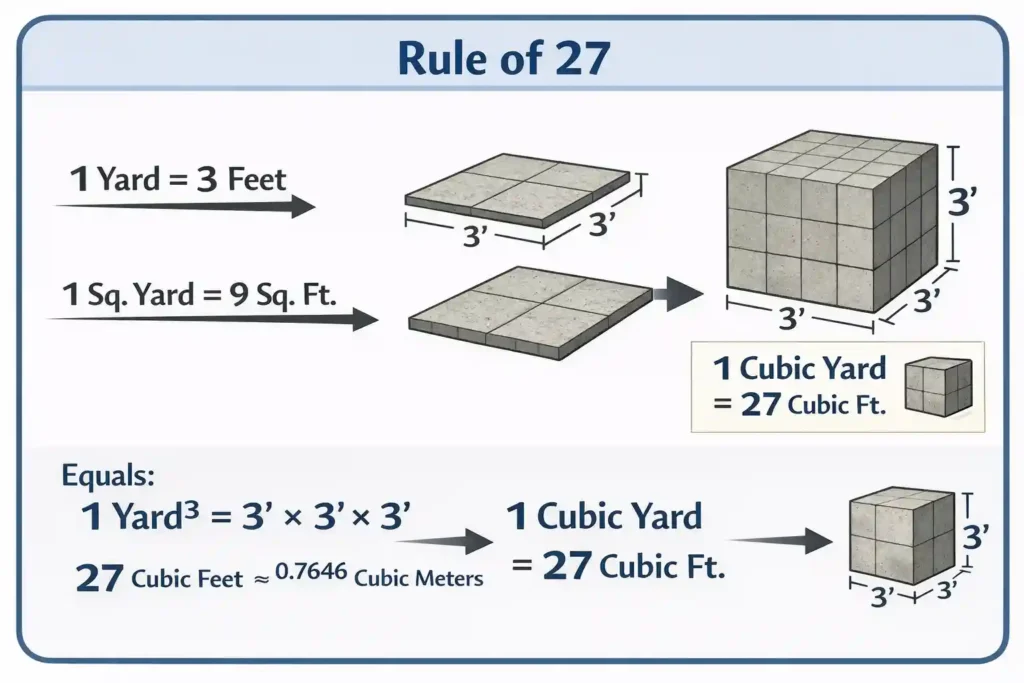
The most critical principle when working with cubic yards is understanding how volume scales geometrically, not linearly:
- Linear: 1 yard = 3 feet
- Area: 1 square yard = 9 square feet (3 × 3)
- Volume: 1 cubic yard = 27 cubic feet (3 × 3 × 3)
Quick Calculation Formula
Cubic Yards = (Length in feet × Width in feet × Depth in feet) ÷ 27
Example: A concrete slab 24′ long × 12′ wide × 0.5′ thick
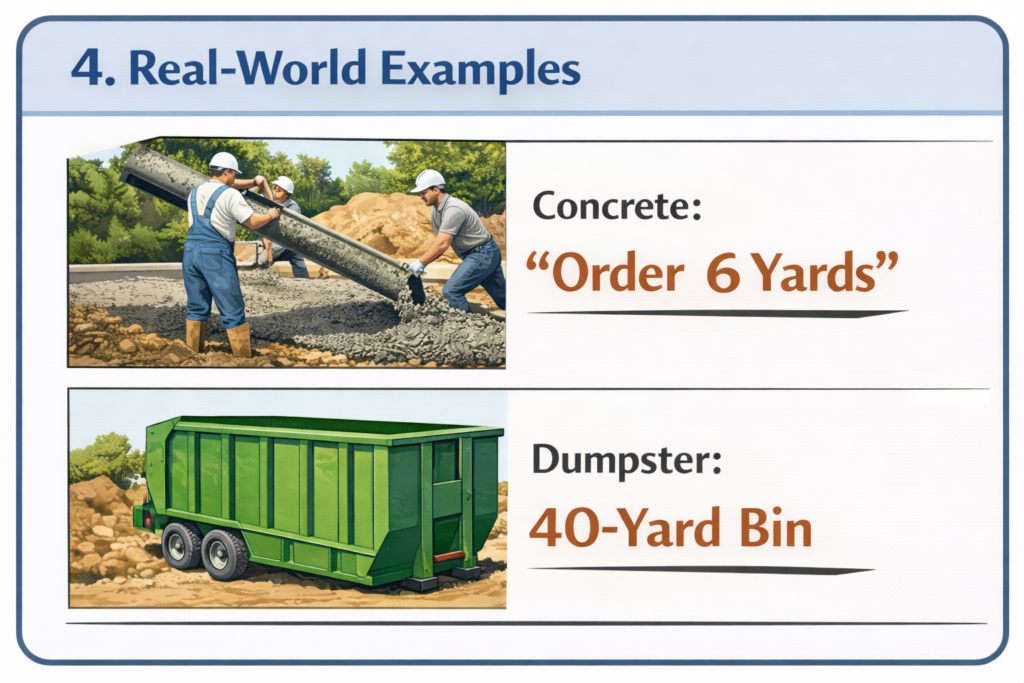
= (24 × 12 × 0.5) ÷ 27 = 5.33 cubic yards (order 6 to account for waste)
Understanding Material States
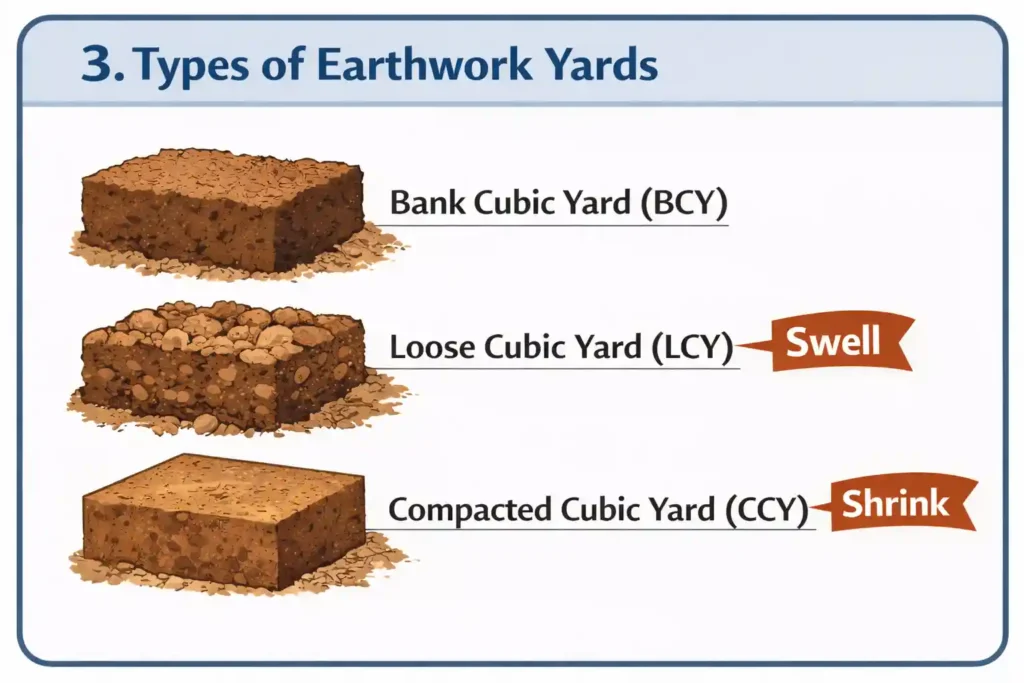
In earthwork and excavation, a cubic yard is not static. Material changes volume depending on how it’s handled—a phenomenon engineers call swell and shrinkage factors.
Bank Cubic Yard (BCY)
Material in its natural, undisturbed state in the ground. This is what surveyors measure when calculating cut/fill requirements.
- Density: High (naturally compacted)
- Use: Site planning and earthwork estimates
Loose Cubic Yard (LCY)
Material after excavation. Once disturbed, earth incorporates air pockets and expands. One BCY typically becomes 1.2-1.3 LCY.
- Density: Low (includes air voids)
- Use: Trucking and hauling calculations
Compacted Cubic Yard (CCY)
Material after mechanical compaction using rollers or plate compactors. Often denser than the original bank state.
- Density: Highest (mechanically compressed)
- Use: Structural fill, road base, embankments
Critical Insight: Ordering 100 cubic yards of “dirt” without specifying BCY, LCY, or CCY can lead to receiving 30% more or less material than your project requires.
Material Weight Reference
The cubic yard measures volume, not weight. Understanding material density is essential for logistics and vehicle capacity planning.
| Material | Weight per Cubic Yard |
| Mulch (bark) | 400-600 lbs |
| Topsoil (dry) | 2,000-2,200 lbs |
| Sand (dry) | 2,500-2,700 lbs |
| Gravel | 2,700-3,000 lbs |
| Concrete (wet) | 3,900-4,050 lbs |
| Asphalt | 3,900-4,000 lbs |
Why this matters: A standard pickup truck can safely carry about 2 cubic yards of topsoil but only 1 cubic yard of gravel or concrete before exceeding its payload capacity.
Real-World Applications
Concrete Projects
Scenario: Pouring a residential driveway
Dimensions: 20′ × 10′ × 4″ thick
Calculation: (20 × 10 × 0.33) ÷ 27 = 2.44 CY
Order: 3 cubic yards (always round up for concrete)
Landscaping
Scenario: Mulching a garden bed
Area: 500 sq ft with 3″ depth
Calculation: (500 × 0.25) ÷ 27 = 4.63 CY
Order: 5 cubic yards
Delivery note: Standard pickup trucks hold approximately 2 cubic yards, so this requires 3 trips or a single dump truck delivery.
Waste Management
Dumpsters are rated by cubic yard capacity:
- 10-yard dumpster = 3 pickup truck loads (best for heavy materials like concrete)
- 20-yard dumpster = 6 pickup truck loads (most common for home renovations)
- 40-yard dumpster = 12 pickup truck loads (large commercial projects, bulky lightweight materials)
Common Mistakes to Avoid
Mistake #1: Confusing Square Yards with Cubic Yards
Wrong: Calculating 300 sq ft ÷ 9 = 33 “yards” of concrete
Right: (300 sq ft × depth in ft) ÷ 27 = cubic yards needed
Mistake #2: Assuming All Materials Weigh the Same
A cubic yard of mulch weighs 500 lbs. A cubic yard of gravel weighs 2,700 lbs. Never use the same hauling plan for different materials.
Mistake #3: Ordering Exact Calculations
Always add 5-10% for waste, spillage, uneven subgrade, and settling. Running short on concrete mid-pour costs far more than over-ordering.
Mistake #4: Ignoring Compaction
Loose soil settles 15-25% after watering and time. If filling a raised bed, order extra to account for settling.
Mistake #5: Visual Underestimation
5 cubic yards of topsoil creates a pile the size of a large SUV. Most homeowners drastically underestimate how much material they can move manually.
Historical Context
The cubic yard derives from the linear yard, which has roots in Old English gerd (rod or stick). King Edward I standardized the “Iron Yard of our Lord the King” in the 13th century for wool trade.
The modern definition was formalized in the 1959 International Yard and Pound Agreement, where six nations defined one yard as exactly 0.9144 meters. This makes the cubic yard technically a metric-derived unit (0.9144³ = 0.7646 m³), though it remains the American construction standard.
Despite global metrication, the US concrete, aggregate, and excavation industries show no signs of abandoning the cubic yard.
Industry Terminology
Understanding how professionals use the term:
“Send me nine yards” = 9 cubic yards of material (often concrete)
“A 20-yarder” = A 20-cubic-yard dumpster
“Bank measure” = Material calculated in its natural state (BCY)
“Truck measure” = Material measured as hauled (LCY)
Modern Technology & Trends
Drone Volumetrics
Photogrammetry and LiDAR-equipped drones now calculate stockpile volumes by generating 3D point clouds, achieving 99% accuracy in minutes—eliminating manual surveying for large earthwork projects.
Smart Trucking
Modern dump trucks use load cells and telematics to measure payload weight, then calculate cubic yards based on known material density for accurate billing regardless of per-ton or per-yard pricing models.
Lean Construction
Building Information Modeling (BIM) enables precise cubic yard calculations to decimal points, reducing waste in sustainable construction projects. The industry is moving away from “order 10% extra” toward exact estimation.
The Metric Question
While global construction firms work in dual units (m³ and yd³), the US domestic market remains firmly committed to cubic yards. Heavy equipment still lists capacities in both units for international compatibility.
Related Terms
Cubic Foot (ft³) – The base unit; 27 cubic feet = 1 cubic yard
Cubic Meter (m³) – Metric equivalent; 1 CY ≈ 0.76 m³
Acre-Foot – Large-scale water/reservoir volume; 1 acre-foot ≈ 1,613 cubic yards
Board Foot – Lumber volume unit (12″ × 12″ × 1″); distinct from cubic yards
Load Factor – Ratio used to convert between BCY, LCY, and CCY
Aggregate – Particulate construction materials (sand, gravel, crushed stone) sold by cubic yard or ton
Specific Gravity – Density ratio enabling cubic yard to weight conversion
Professional Tips
1. Master the Divider
Always divide cubic feet by 27, never 9 or 12. Write it on your hard hat if needed.
2. Specify the State
When ordering earthwork, always clarify: “I need X cubic yards of soil—is that bank, loose, or compacted measure?”
3. Check Vehicle Capacity
Before hauling material yourself, verify both volume capacity AND weight limit. A half-ton pickup carrying a cubic yard of wet concrete will likely suffer suspension damage.
4. Build in Contingency
For concrete, soil, and aggregate, add 5-10% to your calculation. Material waste is cheaper than project delays or emergency reorders.
5. Use Digital Tools
Leverage online calculators or the basic formula before signing purchase orders. Double-check your math—material suppliers rarely accept returns on bulk goods.
6. Understand Pricing Models
Some suppliers charge by weight (ton), others by volume (cubic yard). Know which model applies and how moisture content affects weight-based pricing for materials like soil and sand.
When to Use This Unit
Always use cubic yards for:
- Ready-mix concrete orders
- Bulk soil, mulch, compost
- Aggregate (gravel, sand, crushed stone)
- Excavation and fill estimates
- Dumpster rental sizing
- Asphalt paving calculations
Don’t use cubic yards for:
- Lumber (use board feet)
- Small-scale DIY projects under 1 cubic yard (use cubic feet or bags)
- Liquid volumes (use gallons)
- International projects outside North America (use cubic meters)
Summary
The cubic yard is the fundamental volume unit of American construction, representing 27 cubic feet or approximately 0.76 cubic meters. Success in material ordering requires understanding that volume scales geometrically (not linearly), that different materials have vastly different densities, and that earthwork materials change volume depending on their state (bank, loose, or compacted).
Whether you’re a homeowner ordering mulch or a civil engineer managing a highway project, precision with cubic yards directly impacts project costs, scheduling, and waste management. The unit may be centuries old, but its mastery remains essential to modern construction practice.