
Last updated: May 06, 2026
Boiler Feed Pump Calculation

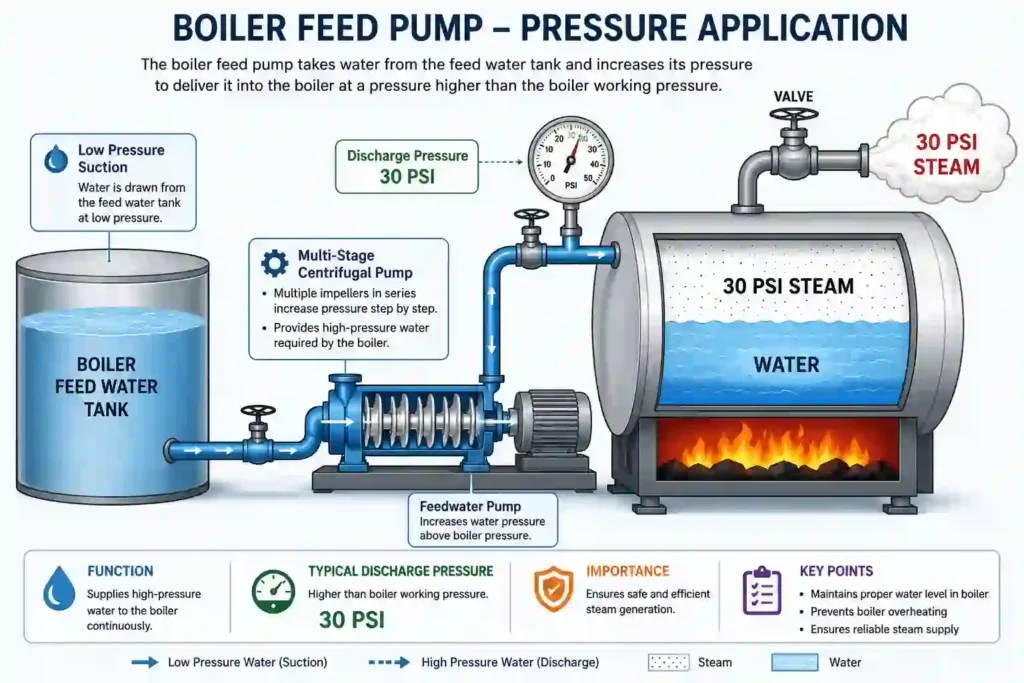
A boiler feed pump (BFP) is one of the most critical pieces of equipment in any steam power plant, industrial boiler system, or process heating facility. Its primary job is simple but vital: it takes water from a feed water tank or deaerator and pushes it into the boiler at a pressure high enough to overcome the boiler’s working pressure. Without a reliable boiler feed pump operating at the right flow and pressure, the boiler cannot produce steam safely or efficiently.
Boiler feed pumps are typically centrifugal pumps, often multi-stage, because boilers operate at high pressures. A single-stage pump cannot usually generate enough head for large boilers, so multiple impellers are arranged in series inside one casing. Each stage adds pressure, and together they achieve the required discharge pressure.
Understanding how to calculate the performance parameters of a boiler feed pump is essential for plant engineers, mechanical engineers, and boiler operators. These calculations determine what size pump to select, what motor is needed, and whether the pump will operate efficiently and safely. This guide walks through every major calculation method in plain language with clear formulas and practical examples.
Key Parameters Before You Calculate
Before performing any boiler feed pump calculation, you must collect and understand the following system parameters. These inputs drive every formula in this guide.
Boiler Operating Pressure
This is the pressure inside the boiler drum, measured in pounds per square inch gauge (PSIG) or bar. The pump must discharge at a pressure higher than this to force water into the boiler. Typical values range from 150 PSIG for small industrial boilers to over 2,400 PSIG for large power plant boilers.
Feed Water Flow Rate
This is the mass or volumetric flow of water the boiler consumes to produce steam. It is determined by the boiler’s steam output, blowdown rate, and any make-up water requirements. Flow is expressed in gallons per minute (GPM), cubic meters per hour (m³/h), or pounds per hour (lb/h).
Feed Water Temperature
Water entering the pump comes from the deaerator or feed water heater. Temperature is typically between 180°F and 250°F (82°C to 121°C). Temperature affects water density and vapor pressure, which are critical for cavitation calculations.
Suction Conditions
The pump suction side must have enough pressure to prevent cavitation. Suction pressure, suction pipe losses, and the water’s vapor pressure at operating temperature all factor into the Net Positive Suction Head (NPSH) calculation.
Pump Efficiency
Centrifugal pumps are not 100% efficient. Typical boiler feed pump hydraulic efficiency ranges from 65% to 85%, depending on pump size, design, and operating point. Motor efficiency is separate and typically ranges from 90% to 96%.
Calculating Total Dynamic Head (TDH)
Total Dynamic Head (TDH) is the total energy the pump must add to the water to move it from the suction source into the boiler. It is expressed in feet (ft) or meters (m) of fluid. TDH is the single most important parameter in pump selection.
The TDH Formula
TDH combines four components:
TDH = Static Head + Friction Head + Pressure Head + Velocity Head
Where:
Static Head = Elevation difference between suction source and
boiler drum (ft)
Friction Head = Pressure losses in pipes, valves, fittings (ft)
Pressure Head = Boiler pressure converted to feet of water
Velocity Head = Usually small, often negligible for BFP sizing
Converting Boiler Pressure to Head
Boiler pressure in PSIG must be converted to feet of water to add it to TDH. The formula depends on water density at operating temperature:
Pressure Head (ft) = Boiler Pressure (PSIG) × 2.31 / Specific Gravity
For cold water (SG = 1.0): 1 PSIG = 2.31 ft
For hot water at 212°F (SG ≈ 0.958): 1 PSIG ≈ 2.41 ft
Example: 300 PSIG boiler with feed water at 200°F (SG = 0.965)
Pressure Head = 300 × 2.31 / 0.965 = 718 ft
Practical TDH Example
Consider a boiler system with the following data:
- Boiler pressure: 300 PSIG
- Feed water temperature: 200°F (SG = 0.965)
- Deaerator is 15 ft above pump centerline (static head = -15 ft, pump gains this)
- Boiler drum is 20 ft above pump (static head = +20 ft)
- Estimated pipe friction losses: 40 ft
- Valve and fitting losses: 15 ft
Calculation: Pressure Head = 300 × 2.31 / 0.965 = 718 ft
Net Static Head = 20 – 15 = 5 ft (boiler above deaerator)
Friction + Fitting Losses = 40 + 15 = 55 ft
TDH = 718 + 5 + 55 = 778 ft
This value is the required pump head at design flow. You would select a pump rated for at least 778 ft of head at the required flow rate, with a design margin of typically 10% to 15%.
Feed Water Flow Rate Calculation
The pump must supply enough water to match the boiler’s steam generation rate plus blowdown. The flow rate calculation starts with the boiler’s steam output.
Basic Flow Rate Formula
Feed Water Flow (lb/h) = Steam Output (lb/h) / (1 – Blowdown Fraction)
Blowdown Fraction: typically 0.02 to 0.10 (2% to 10%)
To convert lb/h to GPM:
GPM = Flow (lb/h) / (Water Density (lb/gal) × 60)
Water density at 200°F ≈ 8.04 lb/gal
Water density at 60°F ≈ 8.33 lb/gal
Flow Rate Example
A boiler produces 50,000 lb/h of steam. Blowdown is 5%. Feed water temperature is 200°F.
Step 1: Feed water flow = 50,000 / (1 – 0.05) = 52,632 lb/h
Step 2: Convert to GPM = 52,632 / (8.04 × 60) = 109 GPM
Select a pump rated for at least 109 GPM. Apply a service factor of 10% to 20% to account for future load growth and pump wear, so specify the pump for approximately 120 to 130 GPM.
Pump Power and Efficiency Calculations
Once TDH and flow rate are known, you can calculate the hydraulic power the pump must deliver and the motor power required.
Hydraulic (Water) Power
Hydraulic power is the actual useful power imparted to the water. It represents the minimum theoretical power needed, assuming perfect efficiency.
Hydraulic Power (HP) = (GPM × TDH × SG) / 3,960
Where:
GPM = Flow rate in gallons per minute
TDH = Total dynamic head in feet
SG = Specific gravity of water at operating temperature
3,960 = Unit conversion constant
SI Units:
Hydraulic Power (kW) = (Q × H × ρ × g) / 1,000
Q = flow (m³/s), H = head (m), ρ = density (kg/m³), g = 9.81 m/s²
Brake Horsepower (BHP)
Brake horsepower accounts for the pump’s hydraulic efficiency. This is the actual shaft power the motor must deliver to the pump.
BHP = Hydraulic Power / Pump Efficiency
BHP = (GPM × TDH × SG) / (3,960 × Pump Efficiency)
Pump Efficiency expressed as decimal (e.g., 0.75 for 75%)
Motor Power Required
The motor must overcome not just pump losses but also mechanical transmission losses and motor efficiency losses.
Motor Input Power (kW) = BHP × 0.7457 / Motor Efficiency
Motor Efficiency: typically 0.90 to 0.96
Always add a motor service factor of 1.15 to 1.25 for safety margin
Power Calculation Example
Using our earlier example: Flow = 109 GPM, TDH = 778 ft, SG = 0.965, pump efficiency = 72%, motor efficiency = 93%.
Hydraulic Power = (109 × 778 × 0.965) / 3,960 = 20.7 HP
BHP = 20.7 / 0.72 = 28.8 HP
Motor Input Power = 28.8 × 0.7457 / 0.93 = 23.1 kW
Specify a 30 kW (40 HP) motor with a 1.15 service factor, giving 34.5 kW capacity, which provides adequate margin.
Net Positive Suction Head (NPSH) Calculation
NPSH is one of the most important calculations for a boiler feed pump because feed water is hot and close to its boiling point. Insufficient NPSH causes cavitation, which destroys pump impellers rapidly.
NPSH Available (NPSHa)
NPSHa is determined by the system suction conditions. It must always exceed the pump’s required NPSH (NPSHr) by a safe margin.
NPSHa = (Suction Pressure – Vapor Pressure) × 2.31 / SG + Static Head
– Suction Friction Losses
All terms converted to feet of fluid
Suction Pressure: absolute pressure at pump suction source (PSIA)
Vapor Pressure: vapor pressure of water at feed water temperature (PSIA)
Static Head: height of liquid surface above pump centerline (ft)
Vapor Pressure Values
| Feed Water Temp (°F) | Vapor Pressure (PSIA) | SG (Specific Gravity) |
| 180 | 7.51 | 0.972 |
| 200 | 11.53 | 0.965 |
| 212 | 14.70 | 0.959 |
| 220 | 17.19 | 0.955 |
| 240 | 24.97 | 0.945 |
| 250 | 29.82 | 0.939 |
NPSH Safety Margin
Always ensure NPSHa exceeds NPSHr by at least 3 ft (1 m), and many engineers require a margin of 5 ft or more for hot feed water applications. The pump manufacturer provides NPSHr on the pump curve.
NPSHa ≥ NPSHr + Safety Margin
Minimum safety margin: 3 ft (1 m) for hot water service
Recommended: 5 ft (1.5 m) or more for boiler feed applications
Multi-Stage Boiler Feed Pump Calculations
Most boiler feed pumps for medium to high pressure boilers are multi-stage centrifugal pumps. Each stage (impeller) adds a fixed amount of head. The stages are connected in series inside one casing so all the flow passes through every stage.
Number of Stages Required
Number of Stages = TDH / Head Per Stage
Head Per Stage = Maximum single-stage head capacity of the pump design
(from manufacturer catalog, typically 200 to 600 ft per stage)
Always round UP to the next whole number
Example: TDH = 1,800 ft, single stage max = 450 ft
Stages = 1,800 / 450 = 4.0 → Use 4 stages
Head per Stage
If the number of stages is fixed by the pump selection, the actual head per stage is:
Head Per Stage = TDH / Number of Stages
Each stage must operate near its best efficiency point (BEP)
for optimal performance and reliability
Quick Reference Calculation Table
The table below summarizes the primary boiler feed pump formulas for fast field reference.
| Parameter | Formula | Units |
| Total Dynamic Head | Static Hd + Friction Hd + Pressure Hd | ft or m |
| Pressure Head | PSIG × 2.31 / SG | ft |
| Feed Water Flow | Steam Output / (1 – Blowdown %) | lb/h or GPM |
| Hydraulic Power | (GPM × TDH × SG) / 3,960 | HP |
| Brake Horsepower | Hydraulic Power / Pump Efficiency | HP |
| Motor Input Power | BHP × 0.7457 / Motor Efficiency | kW |
| Number of Stages | TDH / Head per Stage (round up) | Stages |
| Wire-to-Water Eff. | (Hydraulic Power / Motor Input) × 100 | % |
| NPSH Available | (P_suction – P_vapor) × 2.31 / SG + Static – Losses | ft |
| Annual Energy Cost | Motor kW × Operating Hours × Energy Rate | $/year |
Common Calculation Mistakes and How to Avoid Them
Ignoring Water Temperature Effect on Density
Many engineers use cold water density (8.33 lb/gal, SG = 1.0) when calculating head and power for hot feed water systems. Hot water is less dense. Using cold water density underestimates the head in feet and overestimates the pump’s actual pressure delivery. Always use the specific gravity at actual operating temperature.
Forgetting Design Margin
Always add 10% to 15% to calculated TDH and flow before selecting the pump. Real systems have additional losses not captured in preliminary calculations, and pipes foul over time, increasing friction losses. A pump selected exactly at the calculated duty point will be undersized within a few years of operation.
Neglecting Suction Pipe Sizing
A common error is to focus entirely on discharge pressure and forget the suction side. A suction pipe that is too small creates high velocity, excessive friction losses, and a low NPSHa. For boiler feed pumps handling hot water, the suction velocity should be kept below 3 ft/s (1 m/s) to preserve NPSHa.
Use our pipe volume calculator to quickly calculate the volume of liquid inside a pipe based on its diameter and length. It’s ideal for engineering, plumbing, and industrial applications, providing accurate and instant results.
Not Accounting for Blowdown
Boiler blowdown removes water from the boiler to control dissolved solids concentration. If blowdown is not included in the feed water flow calculation, the pump will be undersized. Even 5% blowdown increases required pump flow by 5.3%. At 10% blowdown, the flow increase is 11.1%.
Confusing Gauge and Absolute Pressure
Boiler pressure is given in PSIG (gauge), but vapor pressure for NPSH calculations is in PSIA (absolute). Failing to add atmospheric pressure (14.7 PSIA at sea level) when converting units leads to NPSHa being underestimated, which may cause a pump to cavitate even though it looks acceptable on paper.
Energy Consumption and Life Cycle Cost
Boiler feed pumps run continuously, often 8,000 hours per year or more. Even a small improvement in pump or motor efficiency produces significant energy and cost savings over the equipment’s 20- to 25-year service life.
Annual Energy Consumption
Annual Energy (kWh) = Motor Input Power (kW) × Annual Operating Hours
Annual Cost ($) = Annual Energy (kWh) × Electricity Rate ($/kWh)
Example: 23.1 kW motor × 8,000 hours × $0.095/kWh = $17,556/year
Wire-to-Water Efficiency
Wire-to-water efficiency is the overall system efficiency from electrical input to hydraulic output. It combines pump efficiency and motor efficiency into a single metric.
Wire-to-Water Efficiency (%) = (Hydraulic Power / Motor Input Power) × 100
= Pump Efficiency × Motor Efficiency × 100
Example: 72% pump × 93% motor = 66.96% wire-to-water efficiency
Cost Impact of Efficiency Improvement
Improving wire-to-water efficiency from 65% to 75% on a 23 kW motor running 8,000 hours/year at $0.095/kWh saves approximately $2,700 per year. Over a 20-year life, this equals $54,000 in savings, which easily justifies selecting a higher-efficiency pump even at a premium purchase price.
Boiler Feed Pump Calculation Checklist
Use this checklist when performing a boiler feed pump calculation for a new installation or pump replacement:
- Confirm boiler operating pressure (PSIG) and design pressure
- Determine steam output rate (lb/h) and blowdown percentage
- Calculate required feed water flow rate (GPM)
- Establish feed water temperature at pump suction
- Look up specific gravity and vapor pressure at that temperature
- Measure or estimate all static head components
- Calculate friction losses in suction and discharge piping
- Calculate TDH and add 10–15% design margin
- Verify NPSHa exceeds NPSHr by at least 3–5 ft
- Calculate hydraulic power, BHP, and motor power
- Select motor with 1.15–1.25 service factor
- For TDH above 400 ft, evaluate multi-stage pump requirement
- Calculate wire-to-water efficiency and annual operating cost
- Compare alternative pump selections on 20-year total cost of ownership
Conclusion
Boiler feed pump calculations are not complicated when approached systematically. The most important values are Total Dynamic Head, required flow rate, and NPSH available. From these three numbers, all other parameters — pump power, motor size, number of stages, and operating cost — follow directly from straightforward formulas.
The biggest errors in practice come from using wrong temperature-dependent properties, skipping design margins, and ignoring the suction side of the system. Hot boiler feed water is particularly sensitive to NPSH because its vapor pressure is close to suction pressure. Give NPSHa careful attention in every calculation.
Multi-stage pumps dominate boiler feed service for medium and high-pressure boilers. Understanding how stages add head in series allows correct pump selection and gives insight into how the pump will behave if system conditions change. A pump with more stages than strictly required offers flexibility to adjust performance by trimming impellers or changing speed.
Finally, do not overlook life cycle cost. A boiler feed pump running 8,000 hours a year at industrial electricity rates accumulates hundreds of thousands of dollars in energy cost over its service life. The difference between a 65% and a 75% efficient pump is real money saved every year. Include efficiency in the selection criteria alongside performance and price to make the best engineering and economic decision.
| Parameter | Value | Unit |
|---|