
Last updated: May 14, 2026
Roof Shingle Calculator
The roof shingle calculator is the essential planning tool for any residential or commercial roofing project. Whether you are replacing a standard gable roof or working through the complexity of a multi-hip structure with dormers, skylights, and valleys, knowing exactly how many shingles, bundles, and squares you need — and what the complete project will cost — prevents expensive over-ordering, mid-project material shortfalls, and poor contractor negotiations.
Roofing is measured in squares, bundles, and linear feet depending on the component. The relationships between these units change with roof pitch, shingle type, waste factor, and roof geometry. A professional-grade roof shingle calculator works through all twelve planning layers that roofing contractors and project managers apply on every job: basic shingle quantity, full cost estimation, complex waste factor analysis, ridge cap and starter strip quantities, underlayment and fastener counts, long-term ROI analysis, pitch and drainage performance, side-by-side shingle type comparison, replacement timeline planning, contractor bid analysis, energy efficiency savings from cool roofs, and a complete material shopping list.
This guide explains every formula, benchmark, and decision point behind those twelve calculation modules so you can use the roof shingle calculator with full confidence, verify every output, and interpret the results for your specific project in 2026.
Use our roof pitch calculator to quickly calculate roof slope, angle, and rise measurements with accurate results. It’s ideal for roofing projects, construction planning, and estimating materials efficiently.
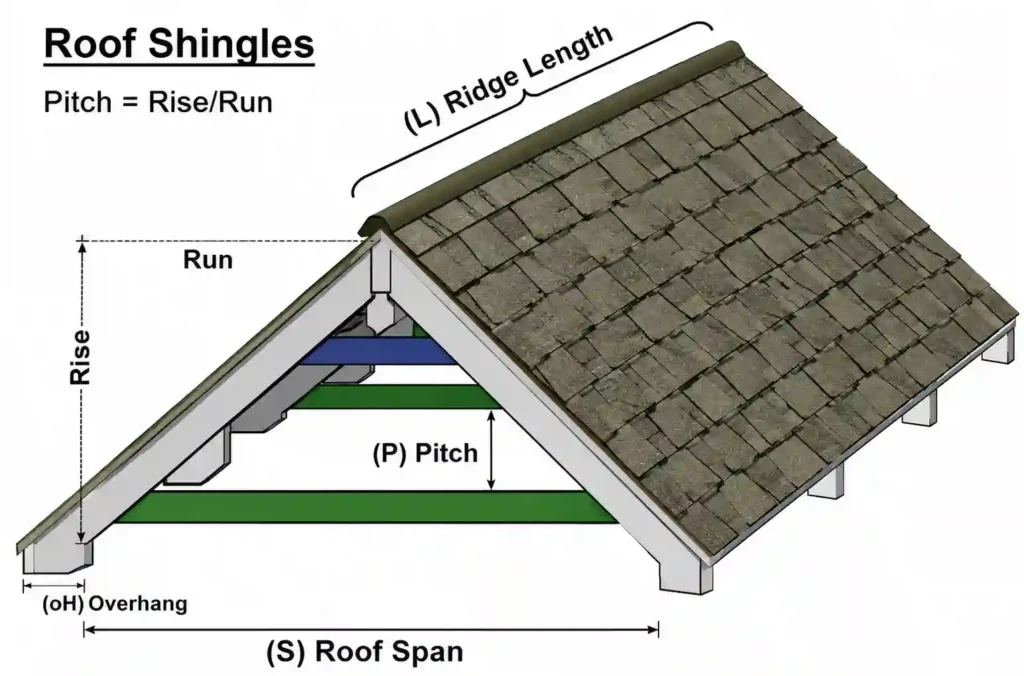
What Is a Roofing Square? — Foundational Definitions
Every roofing calculation starts with the roofing square. A roofing square equals 100 square feet of finished roof coverage. It is the universal unit of measure used by contractors, suppliers, and manufacturers to quote material quantities and labor costs.
Key Roofing Units Defined
| Unit | Definition | Conversion |
| 1 Square | 100 square feet of roof coverage | 1 square = 3 standard bundles |
| 1 Bundle | Covers approx. 33 sq ft (standard asphalt shingles) | 3 bundles = 1 square |
| 1 Shingle | Individual tab or laminate strip | ~79 shingles per square (architectural) |
| 1 Linear Foot | Used for ridge, eave, rake, valley | Ridge cap: ~33 LF per bundle |
| Pitch Multiplier | Factor to convert flat footprint to actual slope area | 4/12 pitch = 1.054 multiplier |
| Waste Factor | Additional material for cuts, overlaps, waste | 10% simple to 30% complex |
Understanding these units before entering any numbers into a calculator prevents the most common mistakes in roofing estimation. The flat footprint of your house is always smaller than the actual roof surface — sometimes by 40 percent or more on steep-pitched roofs — and that difference must be captured before calculating shingle quantities.
The Roof Shingle Calculator — All Twelve Modules Explained
Module 1: Basic Shingle Calculator
The basic shingle calculator is the starting point for every project. It converts the physical dimensions of the roof into the roofing units that suppliers and contractors use: squares, bundles, and total adjusted square footage.
The Core Formula
Step 1 — Calculate the flat footprint area:
Flat Area (sq ft) = Length (ft) x Width (ft) x Number of Roof Sections
Step 2 — Apply the pitch multiplier to find actual sloped surface area:
Actual Area (sq ft) = Flat Area x Pitch Multiplier
Step 3 — Add the waste factor:
Total Material Area (sq ft) = Actual Area x (1 + Waste Factor as decimal)
Step 4 — Convert to squares and bundles:
Squares = Total Material Area / 100
Bundles = Ceiling (Squares x 3)
Pitch Multiplier Reference Table
| Roof Pitch | Multiplier | Angle (degrees) | Description |
| 1/12 | 1.003 | 4.8° | Nearly flat — minimal slope |
| 2/12 | 1.007 | 9.5° | Low pitch — shed and porch roofs |
| 3/12 | 1.031 | 14.0° | Low slope — requires special underlayment |
| 4/12 | 1.054 | 18.4° | Standard residential — most common |
| 5/12 | 1.083 | 22.6° | Moderate — good drainage |
| 6/12 | 1.118 | 26.6° | Traditional — steep enough to walk safely |
| 7/12 | 1.158 | 30.3° | Moderate-steep — safety harness often required |
| 8/12 | 1.202 | 33.7° | Steep — typical colonial and cape cod |
| 9/12 | 1.250 | 36.9° | Steep — significant area increase |
| 10/12 | 1.302 | 39.8° | Very steep — safety gear mandatory |
| 11/12 | 1.357 | 42.5° | Extremely steep — specialty labor required |
| 12/12 | 1.414 | 45.0° | Equal rise and run — dramatic appearance |
Example Calculation
A gable roof measuring 40 feet long by 30 feet wide, with two roof sections, a 6/12 pitch, and a 15% standard waste factor.
- Flat Area = 40 x 30 x 2 = 2,400 sq ft
- Actual Area = 2,400 x 1.118 = 2,683 sq ft
- With 15% waste = 2,683 x 1.15 = 3,086 sq ft
- Squares = 3,086 / 100 = 30.9 squares
- Bundles = ceiling(30.9 x 3) = 93 bundles
Waste Factor Selection Guide
| Waste Factor | Roof Type | Typical Conditions |
| 10% | Simple Gable | One or two planes, no dormers or skylights, straight eaves |
| 15% | Standard Gable or Hip | Few penetrations, moderate complexity |
| 20% | Complex Hip or L-Shape | Multiple planes, some valleys, one or two dormers |
| 25% | Hip Roof | Full hip with multiple ridges, hips, and valleys |
| 30% | Multiple Valleys / Complex | Intersecting rooflines, many penetrations, steep pitch |
Use our Square Yards Calculator to quickly convert roof and construction measurements into square yards for estimating materials, flooring, roofing coverage, and landscaping areas with accurate results.
Module 2: Full Cost Estimation
The cost estimation module translates your shingle quantities into a complete project budget, covering materials, labor, tear-off, disposal, and permit costs. Understanding each cost category prevents budget surprises and enables meaningful contractor bid comparisons.
2026 Shingle Material Cost Ranges
| Shingle Type | Material Low (per sq) | Material High (per sq) | Avg Cost per Square |
| 3-Tab Asphalt | $80 | $110 | $95 |
| Architectural (Laminate) | $95 | $130 | $112 |
| Designer / Premium | $150 | $220 | $185 |
| Impact Resistant | $180 | $260 | $220 |
| Metal Shingles | $350 | $600 | $475 |
| Cedar Shake | $280 | $420 | $350 |
| Slate | $600 | $1,500 | $1,050 |
| Concrete Tile | $350 | $500 | $425 |
Full Cost Breakdown Per Roofing Square
| Cost Category | Typical Range per Square | Notes |
| Shingles (materials) | $80 – $1,500 | Varies dramatically by shingle type |
| Underlayment | $10 – $18 | 30lb felt or synthetic |
| Roofing Nails | $3 – $6 | 6-nail high-wind pattern costs more |
| Flashing (metal) | $12 – $20 | Aluminum standard; copper premium |
| Ridge Cap Shingles | $7 – $12 | Included in most shingle purchases |
| Miscellaneous (caulk, sealant) | $10 – $15 | Tubes, cap nails, membrane tape |
| Tear-Off (1 layer) | $80 – $120 | Per square, includes some disposal |
| Tear-Off (2+ layers) | $120 – $180 | Older homes with layered roofing |
| Disposal / Dump Fee | $15 – $22 | Per square weight-based disposal |
| Permit | $50 – $600 flat fee | Required in most jurisdictions over $500 |
| Labor | $150 – $350 | Per square installed, varies by region |
Use our Square Feet to Cubic Yards Calculator to convert area measurements into cubic yard estimates for roofing tear-off debris, construction materials, mulch, gravel, and waste removal planning efficiently.
Regional Cost Multipliers
Labor markets and material distribution costs vary significantly by geography. The calculator applies a regional multiplier that adjusts all costs proportionally.
| Region | Cost Multiplier | Example Cities |
| Low-Cost Midwest / South | 0.80 – 0.90 | Kansas City, Memphis, Birmingham |
| National Average | 1.00 | Columbus, Indianapolis, Phoenix |
| Above-Average Metro | 1.10 – 1.25 | Denver, Seattle, Minneapolis |
| High-Cost Coastal | 1.30 – 1.60 | San Francisco, New York, Boston, Miami |
Always obtain at least two or three local contractor quotes and compare them against calculator estimates. The calculator provides a reliable national-average baseline for negotiation, not a fixed local price.
Module 3: Complex Waste Factor Analysis
Simple roofs require a straightforward waste factor of 10 to 15 percent. Complex roofs with multiple valleys, hips, dormers, skylights, and chimneys require a more precise analysis that adds incremental waste for each feature separately. The waste factor analyzer calculates total waste by accumulating contributions from each roof feature.
Waste Contribution by Feature
| Roof Feature | Waste Added per Unit | Why It Generates Waste |
| Base (all roofs) | 5 – 10% | Starter course cuts, edge trimming, natural breakage |
| Gable roof type | +0% | Simple shape, minimal additional waste |
| Hip roof type | +5% | Angled hip cuts require significant trimming |
| Gambrel / Barn | +3% | Double-slope transition requires extra cuts |
| Mansard | +8% | Nearly vertical lower plane with tight cuts |
| Complex / Custom | +12% | Irregular geometry, intersecting planes |
| Each Valley | +2 – 3% | V-shaped shingle cuts at each valley line |
| Each Hip Ridge | +1 – 2% | Diagonal cuts along hip rafters |
| Each Dormer | +3 – 5% | Three new intersecting planes per dormer |
| Each Skylight | +1 – 2% | Four-sided cut-out with flashing integration |
| Each Chimney | +1 – 2% | Four-sided penetration with step flashing |
How Total Waste Is Calculated
Total Waste % = Base Waste + (Valleys x 2.5%) + (Hips x 1.5%) + (Dormers x 4%) + (Skylights x 1.5%) + (Chimneys x 1.5%) + Roof Type Adjustment
A complex example: hip roof with 3 valleys, 4 hips, 2 dormers, 1 skylight, and 1 chimney.
- Base waste = 8% (hip roof baseline)
- Hip type adjustment = +5%
- 3 valleys = 3 x 2.5% = 7.5%
- 4 hips = 4 x 1.5% = 6%
- 2 dormers = 2 x 4% = 8%
- 1 skylight = 1.5%
- 1 chimney = 1.5%
- Total waste = 37.5% — nearly double a simple gable roof
This difference is significant. A project requiring 2,400 square feet of base area at 10% waste needs 2,640 sq ft of material. The same project at 37.5% waste requires 3,300 sq ft — an additional 660 sq ft or 6.6 extra squares, roughly 20 bundles of additional shingles.
Module 4: Ridge Cap, Starter Strip, Hip Cap, and Drip Edge Calculator
The perimeter components of a roof — ridge caps, starter strips, hip caps, valley flashing, and drip edge — are separate line items from the main shingles but are essential to a weather-tight installation. Each is calculated from linear feet, not square footage.
Ridge Cap Calculation
Ridge cap shingles cover the peak of the roof where two planes meet. They are sold in bundles that cover approximately 33 linear feet each.
Ridge Cap Bundles = Ceiling[(Total Ridge Length + Total Hip Length) / 33.3]
Starter Strip Calculation
Starter strip shingles are installed along the eaves and rakes before the first course of field shingles. They provide a sealed, adhesive edge at the most vulnerable points of the roof.
Starter Strip Bundles = Ceiling[(Eave Length + Rake Length) / 100]
Drip Edge Calculation
Drip edge is a metal flashing installed along the eaves and rakes to direct water away from the fascia. Standard drip edge comes in 10-foot sticks.
Drip Edge Pieces = Ceiling[(Eave Length + Rake Length) / 10 x 1.1]
The 1.10 factor accounts for end overlaps at each piece joint.
Valley Flashing Calculation
Valley flashing lines the intersection of two roof planes. It is sold in 50-foot rolls and requires approximately 1.5 times the valley length to allow for overlap and edge coverage.
Valley Flashing Rolls = Ceiling[Valley Length / 50 + 0.5]
Flashing Material Options and 2026 Pricing
| Flashing Material | Cost Multiplier | Typical Application | Durability |
| Galvanized Steel | 0.80x base price | Budget installs, mild climates | 15 – 25 years |
| Aluminum | 1.00x (standard) | Most residential applications | 20 – 35 years |
| Copper | 4.50x premium | Premium installs, historic homes | 50 – 100 years |
| Rubber / EPDM | 2.20x | Flat or low-slope transitions | 20 – 30 years |
Example Perimeter Calculation
For a hip roof with ridge 40 ft, total hip length 80 ft, eave 100 ft, rake 60 ft, and valley 30 ft using aluminum flashing:
- Ridge cap bundles = ceiling[(40 + 80) / 33.3] = ceiling[3.6] = 4 bundles
- Starter strip bundles = ceiling[(100 + 60) / 100] = ceiling[1.6] = 2 bundles
- Drip edge pieces = ceiling[(100 + 60) / 10 x 1.1] = ceiling[17.6] = 18 pieces
- Valley flashing rolls = ceiling[30 / 50 + 0.5] = ceiling[1.1] = 2 rolls
Module 5: Underlayment, Nails, and Fasteners Calculator
Underlayment and fasteners are frequently underestimated in roofing budgets because they are purchased separately from shingles and their quantities depend on the nailing pattern and installation method selected. Getting these numbers right eliminates mid-job supply runs and ensures code compliance.
Underlayment Types and Coverage
| Underlayment Type | Coverage per Roll | Best Use | 2026 Approx. Price/Roll |
| 15lb Felt Paper | 400 sq ft (4 squares) | Budget, mild climates, dry regions | $18 – $25 |
| 30lb Felt Paper | 200 sq ft (2 squares) | Standard residential, most climates | $30 – $45 |
| Synthetic Underlayment | 1,000 sq ft (10 squares) | Premium installs, easier handling | $50 – $90 |
| Ice & Water Shield | 200 sq ft (2 squares) | Eaves, valleys, cold climates | $75 – $120 |
Underlayment Rolls = Ceiling[(Total Roof Area x 1.10) / Coverage per Roll]
The 1.10 factor accounts for a minimum 6-inch overlap on horizontal seams and 12-inch overlap on vertical seams.
Nail Count by Nailing Pattern
Roofing nails are specified in pounds and count. The nailing pattern depends on local wind zone requirements.
| Nailing Pattern | Nails per Shingle | Nails per Square | Wind Zone |
| 4-Nail Standard | 4 nails | ~316 nails/square | Low to moderate wind zones |
| 6-Nail High Wind | 6 nails | ~474 nails/square | High wind zones, coastal areas |
| 8-Nail Hurricane Zone | 8 nails | ~632 nails/square | Hurricane-designated zones |
Total Nail Calculation Formula
Shingle Nails = (Total Roof Area / 100) x 79 shingles/square x Nails per Shingle
Starter Nails = (Total Roof Area / 100) x 30
Ridge Cap Nails = (Total Roof Area / 200) x 20
Underlayment Cap Nails = Total Roof Area x 0.5
Total Nails = Sum of all four categories
Nail Weight (lbs) = Total Nails / Nails per Pound
Nail Weight Reference
| Nail Type | Nails per Pound | Best Use |
| Hand Drive 1-3/4 in | 750 per lb | Small projects, manual installation |
| Coil Roofing Nails | 600 per lb | Pneumatic nail gun, most common |
| Plastic Cap Nails | 400 per lb | Underlayment attachment, secure in wind |
| Staples | 300 per lb | Underlayment only in some jurisdictions |
Module 6: Shingle Lifespan, Warranty, and ROI Analysis
Roofing is a major capital expense for any property owner. Choosing a higher-priced shingle type is only justified when the long-term economics support it. The lifespan and ROI module calculates cost per year, return on investment as a percentage of home value, expected lifespan adjusted for climate, and warranty period — giving you the complete picture for any shingle type.
Shingle Type Performance Data (2026)
| Shingle Type | Lifespan Range | Warranty | Wind Rating | Fire Rating | Weight (lbs/sq) |
| 3-Tab Asphalt | 15 – 20 years | 25 years | 60 mph | Class A | 240 |
| Architectural / Laminate | 25 – 30 years | 30 years | 110 mph | Class A | 320 |
| Designer / Premium | 30 – 40 years | 50 years | 130 mph | Class A | 340 |
| Impact Resistant | 35 – 45 years | 40 years | 150 mph | Class A | 350 |
| Metal Shingles | 40 – 70 years | 50 years | 140 mph | Class A | 150 |
| Cedar Shake | 25 – 30 years | 20 years | 100 mph | Class B | 280 |
| Slate | 75 – 150 years | 100 years | 150 mph | Class A | 800 |
| Concrete Tile | 50 – 100 years | 50 years | 150 mph | Class A | 900 |
Climate Zone Life Adjustment Factors
Expected shingle lifespan from manufacturer specifications assumes moderate conditions. Climate affects actual service life.
| Climate Zone | Life Adjustment | Main Stress Factors |
| Mild Climate | +10% above base | Minimal thermal cycling, low UV, no freeze-thaw |
| Moderate Climate | Base lifespan (0%) | Standard seasonal changes, balanced conditions |
| Harsh (Snow/Freeze) | -10 to -15% | Repeated freeze-thaw cycles, ice damming, heavy snow load |
| Tropical / Hurricane | -5 to -10% | High humidity, UV intensity, wind events |
| Desert / Hot-Dry | -5 to -10% | Extreme UV radiation, thermal shock, low humidity cracking |
ROI Calculation
Roofing ROI is measured as the percentage of the project cost that can be recovered through increased home value at sale.
Cost Per Year = Total Project Cost / Adjusted Lifespan (years)
ROI % = (Home Value Recovery / Total Project Cost) x 100
Industry research consistently shows that a new roof returns 60 to 70 percent of its installed cost in added home value at point of sale. Architectural and designer shingles typically achieve the upper end of this range. High-end materials like metal and slate may achieve higher recovery in premium markets where buyers explicitly value longevity and reduced future maintenance.
Module 7: Pitch, Slope, and Water Drainage Analysis
Roof pitch is not just an aesthetic choice. It directly determines drainage capacity, snow load performance, wind uplift resistance, safe walking conditions for installers, and whether specific shingle types are even appropriate for your roof. The pitch analysis module evaluates a roof’s performance across five critical dimensions.
Pitch Performance by Category
| Pitch Range | Drainage | Snow Load Risk | Wind Uplift Risk | Walkability | Recommended Shingles |
| 1 – 2/12 (Low) | Poor | High accumulation | High lift | Easy, but wet | Modified bitumen, TPO only |
| 3/12 (Low-slope) | Fair | Moderate | Moderate | Easy | Special asphalt with ice & water |
| 4 – 6/12 (Standard) | Good | Low – Moderate | Low | Good | All asphalt shingle types |
| 7 – 9/12 (Steep) | Excellent | Very low | Very low | Difficult | All types, safety harness required |
| 10 – 12/12 (Very Steep) | Excellent | Minimal | Minimal | Hazardous | All types, specialized crew required |
Area Multiplier Calculation
Roof Angle (degrees) = Arctan(Rise / Run)
Area Multiplier = Square root of [(Rise / Run)^2 + 1]
Actual Sloped Area = Flat Footprint x Area Multiplier
Snow Load Considerations by Climate
| Climate Zone | Snow Load Risk at 4/12 Pitch | Safe Pitch Threshold | Recommendation |
| South / Warm | Negligible | No requirement | Any pitch acceptable |
| Moderate (Mid-South) | Low | 3/12 minimum | Standard asphalt suitable |
| North / Snow Belt | Moderate | 4/12 minimum | Ice & water at eaves mandatory |
| Mountain / Heavy Snow | High | 6/12 recommended | Metal or steep pitch for self-shedding |
Use our Gravel Calculator to estimate gravel quantities for drainage systems, roofing runoff areas, driveways, and construction projects based on dimensions and depth measurements accurately.
Module 8: Shingle Type Side-by-Side Comparison
Choosing between shingle types requires comparing multiple attributes simultaneously: upfront cost, lifespan, wind resistance, energy efficiency, fire rating, weight loading on the structure, and 30-year total cost of ownership. The comparison module presents all eight shingle types in a head-to-head format for any project size.
30-Year Cost of Ownership Methodology
The 30-year cost model accounts for the fact that cheaper shingles may require one or more mid-period replacements within a 30-year window, while premium shingles do not. A 3-Tab shingle installed in 2026 with a 15-year lifespan will need replacement around 2041, adding a second full project cost. An architectural shingle with a 30-year lifespan incurs only one installation cost over the same period.
30-Year Cost = (30 / Lifespan) x Project Cost per Square x Total Squares
Complete Shingle Comparison Matrix
| Attribute | 3-Tab | Architectural | Designer | Impact Resist. | Metal | Cedar Shake | Slate | Concrete Tile |
| Avg cost/sq | $95 | $112 | $185 | $220 | $475 | $350 | $1,050 | $425 |
| Lifespan | 15–20 yr | 25–30 yr | 30–40 yr | 35–45 yr | 40–70 yr | 25–30 yr | 75–150 yr | 50–100 yr |
| Warranty | 25 yr | 30 yr | 50 yr | 40 yr | 50 yr | 20 yr | 100 yr | 50 yr |
| Wind rating | 60 mph | 110 mph | 130 mph | 150 mph | 140 mph | 100 mph | 150 mph | 150 mph |
| Energy score | 2/10 | 3/10 | 4/10 | 4/10 | 7/10 | 5/10 | 6/10 | 6/10 |
| Fire rating | Class A | Class A | Class A | Class A | Class A | Class B | Class A | Class A |
| Weight/sq | 240 lbs | 320 lbs | 340 lbs | 350 lbs | 150 lbs | 280 lbs | 800 lbs | 900 lbs |
| 30-yr cost/sq | $190 | $112 | $139 | $165 | $204 | $263 | $210 | $128 |
Note that slate and concrete tile have high upfront costs but very low 30-year costs per square because they rarely need replacement within a 30-year planning horizon. Metal shingles offer the best combination of light weight, energy efficiency, and mid-range 30-year cost.
Module 9: Roof Replacement Timeline Planner
Knowing when your current roof will need replacement — and what that replacement will cost in future dollars — is essential for financial planning and insurance purposes. The timeline planner uses the installation year, shingle type, current condition rating, and roof area to produce a complete replacement roadmap.
Current Condition Rating Guide
| Condition Rating | Visual Description | Estimated Remaining Life |
| Excellent (10/10) | New or near-new. Full granule coverage, flat tabs, no curling. | 80–100% of rated lifespan remaining |
| Good (7–8/10) | Minor granule loss, small number of curled tabs at edges. | 50–75% of rated lifespan remaining |
| Fair (5–6/10) | Visible granule loss, multiple curled or cracked shingles, some moss. | 25–50% of rated lifespan remaining |
| Poor (2–4/10) | Widespread damage, missing tabs, exposed decking in spots. | 0–25% of rated lifespan remaining |
| Critical (Replace Now) | Significant leaking, structural exposure, widespread failure. | Immediate replacement required |
Inflation-Adjusted Cost Projection
The timeline planner calculates future replacement cost by applying a 3.5 percent annual inflation rate from the present year to the projected replacement year.
Future Cost = Current Cost x (1 + 0.035)^(Years Until Replacement)
Example: A roof currently needing replacement in 8 years at today’s cost of $14,000 will cost approximately $18,400 at 3.5% annual inflation by that replacement date. Planning ahead by setting aside funds annually avoids the financial stress of an unexpected full roof replacement.
Replacement Year Guidance by Shingle Type and Age
| Shingle Type | Rated Life | Inspect Closely At | Plan Replacement By | Emergency Replace If |
| 3-Tab Asphalt | 15 – 20 yr | 12 years | 15 – 17 years | Active leaking, year 18+ |
| Architectural | 25 – 30 yr | 20 years | 25 – 28 years | Active leaking, year 28+ |
| Designer Premium | 30 – 40 yr | 25 years | 32 – 38 years | Active leaking, year 38+ |
| Impact Resistant | 35 – 45 yr | 30 years | 37 – 43 years | Major hail damage at any age |
| Metal Shingles | 40 – 70 yr | 35 years | 50 – 65 years | Panel corrosion, seam failures |
| Cedar Shake | 25 – 30 yr | 18 years | 22 – 27 years | Rot, widespread splitting |
Use our Pressure Washing Estimate Calculator to estimate cleaning costs, labor, and surface area pricing for roofs, driveways, siding, and exterior cleaning projects with accurate calculations.
Module 10: Contractor Bid Analyzer
Homeowners typically receive two to four contractor bids for a roofing project. Choosing the right contractor is not simply a matter of taking the lowest price. The bid analyzer scores each bid across three weighted dimensions to identify the best overall value, not just the cheapest option.
Bid Scoring Methodology
Each bid is scored on a 100-point scale using three weighted categories:
- Price Score (40% weight): The lowest bid receives 100 points. Higher bids receive proportionally lower scores.
- Warranty Score (35% weight): Longer warranties indicate more confident contractors and better materials. Scored on a 0–30 year normalized scale.
- Experience Score (25% weight): Years of operation reflect contractor stability, reputation, and workmanship quality.
Composite Score = (Price Score x 0.40) + (Warranty Score x 0.35) + (Experience Score x 0.25)
What to Look for Beyond Price
| Evaluation Factor | Green Flag | Red Flag |
| License and Insurance | Provides certificate before work begins | Delays providing documentation |
| Written Contract | Detailed scope, materials, and timeline specified | Verbal agreement only |
| Payment Terms | Deposit of 10–30%, balance on completion | Demands full payment upfront |
| Warranty Terms | 10+ years workmanship clearly defined | Vague or no workmanship warranty |
| Material Specification | Named brands and product codes stated | Generic ‘architectural shingles’ only |
| Subcontractor Disclosure | Owns the crew, minimal subcontracting | Project fully subcontracted without notice |
| Permit Responsibility | Pulls permit and pays fee | Asks homeowner to pull own permit |
| Timeline Commitment | Written start and completion dates | Loose ‘within a few weeks’ only |
Cost-Per-Square Analysis
The bid analyzer converts total bids into a cost-per-square figure for direct comparison when roof sizes differ across bids or when you want to benchmark against market rates.
Cost per Square = Total Bid / Number of Roof Squares
In 2026, expect to pay $350 to $700 per square for architectural shingles fully installed (materials plus labor plus tear-off plus disposal plus permit) in most U.S. markets. Bids below $300 per square warrant careful scrutiny of what is included. Bids above $900 per square for standard asphalt should be questioned unless premium materials are specified.
Module 11: Energy Efficiency and Cool Roof Savings Calculator
Shingle color and material type have a measurable effect on home cooling costs. Dark-colored asphalt shingles absorb 70 to 90 percent of solar radiation and transfer that heat directly into the attic. Light-colored, Energy Star cool roof shingles, white metal roofing, and solar-reflective shingles reflect significantly more radiation, reducing attic temperatures and air conditioning demand.
Energy Savings Rates by Climate and Upgrade Type
| Climate Zone | Dark to Cool Roof | Medium to Cool Roof | Any to White Metal | Any to Solar-Reflective |
| Hot Climate (South/SW) | 20% savings | 15% savings | 25% savings | 18% savings |
| Warm Climate | 15% savings | 12% savings | 18% savings | 15% savings |
| Mixed Climate | 10% savings | 8% savings | 12% savings | 10% savings |
| Cool Climate (North) | 5% savings | 3% savings | 6% savings | 5% savings |
Annual and 10-Year Savings Calculation
Annual Savings = Annual Cooling Cost x Energy Savings Percentage
Payback Period (years) = Upgrade Cost / Annual Savings
10-Year Savings = Annual Savings x 10
Example Calculation
A 2,200 sq ft roof in a warm climate is upgraded from dark shingles to an Energy Star cool roof. Annual cooling cost is $1,400 and upgrade cost is $800.
- Savings percentage = 15% (dark to cool, warm climate)
- Annual Savings = $1,400 x 0.15 = $210 per year
- Payback Period = $800 / $210 = 3.8 years
- 10-Year Savings = $210 x 10 = $2,100 cumulative
Carbon Footprint Reduction
The calculator estimates CO2 reduction based on energy saved. Using national average grid emission factors of approximately 0.92 lbs CO2 per kWh:
CO2 Reduction (tons/year) = (Annual Savings / $0.12 per kWh) x 0.92 lbs/kWh / 2,000 lbs/ton
In the example above, $210 in annual savings equates to approximately 1,750 kWh less electricity consumed and about 0.8 tons of CO2 avoided per year — equivalent to planting approximately 36 trees annually.
Energy Star Cool Roof Requirements (2026)
- Initial Solar Reflectance: 0.25 or higher (steep slope); 0.65 or higher (low slope)
- Thermal Emittance: 0.75 or higher for all slopes
- 3-Year Aged Reflectance: minimum 0.15 (steep slope); 0.50 (low slope)
- Certification: Must be listed on the Cool Roof Rating Council (CRRC) database
Module 12: Complete Material Shopping List
The material shopping list module generates a consolidated, itemized list of every material needed for a complete roofing installation — from shingles and underlayment to nails, caulk, ridge caps, and drip edge — with quantities and 2026 national average price estimates for each item.
Standard Material List for a 22-Square Architectural Shingle Roof
| Material | Quantity | Unit | Est. 2026 Cost |
| Architectural Shingles | 66 | Bundles | $2,475 |
| 30lb Felt Underlayment | 12 | Rolls | $624 |
| Ridge Cap Shingles | 2 | Bundles | $90 |
| Starter Strip Shingles | 2 | Bundles | $110 |
| Drip Edge (10 ft sticks) | 19 | Pieces | $133 |
| Roofing Nails 1-3/4 in | 56 | lbs | $672 |
| Roofing Sealant / Caulk | 3 | Tubes | $27 |
| Cap Nails (Underlayment) | 11 | lbs | $154 |
| TOTAL MATERIALS | — | — | $4,285 |
Shingles represent approximately 58 percent of total material cost in a standard architectural shingle installation. Underlayment and fasteners together account for roughly 30 percent. Ridge cap and starter strip make up the remaining 12 percent.
Shopping List Best Practices
- Order 5 to 10 percent extra bundles beyond the calculated quantity and store them for future repairs. Matching shingle color later is difficult as dye lots change between production runs.
- Purchase all materials from a single supplier when possible to ensure consistent manufacturing batches and simplify returns.
- Verify that the underlayment type meets local building code. Many jurisdictions require synthetic underlayment or ice-and-water shield at eaves in cold climates.
- Nail gauge requirements vary by jurisdiction. Standard residential roofing uses 11-gauge, 1-3/4 inch hot-dipped galvanized nails minimum.
- Order drip edge and flashing in the same material type as your existing trim to maintain visual consistency and prevent galvanic corrosion between dissimilar metals.
Use our Cubic Yard Calculator to estimate material quantities for roofing debris removal, gravel, concrete, or landscaping projects with fast and accurate volume calculations. It’s especially useful for construction planning and large roofing cleanup jobs.
How to Use the Roof Shingle Calculator — Step by Step
Step 1 — Measure Your Roof From the Ground or Attic
You do not need to climb the roof to get accurate measurements. Measure the building footprint from the ground — length and width — and note the number of roof sections. If the roof has multiple pitches, measure each section separately. Measure ridge, eave, and rake lengths with a tape measure from the gutter line and peak. For very complex roofs, a Google Maps satellite view or tax assessor records may provide initial estimates.
Step 2 — Identify Your Roof Pitch
Roof pitch can be read from the home’s architectural drawings, measured from the attic with a level and tape measure, or estimated using a pitch gauge app on a smartphone. Place a 12-inch level horizontally on the roof surface and measure the vertical rise over that 12-inch run. A 6-inch rise over 12 inches of run is a 6/12 pitch.
Step 3 — Count All Roof Features
Walk the perimeter of your home and count every penetration and intersection: valleys (V-shaped intersections), hips (diagonal ridges), dormers (bump-out structures), skylights, and chimneys. Each feature adds waste and additional perimeter materials. Missing even one large dormer can understate your material estimate by 5 to 8 percent.
Step 4 — Select the Appropriate Shingle Type
Choose your shingle type based on budget, climate zone, local aesthetic standards, and structural capacity. Check your home’s structural engineer specifications or consult with a roofer if you are considering heavy materials like slate (800 lbs per square) or concrete tile (900 lbs per square), as many residential frames cannot support these weights without reinforcement.
Step 5 — Enter Local Pricing
Get at least one material quote from a local roofing supply house or big-box store before entering prices. The calculator defaults are 2026 national averages and may differ from your local market by 15 to 40 percent depending on region. Labor rates vary even more — always collect multiple contractor bids.
Step 6 — Review All Output Modules
A complete roofing project touches all twelve calculation areas. Review the basic shingle count first, then check the waste factor module for complex roofs, run the cost estimator, generate the material shopping list, and review the lifespan ROI module before making a shingle type decision. If energy efficiency is a priority in a hot or warm climate, run the cool roof savings module before committing to a dark shingle color.
Common Mistakes to Avoid in Roof Shingle Estimation
Mistake 1 — Using Flat Area Instead of Actual Sloped Area
The most common and costly estimation error is calculating shingles based on the flat footprint of the building without applying the pitch multiplier. A 4/12 pitch adds 5.4 percent to material area. A 12/12 pitch adds 41.4 percent. On a 2,000 square foot footprint, the difference between flat area and 12/12 actual area is 828 square feet — more than 8 squares of shingles and roughly 25 additional bundles.
Mistake 2 — Using Too Low a Waste Factor for Complex Roofs
Contractors see this frequently: a homeowner orders material for a 15% waste factor on a roof that actually requires 35% waste due to multiple hips, valleys, and dormers. The project stalls mid-installation while additional material is sourced, often at higher spot pricing. Always use the complex waste factor analysis for any roof with more than two planes or any roof features.
Mistake 3 — Forgetting Perimeter and Accessory Materials
Shingle bundles cover the field of the roof. Ridge caps, starter strips, drip edge, and valley flashing are separate purchases. On a typical 20-square hip roof, these accessory materials add $300 to $600 to the material budget. Failing to include them in the initial estimate creates a significant surprise at the supply house.
Mistake 4 — Choosing a Contractor Based on Price Alone
The lowest bid is not always the best value. A contractor who underbids a project may cut corners on underlayment quality, use fewer nails than code requires, skip flashing details, or subcontract to crews with less experience. The contractor bid analyzer scores each bid on price, warranty, and experience together — because a slightly higher bid with a 10-year workmanship warranty and 15 years of local experience often delivers better value than the lowest number on a spreadsheet.
Mistake 5 — Ignoring Structural Weight Limits for Premium Materials
Concrete tile weighs 900 lbs per square. Slate weighs 800 lbs per square. Standard residential framing is designed for asphalt shingles at 240 to 350 lbs per square. Before selecting tile, slate, or concrete, obtain a structural assessment. Roof frame upgrades can add $3,000 to $12,000 to the project cost and must be included in any true total-cost comparison between shingle types.
Mistake 6 — Assuming All Warranty Years Are Equal
A 30-year manufacturer warranty and a 30-year workmanship warranty are completely different things. Manufacturer warranties cover defective materials only. Workmanship warranties cover installation errors that lead to leaks. Most roofing failures occur at flashing points, penetrations, and valleys — all installation details, not material defects. Always ask contractors to specify both warranty types in writing.
Roof Shingle Quick Reference — Bundles and Squares by Project Size
Use this table to quickly estimate material quantities for common residential project sizes at a standard 15% waste factor and 4/12 pitch.
| Footprint Area | Actual Area (4/12 pitch) | +15% Waste | Squares | Bundles Needed | Approx. Material Cost (Architectural) |
| 1,000 sq ft | 1,054 sq ft | 1,212 sq ft | 12.1 | 37 bundles | $1,355 |
| 1,200 sq ft | 1,265 sq ft | 1,455 sq ft | 14.6 | 44 bundles | $1,627 |
| 1,500 sq ft | 1,581 sq ft | 1,818 sq ft | 18.2 | 55 bundles | $2,033 |
| 1,800 sq ft | 1,897 sq ft | 2,182 sq ft | 21.8 | 66 bundles | $2,440 |
| 2,000 sq ft | 2,108 sq ft | 2,424 sq ft | 24.2 | 73 bundles | $2,710 |
| 2,400 sq ft | 2,530 sq ft | 2,909 sq ft | 29.1 | 88 bundles | $3,253 |
| 3,000 sq ft | 3,162 sq ft | 3,636 sq ft | 36.4 | 110 bundles | $4,067 |
| 4,000 sq ft | 4,216 sq ft | 4,848 sq ft | 48.5 | 146 bundles | $5,422 |
Roof Shingle Installation Best Practices
Decking Preparation
A sound shingle installation begins with verified decking condition. Inspect all plywood or OSB decking for rot, soft spots, delamination, and adequate nailing to rafters. Decking boards must be firmly attached at every rafter intersection. Sagging or spongy decking must be replaced before underlayment is installed. The calculator does not include decking replacement costs, which run $80 to $120 per square for replacement boards and labor.
Underlayment Installation
Install underlayment starting at the eave edge and working up the slope. Horizontal laps should overlap a minimum of 6 inches. End laps where two rolls meet should overlap a minimum of 12 inches. In climates where ice damming is a risk, install a self-adhering ice-and-water shield membrane for the first 24 inches up from the eave edge and around all penetrations regardless of the primary underlayment type.
Starter Course
The starter course is installed along the eave before the first course of field shingles. Its purpose is to provide a sealed edge beneath the cutouts of the first course of field shingles. Use a purpose-made starter strip product, not cut field shingles installed upside down. Starter strips with pre-applied adhesive are significantly more effective at wind resistance than cut shingles.
Nailing Pattern and Nail Placement
Nail placement within the nail strip on the shingle is as important as nail count. Nails placed too high (above the nail strip) reduce pullout resistance. Nails placed too low reduce the hold on the lower course of shingles underneath. Standard nail placement is 1 inch from each end of the shingle and evenly spaced across the nail strip. In high-wind zones, use 6 nails per shingle and follow manufacturer installation instructions exactly to maintain wind warranty coverage.
Flashing at All Penetrations
Every penetration through the roof deck — chimney, skylight, pipe jack, exhaust vent — must be flashed with compatible metal flashing and sealed with high-quality roofing sealant. Step flashing is used at vertical wall intersections. Continuous counter flashing is used at chimney sides. Valley flashing must extend a minimum of 8 inches up each side from the valley center. Improper flashing is the leading cause of roof leaks within warranty periods.
Frequently Asked Questions
How many bundles of shingles do I need for 1,000 square feet of roof?
At a standard 4/12 pitch with 15% waste, a 1,000 square-foot footprint results in approximately 1,212 square feet of material area needed. That equals 12.1 squares, requiring 37 bundles (ceiling of 12.1 x 3). On a steeper 8/12 pitch, the same footprint grows to approximately 13.2 squares and 40 bundles.
What is the difference between squares and bundles?
A roofing square equals 100 square feet of coverage area. Standard asphalt shingles — including 3-tab and most architectural styles — are packaged so that 3 bundles cover one square (approximately 33 square feet per bundle). Some heavier or larger-format shingles use 4 bundles per square. Always confirm with your supplier how many bundles cover one square for your specific shingle product.
What shingle type is best for high-wind areas?
Impact-resistant and architectural shingles rated for winds above 110 mph are recommended for high-wind coastal areas. Impact-resistant shingles achieve Class 4 hail ratings and 150 mph wind ratings, making them the best performing asphalt option. Metal shingles rated to 140 mph are also excellent in coastal environments with the added benefit of corrosion resistance. Any shingle used in a wind zone must be installed with the manufacturer-specified nailing pattern (typically 6 nails per shingle) to maintain the wind warranty.
How do I calculate how much underlayment I need?
Multiply your total roof area by 1.10 to account for overlaps, then divide by the coverage per roll of your chosen underlayment type. For 30lb felt (200 sq ft per roll) on a 2,400 sq ft roof: 2,400 x 1.10 = 2,640, divided by 200 = 13.2, rounded up to 14 rolls. Synthetic underlayment covers 1,000 sq ft per roll, so the same roof would need only 3 rolls.
What does a roof replacement cost in 2026?
A typical 1,500 to 2,000 square foot residential roof replacement with architectural asphalt shingles runs $8,000 to $18,000 fully installed in most U.S. markets, including tear-off, disposal, underlayment, flashing, and labor. High-cost coastal markets (California, New York, Massachusetts) typically run 25 to 50 percent above these figures. Metal roofing runs $15,000 to $35,000 for the same roof size. Premium materials like slate or tile can reach $40,000 to $80,000 or more at full installed cost.
How long does a roof last?
Lifespan depends heavily on shingle type and climate. Standard 3-tab asphalt shingles last 15 to 20 years. Architectural shingles last 25 to 30 years. Impact-resistant and designer shingles extend to 35 to 45 years. Metal roofing lasts 40 to 70 years. Slate can last 75 to 150 years. All lifespans are reduced in harsh freeze-thaw climates, high-UV desert environments, and tropical hurricane zones by 5 to 15 percent below manufacturer estimates.
Should I use 15lb or 30lb felt underlayment?
30lb felt is the minimum recommended for most residential roofing. 15lb felt is acceptable only in mild climates for budget installations. Synthetic underlayment outperforms both felt products in tear resistance, moisture resistance, and UV protection before shingles are applied. Ice-and-water shield is mandatory at eaves in cold climates and required by code in most northern U.S. states for the first 24 inches above the eave edge.
How many ridge cap bundles do I need?
One bundle of ridge cap covers approximately 33 linear feet of ridge or hip. Add together your total ridge length and total hip length, then divide by 33 and round up to the nearest whole bundle. A gable roof with a 40-foot ridge needs ceiling(40/33) = 2 bundles. A hip roof with a 40-foot ridge and 80 feet of hip needs ceiling(120/33) = 4 bundles.
Final Thoughts
A roof shingle estimate is only as accurate as the inputs it is built on. Measure carefully, apply the correct pitch multiplier, account for every roof feature in your waste factor analysis, and evaluate shingles on 30-year cost of ownership rather than upfront price alone. Use the contractor bid analyzer before signing any contract, and always generate the complete material shopping list before visiting the supply house. The twelve-module roof shingle calculator at IntelCalculator covers every step of this process — from the first measurement to the final material tally — so your project arrives on budget, on schedule, and on spec.
Use the free Roof Shingle Calculator to run all twelve modules instantly — no sign-up required. Enter your dimensions, select your shingle type, add local pricing, and get a complete quantity, cost, waste, timeline, energy savings, and material shopping list estimate in seconds.
About This Calculator
The Roof Shingle Calculator at Intelligent Calculator is part of the Construction & Contractor Tools suite, built on NRCA roofing industry standards, manufacturer specification data, and 2026 national average pricing from roofing supply markets. All price ranges are estimates reflecting national U.S. averages and should be verified against current local supplier quotes and contractor bids before finalizing any project budget. Free. No sign-up required.
| Component | Value |
|---|---|
| Flat Footprint Area | -- |
| Pitch Multiplier | -- |
| Actual Roof Area | -- |
| Waste Addition | -- |
| Total Material Needed | -- |
| Item | Cost | % |
|---|
| Feature | Count | Waste Added |
|---|
| Material | Quantity | Unit |
|---|
| Attribute | Type A | Type B |
|---|
| Material | Qty | Unit | Est. Cost |
|---|