
Quick Answer: The Core Quart-to-Gallon Ratio
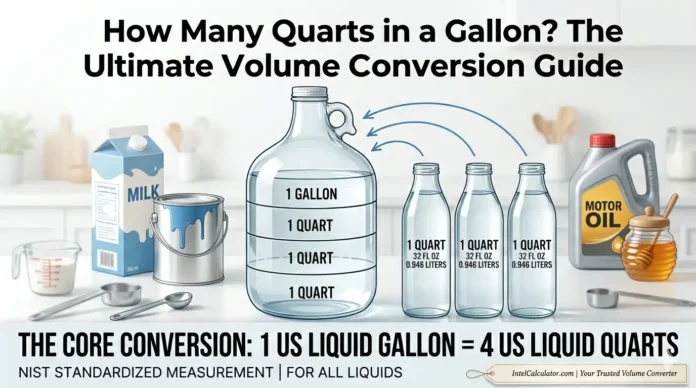
There are exactly 4 quarts in 1 US liquid gallon, a relationship defined and standardized by the National Institute of Standards and Technology (NIST). This single ratio forms the foundation of the entire US customary liquid measurement system and applies to every liquid volume from water and milk to motor oil and paint.
Use the interactive converter above to instantly convert any quart or gallon value. Enter the number of quarts to see the equivalent in gallons, or type gallons to calculate quarts — the calculator updates in real time.
| 1 Gallon = 4 Quarts |
|---|
| 1 Quart = 0.25 Gallons |
| 1 Gallon = 128 Fluid Ounces |
| 1 Quart = 32 Fluid Ounces |
The NIST legally defines the US liquid gallon as exactly 231 cubic inches (3.785411784 liters). Because a gallon contains exactly 4 equal parts, a single liquid quart is precisely 57.75 cubic inches — that is, 231 divided by 4. This cubic-inch definition is what makes the US gallon a fixed, legally enforceable standard across commercial measuring devices in every US state.
The Liquid Measurement Hierarchy: From Fluid Ounces to Gallons
The US customary system is built on a consistent doubling pattern, which means every unit is exactly twice the size of the unit below it. Understanding this geometric progression lets you convert between any two units without memorizing separate formulas for each pair.
The complete volumetric hierarchy from smallest to largest works as follows, and every step is a precise doubling of the previous unit. Starting from the fluid ounce and working upward, the system scales cleanly all the way to the gallon.
1 Gallon   =   4 Quarts    =   8 Pints    =   16 Cups   =   128 fl oz
1 Quart    =   2 Pints     =   4 Cups     =   32 fl oz
1 Pint     =   2 Cups      =   16 fl oz
1 Cup      =   8 Fluid Ounces
| Unit | Fluid Ounces | Cups | Pints | Quarts | Gallons |
|---|---|---|---|---|---|
| 1 Fluid Ounce | 1 fl oz | 0.125 | 0.0625 | 0.03125 | 0.0078 |
| 1 Cup | 8 fl oz | 1 | 0.5 | 0.25 | 0.0625 |
| 1 Pint | 16 fl oz | 2 | 1 | 0.5 | 0.125 |
| 1 Quart | 32 fl oz | 4 | 2 | 1 | 0.25 |
| 1 Gallon | 128 fl oz | 16 | 8 | 4 | 1 |
Once you know that one gallon equals 4 quarts, you can derive every other relationship in the table by simple multiplication or division. You can also convert quarts directly to cups or explore pints-to-cups conversions for the related units in this hierarchy.
The Formulas: How to Convert Quarts to Gallons and Vice Versa
Converting Quarts to Gallons — The Division Formula
To convert any number of quarts into gallons, divide the quart value by 4. This works because one gallon contains exactly four quarts, so you are counting how many complete gallons fit inside your quart measurement.
Formula: Gallons = Quarts ÷ 4
Step-by-step example — converting 18 quarts to gallons: 18 ÷ 4 = 4.5 gallons
This means 18 quarts of liquid fills exactly 4 and a half gallon-sized containers. A painter buying 18 quarts of exterior paint is purchasing the equivalent of 4.5 gallons of product.
Converting Gallons to Quarts — The Multiplication Formula
To convert gallons into quarts, multiply the gallon value by 4. This is the reverse operation and the one used most often when scaling recipes or calculating how many individual quart containers are needed to fill a larger vessel.
Formula: Quarts = Gallons × 4
Step-by-step example — converting 3.5 gallons to quarts: 3.5 × 4 = 14 quarts
A stockpot rated at 3.5 gallons holds exactly 14 quarts of liquid at capacity. You can run the reverse calculation anytime using our gallons to quarts converter.
Dry Quarts vs. Liquid Quarts: The Crucial Agricultural Distinction
Most people assume there is only one kind of quart. In reality, the US Customary System maintains two entirely separate volume standards: one for liquids and one for dry commodities such as berries, grain, flour, and agricultural produce.
The US Dry Gallon is defined by NIST as exactly 268.8025 cubic inches, which is significantly larger than the liquid gallon’s 231 cubic inches. Dividing by 4, a US Dry Quart equals exactly 67.2006 cubic inches. Comparing the two directly reveals a critical difference that affects every kitchen and farm.
| Measurement | Liquid Standard | Dry Standard | Difference |
|---|---|---|---|
| 1 Gallon | 231.000 in³ (3.785 L) | 268.803 in³ (4.405 L) | +16.36% |
| 1 Quart | 57.750 in³ (0.946 L) | 67.201 in³ (1.101 L) | +16.36% |
| Primary Use | Water, milk, oil, beverages | Berries, grain, flour, produce | — |
A dry quart is 16.36% larger than a liquid quart. This means that if a recipe calls for 1 dry quart of blueberries and you measure using a liquid quart measuring cup, you will be approximately 16% short on volume. This error is large enough to ruin jams, preserves, and baked goods that depend on precise fruit-to-sugar ratios. Always confirm whether a recipe intends a liquid or dry measurement before beginning.
Substance-Specific Weights: How Much Does a Quart or Gallon Weigh?
A gallon of any liquid always contains exactly 4 liquid quarts — but the physical weight of that gallon varies dramatically depending on what substance fills it. Volume and weight are two different properties, and conflating them is one of the most common errors in cooking, automotive maintenance, and industrial logistics.
Why Density and Specific Gravity Matter in Liquid Conversions
Specific gravity (SG) is the ratio of a liquid’s density to the density of pure water at standard temperature. Water has an SG of exactly 1.00, motor oil has an SG of approximately 0.88 (lighter than water), and latex paint has an SG of approximately 1.20 (heavier than water). To calculate the weight of any liquid volume, use the following formula established for US liquid quarts:
Weight (lbs) = Volume (quarts) × 2.086 × Specific Gravity
The constant 2.086 is the weight of one US liquid quart of pure water in pounds. Multiplying by specific gravity scales this baseline weight up or down depending on the actual density of the substance being measured.
| Substance | Specific Gravity | Weight per Quart | Weight per Gallon |
|---|---|---|---|
| Pure Water | 1.00 | 2.086 lbs | 8.34 lbs |
| Whole Milk | 1.03 | 2.15 lbs | 8.60 lbs |
| Motor Oil (10W-30) | 0.88 | 1.84 lbs | 7.35 lbs |
| Latex Paint | 1.20 | 2.50 lbs | 10.00 lbs |
| Honey | 1.42 | 2.96 lbs | 11.85 lbs |
| Diesel Fuel | 0.85 | 1.77 lbs | 7.09 lbs |
Automotive Applications: How Many Quarts of Oil in a Gallon?
Motor oil is sold in individual 1-quart bottles in virtually every auto parts store in the United States. A standard passenger car engine oil change requires between 5 and 6 quarts of oil, which equals 1.25 to 1.5 gallons. Buying a 5-quart jug is equivalent to buying 1.25 gallons, and a 6-quart purchase equals exactly 1.5 gallons.
Because motor oil has a specific gravity of 0.88, it weighs only 7.35 lbs per gallon — notably lighter than the same volume of water at 8.34 lbs. For detailed fuel density calculations, see our fuel density and weight per gallon calculations reference page.
Culinary Applications: How Much Does a Gallon of Milk or Paint Weigh?
A gallon of whole milk contains 4 liquid quarts and weighs approximately 8.60 lbs due to its specific gravity of 1.03 — slightly heavier than pure water. A gallon of standard latex paint contains the same 4 quarts but weighs close to 10 lbs because paint’s higher density (SG 1.20) adds significant mass to the same volume. Always check the weight when calculating shipping costs or determining whether a shelf or vehicle can handle a load of liquid containers.
US Customary vs. British Imperial: Why the Same Name Means Different Volumes
The United States and United Kingdom both use the word “gallon” and “quart,” but these units refer to measurably different physical volumes. Understanding the origin of this divergence prevents costly international shipping errors and ensures that foreign recipes are measured correctly.
The 1824 Divergence
In 1824, the British Parliament passed the Weights and Measures Act, which redefined the Imperial gallon as the volume of exactly 10 pounds of pure water at 62°F. This produced a gallon of 277.42 cubic inches (4.546 liters). The United States, having declared independence in 1776, chose instead to retain the older British “Queen Anne” wine gallon of 231 cubic inches, which had been the legal standard in the American colonies before separation.
Both systems kept the same 4:1 ratio between the gallon and the quart — but because the gallons are different sizes, the quarts are also different sizes.
| Unit | US Customary | British Imperial | Difference |
|---|---|---|---|
| 1 Gallon | 3.785 L (231 in³) | 4.546 L (277.42 in³) | Imperial is ~20% larger |
| 1 Quart | 0.946 L (57.75 in³) | 1.136 L (69.35 in³) | Imperial is ~20% larger |
| 1 Pint | 0.473 L | 0.568 L | Imperial is ~20% larger |
| Quarts per Gallon | 4 | 4 | Same ratio |
If a British recipe calls for 2 Imperial quarts of stock and you measure in US quarts, you will be approximately 20% short on liquid. Use our liters to gallons converter to switch cleanly between US, Imperial, and metric measurements when working with international sources.
Fractional Gallons: Quarts in a Quarter, Half, and One-and-a-Half Gallons
Not every measurement falls on a whole-gallon boundary. Understanding how quarts map onto fractional gallons is essential for recipe scaling, purchasing decisions, and inventory management.
| Gallon Fraction | Gallons | Quarts | Cups | Fluid Ounces |
|---|---|---|---|---|
| Quarter Gallon | 0.25 gal | 1 quart | 4 cups | 32 fl oz |
| Half Gallon | 0.50 gal | 2 quarts | 8 cups | 64 fl oz |
| Three-Quarter Gallon | 0.75 gal | 3 quarts | 12 cups | 96 fl oz |
| One Gallon | 1.00 gal | 4 quarts | 16 cups | 128 fl oz |
| One and a Half Gallons | 1.50 gal | 6 quarts | 24 cups | 192 fl oz |
| Two Gallons | 2.00 gal | 8 quarts | 32 cups | 256 fl oz |
A quarter gallon is simply 1 quart — the two terms refer to the exact same volume and are completely interchangeable. A half gallon is 2 quarts, which is the standard size for milk and juice cartons sold in US grocery stores. A gallon and a half equals 6 quarts, a measurement frequently needed when doubling a large soup or stew recipe.
Industrial Scaling: Quarts in 5-Gallon Buckets and 55-Gallon Drums
Construction workers, painters, farmers, and logistics managers regularly work with bulk liquid containers that far exceed household measurement scales. Knowing the quart equivalents for these standard industrial containers eliminates calculation errors on job sites and in warehouses.
The 5-Gallon Bucket — 20 Quarts
The standard 5-gallon utility bucket is the most common bulk container in construction and home improvement. It holds exactly 20 liquid quarts of material. Whether it contains drywall compound, latex paint, agricultural fertilizer, or drinking water, the volumetric capacity is always 5 gallons or 20 quarts.
Calculation: 5 gallons × 4 = 20 quarts
The 55-Gallon Drum — 220 Quarts
The standard industrial shipping drum used across manufacturing, chemical processing, and petroleum logistics holds exactly 55 US gallons, which equals precisely 220 liquid quarts. A fleet manager ordering 55-gallon drums of motor oil is purchasing 220 individual quart-equivalent volumes of product per drum.
Calculation: 55 gallons × 4 = 220 quarts
The Quarter Keg (Pony Keg) — 31 Quarts
A quarter keg, also known as a pony keg, is a standard beverage industry container holding exactly 7.75 US gallons of beer or other liquid. That equals precisely 31 quarts, or 124 cups — enough to fill approximately 82 standard 12-ounce glasses. If you are planning a large event and calculating beverage volumes, use our wedding alcohol planner to scale punch, beverages, and keg quantities accurately.
Calculation: 7.75 gallons × 4 = 31 quarts
Rapid Reference Chart: Quarts to Gallons Conversion Table
| Quarts (qt) | Gallons (gal) | Fluid Ounces (fl oz) | Liters (L) |
|---|---|---|---|
| 1 qt | 0.25 gal | 32 oz | 0.946 L |
| 2 qt | 0.50 gal | 64 oz | 1.892 L |
| 3 qt | 0.75 gal | 96 oz | 2.839 L |
| 4 qt | 1.00 gal | 128 oz | 3.785 L |
| 6 qt | 1.50 gal | 192 oz | 5.678 L |
| 8 qt | 2.00 gal | 256 oz | 7.570 L |
| 10 qt | 2.50 gal | 320 oz | 9.463 L |
| 12 qt | 3.00 gal | 384 oz | 11.356 L |
| 16 qt | 4.00 gal | 512 oz | 15.141 L |
| 20 qt | 5.00 gal | 640 oz | 18.927 L |
| 31 qt | 7.75 gal | 992 oz | 29.342 L |
| 220 qt | 55.00 gal | 7,040 oz | 207.975 L |
To find the weight of any of these volumes in pounds, use the quarts-to-pounds weight calculator which applies the specific gravity formula automatically for common substances.
Common Conversion Mistakes and How to Avoid Them
Mistake 1 — Confusing US and Imperial Gallons
Using Imperial gallon values in a US context produces an error of approximately 20 percent in every calculation. A British recipe calling for 1 Imperial gallon contains roughly 1.2 US gallons. Always check which country published a recipe, formula, or specification before applying a conversion factor.
Mistake 2 — Treating Dry Quarts and Liquid Quarts as Equal
A dry quart of strawberries is 16.36% larger than a liquid quart of juice. Using a liquid measuring cup to portion dry goods for a canning recipe will consistently underfill jars and distort the sugar-to-fruit ratios in preserves, jams, and pickles.
Mistake 3 — Assuming Volume and Weight Are Interchangeable
A quart of honey weighs 2.96 lbs while a quart of motor oil weighs only 1.84 lbs — the same volume, but more than a pound apart in weight. Volume tells you how much space a substance occupies; weight tells you its mass. Always use the specific gravity formula when a calculation requires both properties.
Mistake 4 — Using Only Ending Volume Instead of Average Total Assets
This error appears frequently in industrial contexts: measuring only the remaining liquid in a container rather than accounting for total capacity. A 55-gallon drum that is three-quarters full contains 41.25 gallons or 165 quarts — not 55 gallons or 220 quarts.
Frequently Asked Questions
How many quarts are in a gallon and a half?
A gallon and a half contains exactly 6 quarts. Multiply 1.5 gallons by 4 to reach this answer. This is a frequent measurement in large-batch cooking and commercial recipe scaling.
How many quarts are in a half gallon?
A half gallon contains exactly 2 quarts. This is the standard volume of most milk and orange juice cartons sold in US grocery stores, and it equals 64 fluid ounces or 8 cups.
Is a quart bigger than a liter?
A US liquid quart is slightly smaller than a liter, equaling 0.946 liters. An Imperial quart, however, is slightly larger than a liter at 1.136 liters. In practical cooking, the 5.4% difference between a US quart and a liter is negligible for most applications, but it matters in precise pharmaceutical and scientific contexts.
How many cups are in a quarter gallon?
A quarter gallon is exactly 1 quart, which contains 4 cups or 32 fluid ounces. The terms “quarter gallon” and “quart” are completely interchangeable — quart itself derives from the Latin word quartus, meaning one-fourth.
How many ounces are in a quarter gallon?
A quarter gallon contains exactly 32 fluid ounces. This is the same as 1 liquid quart, 4 cups, or 2 pints.
How many quarts are in a 5-gallon bucket?
A standard 5-gallon utility bucket holds exactly 20 liquid quarts. This is the most common bulk container used in painting, construction, and home water storage.
How many quarts in a 55-gallon drum?
A standard industrial 55-gallon drum holds exactly 220 liquid quarts. At 7.35 lbs per quart (for motor oil at SG 0.88), a full drum of motor oil weighs approximately 1,617 lbs — important data for floor load and transportation planning.
How many quarts of oil are in a gallon?
There are exactly 4 quarts of motor oil in 1 gallon. Because most engines require 5 to 6 quarts per oil change, a full oil change uses 1.25 to 1.5 gallons of oil.
How many gallons are in a quarter keg?
A quarter keg (pony keg) holds exactly 7.75 US gallons, which equals 31 quarts or 992 fluid ounces.
Key Takeaway:
There are exactly 4 quarts in 1 US liquid gallon, as defined by NIST (231 cubic inches per gallon, 57.75 cubic inches per quart). A dry quart is 16.36% larger than a liquid quart. An Imperial quart is approximately 20% larger than a US quart. Use the formula Quarts = Gallons × 4 for liquid conversions, and always confirm substance density when weight is required alongside volume.

. Get instant conversions for oil, paint, milk, dry quarts, 5-gallon buckets, and 55-gallon drums. Free calculator included.)