
Whether you are planning a garden bed refresh, pouring a concrete slab, or ordering a load of gravel for your driveway, understanding the relationship between cubic feet and cubic yards is the single most important calculation standing between you and a successful material order. The gap between measuring your project in inches and feet at home and placing a bulk order by the cubic yard from a commercial quarry or nursery trips up homeowners and contractors alike — and getting it wrong means either running short mid-project or overpaying for material you never use.
Before you work through the manual formulas below, the fastest way to eliminate calculation errors entirely is to use the interactive cubic yard calculator on this site. Enter your dimensions, select your material type, and get an instant result in cubic feet, cubic yards, and estimated payload weight. If you are starting from a square footage measurement and need to convert it to a volume, the square feet to cubic yards calculator automates that conversion in seconds. For those who want to understand the math behind the numbers, every formula used in those tools is explained in full detail below.
The Core Conversion: How Many Cubic Feet Are in a Cubic Yard?
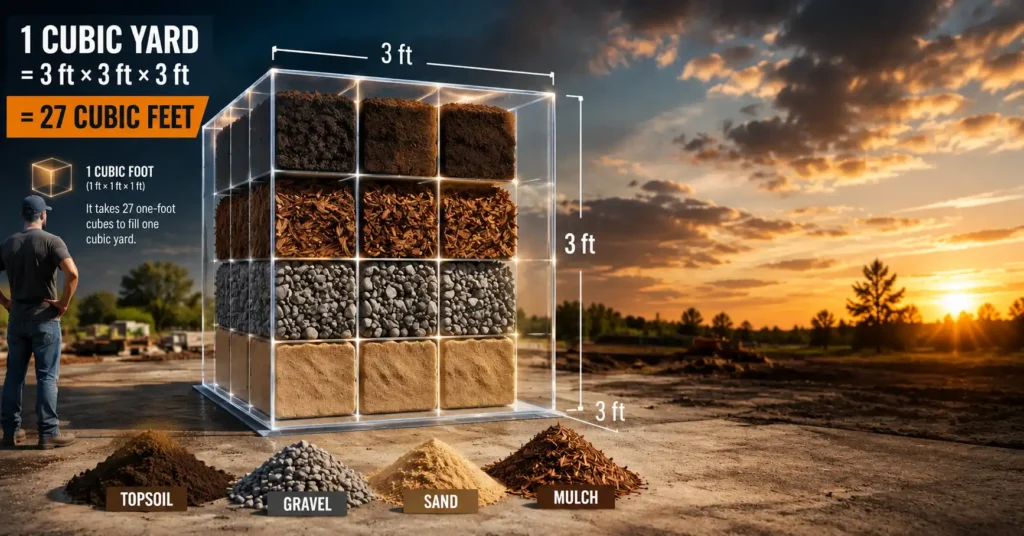
One cubic yard contains exactly 27 cubic feet. This is not an approximation — it is a geometric certainty derived from the definition of a yard as 3 linear feet.
A cubic yard is a cube that measures 3 feet on every side. To find its volume in cubic feet, you multiply all three dimensions together:
1 Cubic Yard = 3 ft × 3 ft × 3 ft = 27 ft³
Visualize a standard cardboard box that is exactly 3 feet long, 3 feet wide, and 3 feet tall. That box holds exactly 1 cubic yard of material, and it would take 27 one-foot cubes stacked inside to fill it completely. This 27:1 ratio is the foundation of every bulk material calculation in landscaping, construction, and agriculture.
To convert in the other direction — from cubic feet to cubic yards — you simply divide by 27:
Cubic Yards (yd³) = Cubic Feet (ft³) ÷ 27
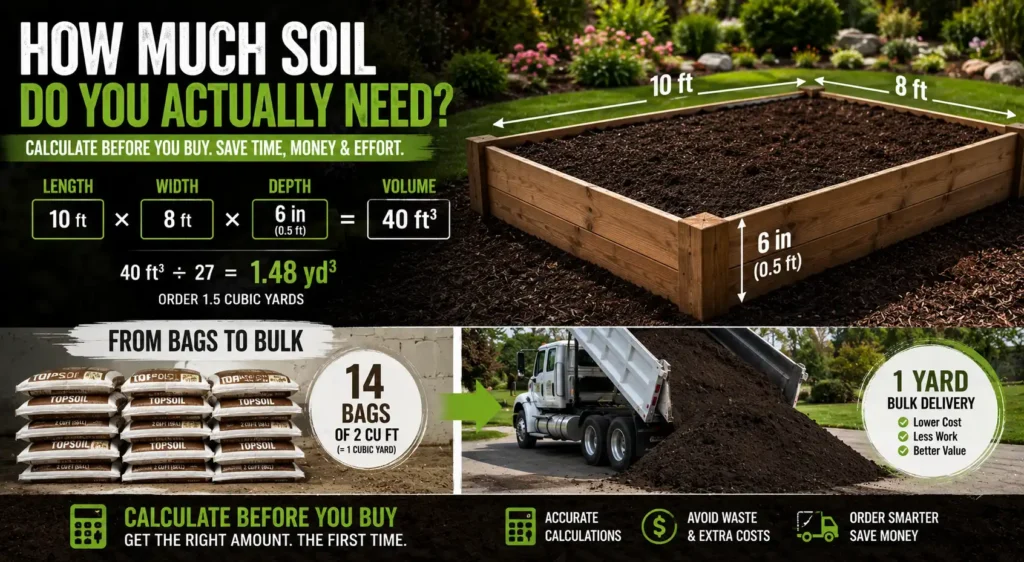
A practical example: if your rectangular garden bed is 10 feet long, 8 feet wide, and you want to fill it with 6 inches (0.5 feet) of new topsoil, the volume in cubic feet is 10 × 8 × 0.5 = 40 cubic feet. Divide 40 by 27 to get approximately 1.48 cubic yards. You would order 1.5 cubic yards from your local supplier.
For quick reference, here are the most commonly needed conversions:
| Cubic Feet | Cubic Yards |
|---|---|
| 1 ft³ | 0.037 yd³ |
| 5 ft³ | 0.185 yd³ |
| 10 ft³ | 0.370 yd³ |
| 27 ft³ | 1.00 yd³ |
| 54 ft³ | 2.00 yd³ |
| 81 ft³ | 3.00 yd³ |
| 135 ft³ | 5.00 yd³ |
| 270 ft³ | 10.00 yd³ |
| 500 ft³ | 18.52 yd³ |
Cubic Yards to Square Feet: Bridging 2D Area and 3D Volume
A common point of confusion is the question of how many square feet are in a cubic yard. The answer is that a cubic yard cannot be directly converted to square feet because these are measurements of different dimensions — one is volume (three-dimensional) and the other is area (two-dimensional). The conversion only becomes possible once you specify the depth of the material you are spreading.
The formula that bridges a 2D area to a 3D volume is:
Volume (ft³) = Area (ft²) × Depth (ft)
Once you have the volume in cubic feet, divide by 27 to get cubic yards.
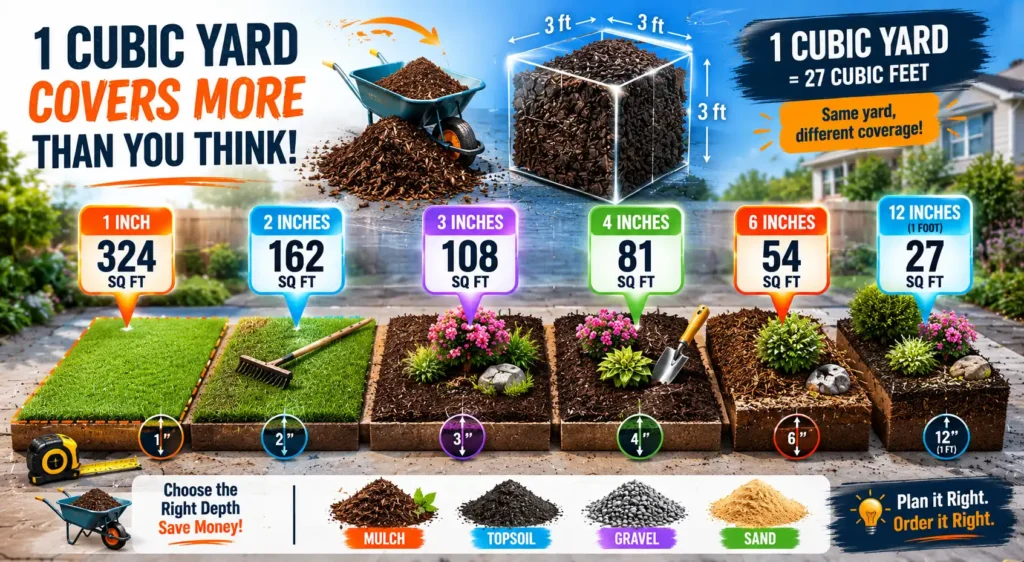
The practical implication is that 1 cubic yard covers a dramatically different surface area depending on how thick you spread it. Here is a depth coverage table for 1 cubic yard of material:
| Depth of Coverage | Area Covered by 1 Cubic Yard |
|---|---|
| 1 inch | 324 square feet |
| 2 inches | 162 square feet |
| 3 inches | 108 square feet |
| 4 inches | 81 square feet |
| 6 inches | 54 square feet |
| 12 inches (1 foot) | 27 square feet |
For landscaping applications, the most common mulch application depth is 3 inches, which means 1 cubic yard of mulch covers approximately 108 square feet of garden bed. For a topsoil base layer beneath sod, a standard 4-inch depth means 1 cubic yard covers 81 square feet. For the square feet to cubic yards calculator, these depth variables are built directly into the interface, so you can skip the manual arithmetic entirely.
The Retail Bag Dilemma: How Many Bags Equal One Cubic Yard?
Home improvement stores and garden centers sell loose materials like topsoil, compost, mulch, and potting mix in pre-packaged bags measured in cubic feet. Commercial nurseries, quarries, and landscape supply yards sell the same materials by the cubic yard. Understanding the conversion between bag sizes and bulk cubic yards is essential for deciding whether to buy retail or order in bulk.
Since 1 cubic yard equals 27 cubic feet, the number of bags needed to equal one cubic yard depends entirely on the bag’s labeled volume:
| Bag Size | Bags Needed to Equal 1 Cubic Yard |
|---|---|
| 0.5 cubic foot bags | 54 bags |
| 0.75 cubic foot bags | 36 bags |
| 1.0 cubic foot bags | 27 bags |
| 1.5 cubic foot bags | 18 bags |
| 2.0 cubic foot bags | 13.5 bags (buy 14) |
| 3.0 cubic foot bags | 9 bags |
Converting 2 Cubic Feet Bags to Cubic Yards
The 2 cubic foot bag is one of the most common sizes sold at major retail chains. To find how many bags of 2 cubic feet make a yard, divide 27 by 2: 27 ÷ 2 = 13.5 bags. Because you cannot buy half a bag, you will need 14 bags to have enough material to cover exactly 1 cubic yard without running short.
Converting 3 Cubic Feet Bags to Cubic Yards
A 3 cubic foot bag is the largest size typically sold at retail. To calculate how many bags of 3 cubic feet make a yard: 27 ÷ 3 = exactly 9 bags per cubic yard. This is the cleanest conversion of any standard bag size.
The Cost-Benefit Analysis: Retail Bags vs. Bulk Delivery
Buying bagged material at a retail store is significantly more expensive per cubic yard than ordering in bulk. A 2 cubic foot bag of premium topsoil often retails for $6 to $8. To assemble 1 cubic yard, you need 14 bags, which puts the retail cost at $84 to $112 per cubic yard including packaging. By contrast, bulk topsoil delivered from a landscape supply yard typically costs $30 to $60 per cubic yard depending on your region. Ordering in bulk can reduce your material cost by 40% to 60%, eliminates the need to transport dozens of heavy bags, and generates no plastic waste. For projects requiring more than 2 cubic yards of any material, bulk ordering is almost always the more economical and practical choice.
Material Weights: How Much Does a Cubic Yard of Soil, Gravel, or Sand Weigh?
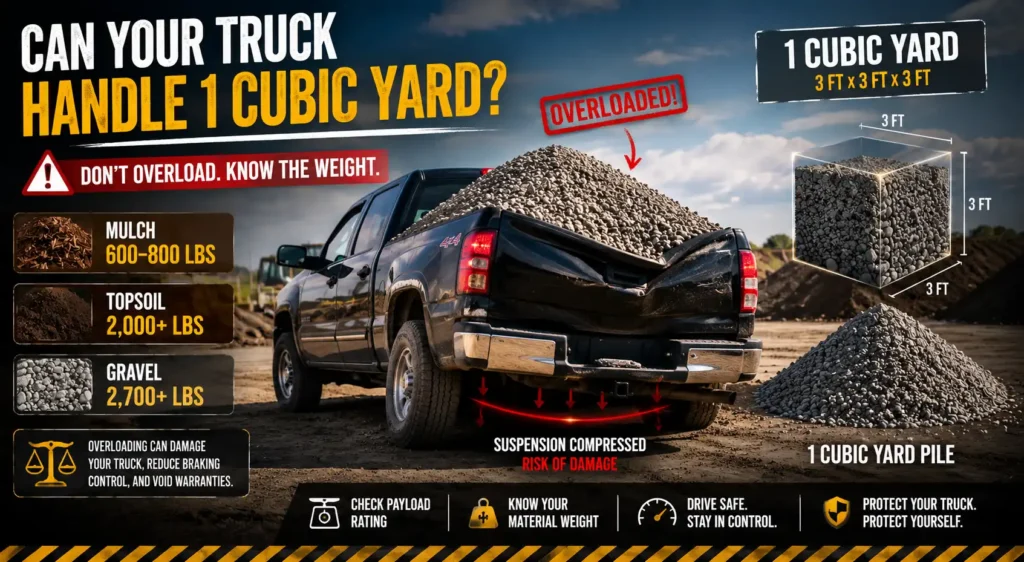
Every cubic yard of material occupies the same volume — 27 cubic feet — but the weight of that volume varies enormously depending on the material’s bulk density and moisture content. This distinction matters because delivery trucks have legal payload weight limits, and overloading a standard pickup truck bed with heavy stone is a common and costly mistake.
The following material weight table gives approximate weights per cubic yard for the most common bulk landscaping and construction materials:
| Material | Weight per Cubic Yard | Weight per Cubic Foot |
|---|---|---|
| Bark Mulch (dry) | 600 – 800 lbs | 22 – 30 lbs |
| Wood Chip Mulch | 700 – 1,000 lbs | 26 – 37 lbs |
| Topsoil (dry, loamy) | 2,000 – 2,200 lbs | 74 – 81 lbs |
| Topsoil (wet / clay-heavy) | ~3,000 lbs | ~111 lbs |
| Compost (screened) | 1,000 – 1,400 lbs | 37 – 52 lbs |
| Play Sand | 2,600 – 2,900 lbs | 96 – 107 lbs |
| Crushed Gravel / Road Base | 2,500 – 2,800 lbs | 92 – 104 lbs |
| River Rock (rounded stone) | ~2,700 lbs | ~100 lbs |
| Concrete (mixed, wet) | 3,700 – 4,050 lbs | 137 – 150 lbs |
| Pea Gravel | 2,500 – 2,700 lbs | 92 – 100 lbs |
A standard short-bed pickup truck has a payload rating of approximately 1,500 to 2,000 lbs. That means a short-bed pickup can safely carry about 1.5 to 2 cubic yards of light mulch but only about 0.5 to 0.75 cubic yards of gravel or wet soil before exceeding its rated capacity. Always verify the payload capacity of your vehicle before loading heavy materials. Use the gravel calculator or the sand calculator to estimate the exact weight of your order before scheduling a pickup or delivery. For river rock and decorative stone projects, the river rock calculator includes material-specific weight estimates.
A tandem-axle dump truck, by comparison, can typically carry 14 to 16 cubic yards of mulch, but due to legal axle weight limits on public roads, that same truck can only carry 8 to 10 cubic yards of dense crushed gravel before hitting its gross vehicle weight rating. Your material supplier will account for this automatically when scheduling deliveries, but understanding the weight constraints helps you plan how many truckloads your project will require.
Material Compaction and Waste Factors: Why “Exact” Math Leads to Shortfalls
Calculating the geometric volume of your project area and ordering exactly that amount in cubic yards is a formula for running short. Granular materials like gravel, crushed stone, and topsoil compress significantly when they are spread and compacted. Concrete has unavoidable placement losses due to excavation irregularities and formwork seepage. Any professional contractor accounts for compaction and waste before placing a material order, and you should too.
The standard formula for calculating the adjusted order volume is:
Total Material to Order = Geometric Volume × (1 + Compaction Factor)
Where the Compaction Factor (Cc) represents the percentage of volume loss after placement and settling. The following table gives industry-standard compaction factors by material type:
| Material | Compaction / Settlement Rate | Order Multiplier |
|---|---|---|
| Bark Mulch | 5% – 10% settling over time | Order 1.10× geometric volume |
| Topsoil / Loam | 10% – 15% compaction | Order 1.15× geometric volume |
| Compost | 15% – 20% settling | Order 1.20× geometric volume |
| Pea Gravel | 10% – 15% compaction | Order 1.15× geometric volume |
| Crushed Stone / Road Base | 15% – 20% compaction | Order 1.20× geometric volume |
| Concrete (poured slab) | 5% – 10% wastage allowance | Order 1.10× geometric volume |
| Sand (screeding base) | 10% – 12% compaction | Order 1.12× geometric volume |
A practical example: your patio project requires 5 cubic yards of road base according to geometric calculations. Applying the 1.20 compaction multiplier for crushed stone, you should order 5 × 1.20 = 6 cubic yards to account for the volume lost when the material is compacted and graded. Failing to apply this factor is one of the most frequent reasons homeowners find themselves one or two yards short on delivery day.
For concrete specifically, the 5% to 10% wastage allowance accounts for uneven subgrade surfaces, slight formwork flexing under pour pressure, and the small amount of concrete that inevitably remains in the mixer drum or truck chute. On any slab exceeding 3 cubic yards, always round up by at least half a yard.
How to Calculate Volume for Irregular Shapes
Not every landscaping or construction project fits neatly into a rectangle. Circular flower beds, triangular corner garden beds, kidney-shaped pond surrounds, and curved retaining wall backfills all require geometry beyond the basic length × width × depth formula.
Circular Areas (Tree Rings, Round Patios, Fire Pit Bases)
For any circular area — a tree ring, a circular patio, a fire pit surround — use the standard circle area formula multiplied by the desired depth:
Volume (ft³) = π × r² × d
Where r is the radius of the circle in feet (half the diameter) and d is the desired depth in feet. Divide the result by 27 to convert to cubic yards.
Example: you want to fill a circular flower bed with a 5-foot radius to a depth of 4 inches (0.333 feet). The volume is 3.14159 × 5² × 0.333 = 3.14159 × 25 × 0.333 = 26.18 cubic feet. Divide by 27 to get approximately 0.97 cubic yards. You would order 1 cubic yard.
For ring-shaped beds — where a circular hole sits inside a larger circle, such as a tree ring with a defined inner and outer radius — calculate the volume of the full outer circle and subtract the volume of the inner hole to get the net ring volume.
Triangular Areas (Corner Garden Beds, Diagonal Borders)
For triangular garden beds or corner fills, use the triangle area formula:
Volume (ft³) = (Base × Height ÷ 2) × d
Where Base and Height are the two perpendicular sides of the right triangle in feet, and d is the depth in feet. Divide by 27 to convert to cubic yards.
Example: a triangular corner bed with a base of 6 feet and a height of 4 feet, filled to 3 inches (0.25 feet) deep. Volume = (6 × 4 ÷ 2) × 0.25 = 12 × 0.25 = 3 cubic feet = 0.11 cubic yards.
Sloped Areas
For areas with a slope, calculate the average depth rather than using a fixed depth. Measure the depth at the shallow end and the depth at the deep end, add them together, and divide by 2 to get your average depth. Use this average depth value in all standard formulas above.
Advanced Unit Conversions: Bushels, Cubic Inches, and Square Yards
Beyond the standard cubic feet and cubic yards relationship, several specialized unit conversions appear regularly in agricultural purchasing, material data sheets, and engineering specifications.
Bushels to Cubic Feet
A US bushel is a unit of dry volume used heavily in agriculture for bulk compost, grain, and some mulch products. The exact conversion factor is:
1 US Bushel ≈ 1.24446 cubic feet
To convert bushels to cubic yards: Cubic Yards = (Bushels × 1.24446) ÷ 27
Example: 50 bushels of compost = (50 × 1.24446) ÷ 27 = 62.22 ÷ 27 = 2.30 cubic yards.
Cubic Inches to Cubic Yards
Since 1 yard equals 36 inches, a cubic yard contains 36 × 36 × 36 = 46,656 cubic inches. To convert cubic inches to cubic yards, divide by 46,656.
To convert cubic inches to cubic feet, divide by 1,728 (since 12 × 12 × 12 = 1,728).
Square Yards to Cubic Yards
A square yard is a unit of area (2D), while a cubic yard is a unit of volume (3D). To convert square yards to cubic yards, multiply the square yard area by your desired depth expressed in yards (1 inch = 0.0278 yards, 3 inches = 0.0833 yards, 6 inches = 0.1667 yards).
Metric Conversions (International Reference)
For international projects or metric material data sheets: 1 cubic yard = approximately 0.7646 cubic meters. To convert cubic meters to cubic yards, multiply by 1.308.
How to Use the Cubic Yard Calculator to Automate Your Project
All of the formulas above can be calculated instantly using the interactive cubic yard calculator. Here is how to use it step by step:
Step 1 — Select Your Shape. Choose from Rectangular, Circular, or Triangular depending on the shape of the area you are filling. For irregular areas, break the project into multiple zones and calculate each separately.
Step 2 — Enter Your Dimensions. Input the boundary measurements in feet or inches. For rectangular areas, enter Length and Width. For circles, enter the Diameter or Radius. For triangles, enter Base and Height.
Step 3 — Enter Your Desired Depth. Input the intended material depth in inches. The calculator accepts fractional inch values, so 3.5 inches is a valid entry.
Step 4 — Select Your Material Type. Choose from the material dropdown to automatically apply bulk density values and receive an estimated total weight in pounds and tons alongside the cubic yard result.
Step 5 — Read Your Results. The calculator instantly returns the volume in cubic feet, cubic yards, and a recommended order quantity that already incorporates a standard compaction and wastage margin.
For projects involving concrete, use the concrete calculator which is specifically designed to handle slab thickness specifications, rebar layouts, and the standard 10% waste margin that concrete pours require.
Skip the manual division. Plug your dimensions directly into the cubic yard calculator to get an instant, error-free measurement.
Summary Quick-Reference: Cubic Feet to Cubic Yards Conversion Table
The following expanded conversion table covers a range of cubic foot values from 1 to 500, including approximate weight in tons for dry topsoil to give you a real-world sense of scale:
| Cubic Feet | Cubic Yards | Approx. Weight (Topsoil, dry) |
|---|---|---|
| 1 | 0.037 | ~75 lbs |
| 5 | 0.185 | ~375 lbs |
| 10 | 0.370 | ~750 lbs |
| 13.5 | 0.500 | ~1,013 lbs |
| 27 | 1.00 | ~2,100 lbs (1.05 tons) |
| 40 | 1.48 | ~3,000 lbs (1.5 tons) |
| 54 | 2.00 | ~4,200 lbs (2.1 tons) |
| 81 | 3.00 | ~6,300 lbs (3.15 tons) |
| 108 | 4.00 | ~8,400 lbs (4.2 tons) |
| 135 | 5.00 | ~10,500 lbs (5.25 tons) |
| 162 | 6.00 | ~12,600 lbs (6.3 tons) |
| 189 | 7.00 | ~14,700 lbs (7.35 tons) |
| 216 | 8.00 | ~16,800 lbs (8.4 tons) |
| 270 | 10.00 | ~21,000 lbs (10.5 tons) |
| 350 | 12.96 | ~27,200 lbs (13.6 tons) |
| 405 | 15.00 | ~31,500 lbs (15.75 tons) |
| 500 | 18.52 | ~38,900 lbs (19.45 tons) |
Topsoil weights are approximate for dry, loamy soil. Wet or clay-heavy soils can weigh 35% to 50% more per cubic yard. Heavy materials like gravel can easily overload a standard pickup truck. Use the gravel calculator to calculate the exact weight of your order before scheduling a pickup.
Frequently Asked Questions
How many cubic feet are in a cubic yard?
There are exactly 27 cubic feet in one cubic yard. This is because a cubic yard is a cube measuring 3 feet per side, and 3 × 3 × 3 = 27.
How many bags of 2 cubic feet equal one cubic yard?
You need 13.5 bags of 2 cubic feet to equal one cubic yard (27 ÷ 2 = 13.5). Since you cannot purchase a half bag, order 14 bags to ensure you have enough material.
How many bags of 3 cubic feet make a yard?
Exactly 9 bags of 3 cubic feet equal one cubic yard (27 ÷ 3 = 9).
How heavy is a cubic yard of topsoil?
A cubic yard of dry topsoil weighs approximately 2,000 to 2,200 pounds. Wet, clay-heavy topsoil can weigh up to 3,000 pounds per cubic yard.
Can I convert a cubic yard directly to square feet?
Not without specifying depth. At 3 inches deep, 1 cubic yard covers approximately 108 square feet. At 4 inches deep, it covers 81 square feet. Use the square feet to cubic yards calculator to automatically compute this based on your project’s depth.
Do I need to order extra material to account for compaction?
Yes. For gravel and crushed stone, add 15% to 20% to your geometric calculation. For topsoil and compost, add 10% to 15%. For concrete slabs, add 5% to 10%. Multiply your base volume by the appropriate factor (e.g., 1.15 for topsoil) to get the correct order quantity.
How many cubic inches are in a cubic yard?
There are 46,656 cubic inches in one cubic yard (36 × 36 × 36 = 46,656).
How do I convert bushels to cubic feet?
One US bushel equals approximately 1.244 cubic feet. Multiply the number of bushels by 1.244 to get cubic feet, then divide by 27 to convert to cubic yards.