A dividend stock represents an equity security that distributes a portion of corporate earnings to shareholders on a regular schedule. The best dividend stocks for 2026 combine a sustainable yield, consistent dividend growth, strong free cash flow, and reasonable valuation. A 9% yield experiencing a cut in 18 months destroys more wealth than a 3.5% yield doubling over 10 years. This guide applies a 5-factor screening process across 8 major sectors to identify stocks meeting strict quality criteria.
How Do Investors Screen For The Best Dividend Stocks?
Investors screen for the best dividend stocks by requiring a yield between 2% and 6%, a payout ratio below 65%, 5 consecutive years of dividend increases, free cash flow covering the dividend by 1.5x, and diversified representation across 8 sectors.
- Target a yield between 2% and 6%. Dividend yield measures the annual dividend payment divided by the stock price. This range captures meaningful income without crossing into the danger zone above 7% where dividend cuts become mathematically probable. Stocks yielding less than 2% offer minimal current income.
- Maintain a payout ratio below 65%. The payout ratio calculates the percentage of earnings paid to shareholders as dividends. A company paying out more than 65% of earnings possesses limited capacity to grow the dividend, weather a revenue downturn, or reinvest in the business. Use the Dividend Payout Ratio Calculator to verify this figure for any stock you are considering, as payout ratios can change significantly quarter to quarter.
- Require 5 consecutive years of dividend increases. A multi-year track record proves management consistently prioritizes income investors through economic cycles. Dividend Aristocrats represent S&P 500 companies with 25 consecutive years of dividend increases.
- Verify free cash flow covers the dividend by at least 1.5x. A stock paying $1.00 in dividends per share generates at least $1.50 in free cash flow per share. Ratios below 1.2x indicate the dividend outpaces the company’s funding ability.
- Ensure diversified representation across 8 sectors. A sector is a broad segment of the economy containing companies sharing similar business activities. Sector concentration amplifies risk.
For the definitive list of quality-screened dividend stocks, see our complete Dividend Aristocrats list.
What Are The Best Dividend Stocks By Sector For 2026
The best dividend stocks by sector include Procter & Gamble for Consumer Staples, Johnson & Johnson for Healthcare, NextEra Energy for Utilities, JPMorgan Chase for Financials, Microsoft for Technology, Realty Income for REITs, Illinois Tool Works for Industrials, and Chevron for Energy.
| Sector | Representative Stocks | Yield Range | Payout Ratio | Dividend Growth | Risk Profile |
| Consumer Staples | Procter & Gamble, Coca-Cola, Colgate | 2.5% – 3.5% | 55% – 65% | 25–60+ years | Low |
| Healthcare | Johnson & Johnson, AbbVie, Becton Dickinson | 2.8% – 4.5% | 45% – 65% | 10–60+ years | Low–Medium |
| Utilities | NextEra Energy, Southern Co | 3.0% – 5.5% | 55% – 75% | 10–28+ years | Medium |
| Financials | JPMorgan Chase, BlackRock, T. Rowe Price | 2.2% – 4.0% | 30% – 55% | 8–15+ years | Medium |
| Technology | Microsoft, Apple, Texas Instruments | 0.8% – 2.5% | 20% – 45% | 8–20+ years | Low–Medium |
| REITs | Realty Income, VICI, Prologis, Agree Realty | 3.5% – 6.5% | 65% – 85% (AFFO) | 5–28+ years | Medium–High |
| Industrials | Illinois Tool Works, Emerson, Caterpillar | 1.8% – 3.2% | 35% – 55% | 10–48+ years | Medium |
| Energy | Chevron, EOG Resources, Enterprise Products | 3.0% – 6.5% | 35% – 65% | 5–35+ years | Medium–High |
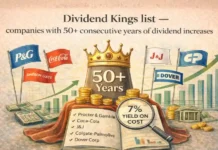
Consumer Staples represent companies producing essential everyday goods. Healthcare includes businesses providing medical services and products. Utilities are companies providing basic amenities like electricity and water. Financials encompass firms providing banking and investment services. Technology involves companies developing software and electronics. REITs are Real Estate Investment Trusts owning income-producing real estate. Industrials represent companies manufacturing capital goods. Energy includes businesses involved in producing and distributing power. For the most elite dividend payers with 50+ year streaks, see our Dividend Kings list.
What Are The Best Dividend Growth Stocks
The best dividend growth stocks include Microsoft and Texas Instruments, which offer lower initial yields between 1.5% and 3% but deliver annual dividend growth rates of 7% to 15%, transforming modest starting yields into high yields on cost over 10 years.
A dividend growth stock is a company that consistently increases its dividend payout over time. Yield on cost measures the annual dividend income divided by the original purchase price of the investment. Technology and healthcare dominate the dividend growth category.
- Microsoft increases its dividend at a compound annual rate exceeding 10% over 10 years while maintaining a 30% payout ratio.
- Texas Instruments delivers a dividend growth rate above 15% annually for 10 years, backed by dominant market share in analog semiconductors and exceptional free cash flow conversion.
- Healthcare companies with entrenched drug pipelines and recurring revenue from medical devices offer multi-decade growth runways.
Purchasing a $50 stock yielding 2% with a 10% annual dividend growth rate generates a 5.2% yield on cost in 10 years and 13.5% in 20 years. The portfolio value grows alongside the dividend.
What Are The Best High Yield Dividend Stocks
The best high yield dividend stocks operate in the Utilities, REITs, Telecom, and Energy MLP sectors, delivering immediate yields between 4% and 7% while maintaining sustainable payout ratios and strong free cash flow to fund distributions.
A high yield dividend stock is an equity paying a dividend significantly higher than the market average. A dividend yield above 7% in a normal interest rate environment prices in an elevated risk of a dividend cut. Investors analyze the payout ratio, debt levels, revenue trends, and free cash flow before purchasing 7% yielding assets.
| Sector | Typical Yield Range | Payout Ratio Guide | Primary Risk | Safety Signal |
| Utilities | 3.5% – 5.5% | Below 70% | Rising interest rates | Low |
| REITs (core) | 4.0% – 6.5% | Below 80% AFFO | Rate sensitivity, occupancy | Medium |
| Telecom | 4.5% – 7.0% | Below 65% FCF | Debt, subscriber churn | Medium |
| Energy MLPs | 5.0% – 8.0% | Below 70% DCF | Commodity price, policy | Medium–High |
| BDCs | 7.0% – 11.0% | Below 90% NII | Credit quality, rate cycle | High |
Telecom represents companies transmitting data and voice globally. Energy MLPs are Master Limited Partnerships operating energy infrastructure. BDCs are Business Development Companies lending to small and mid-sized businesses.
Best Dividend ETFs For Income Investors
The best dividend ETFs include SCHD for overall quality, VYM for high yield, DGRO for dividend growth, VIG for long-term appreciation, and JEPI for options-based premium income, providing instant diversification and professional stock selection for portfolios under $100,000.
An ETF is an Exchange-Traded Fund, a pooled investment security operating like a mutual fund but trading on a stock exchange. ETFs provide superior efficiency for investors lacking time to monitor quarterly earnings and payout ratios.
| ETF Ticker | Fund Name | Yield | Expense Ratio | Strategy |
| SCHD | Schwab U.S. Dividend Equity ETF | 3.3% | 0.06% | Quality + Yield |
| VYM | Vanguard High Dividend Yield ETF | 2.9% | 0.06% | High Income |
| DGRO | iShares Core Dividend Growth ETF | 2.3% | 0.08% | Dividend Growth |
| VIG | Vanguard Dividend Appreciation ETF | 1.8% | 0.06% | Long-term Growth |
| JEPI | JPMorgan Equity Premium Income ETF | 6.5% – 8.0% | 0.35% | Income + Options |
- SCHD screens for a 10-year dividend payment history, strong fundamentals, and high relative dividend yield.
- VYM tracks stocks forecasted to have above-average dividend yields.
- DGRO focuses on companies with a minimum 5-year history of dividend growth and sustainable payout ratios.
- VIG tracks companies with 10 consecutive years of dividend increases.
- JEPI uses a covered call options overlay to generate above-market income.
Red Flags Indicating A Dividend Cut
Red flags indicating a dividend cut include a yield above 8% without structural explanation, a payout ratio exceeding 85%, declining revenue for 3 consecutive years, a previous dividend cut within 5 years, and a debt-to-equity ratio above 2.0x.
A dividend cut is a corporate decision to reduce the amount of dividend paid to shareholders. Dividend investing failures trace back to ignoring specific warning signs preceding significant dividend eliminations.
- Investigate yields above 8% with no special structural explanation. An 8% yield signals the market discounted the share price due to elevated cut risk.
- Reject payout ratios above 85%. A company paying 85% of earnings as dividends possesses zero capacity to absorb a revenue shortfall. REITs represent the only exception, utilizing AFFO-based payout ratios up to 85%.
- Avoid companies with declining revenue for 3 consecutive years. A shrinking revenue base serves as the most reliable leading indicator of an eventual dividend cut.
- Eliminate stocks with a dividend cut in the last 5 years. Prior cuts dramatically increase the statistical likelihood of a future cut.
- Analyze heavy debt loads with debt-to-equity ratios above 2.0x in rising interest rate environments. Companies face compounding refinancing costs directly competing with dividend payments.
How Do Investors Build A Dividend Portfolio?
Investors build a dividend portfolio by diversifying across 4 to 8 sectors, allocating 60% to dividend growth stocks and 40% to high-yield stocks, enabling Dividend Reinvestment Plans (DRIP), and reviewing payout ratios and free cash flow quarterly.
- Diversify across a minimum of 4 sectors. Consumer staples and healthcare form a defensive income core. Utilities and REITs add higher current yield. Financials and industrials introduce cyclical growth. Technology provides long-term dividend growth. Limit single sector exposure to 30% of portfolio weight.
- Allocate 60% of portfolio weight to dividend growth stocks and 40% to high-yield positions. This balance delivers present income and rising future income outpacing inflation.
- Enable DRIP on all accumulation-phase positions. A $500,000 portfolio at 4% yield growing at 7% with full reinvestment reaches $1,930,000 in 20 years compared to $1,650,000 taken as cash. Use a Dividend Reinvestment Plan Calculator to model the exact long-term impact for your portfolio size and timeline
- Review payout ratio and free cash flow coverage every 3 months. A company’s payout ratio climbing from 50% to 75% over 6 quarters serves as an early warning signal requiring immediate action.
Frequently Asked Questions
What Is The Highest Paying Dividend Stock Right Now?
The highest paying dividend stocks currently include Energy Master Limited Partnerships (MLPs), select Business Development Companies (BDCs), and covered call ETFs, which historically offer sustainable yields in the 6% to 9% range when backed by strong distributable cash flow. Investors verify any yield above 9% against free cash flow coverage before purchasing the asset.
Are Dividend Stocks Safe Investments?
Dividend stocks are equities subject to market volatility and price fluctuations, but high-quality dividend payers offer relative resilience because their income streams remain partially decoupled from share price movements, providing a behavioral anchor during market downturns. Dividend Aristocrats maintained or increased their dividends through the 2008 financial crisis and the 2020 market crash while prices fell.
Which Sector Has The Best Dividend Stocks?
Consumer Staples and Healthcare sectors have the best dividend stocks for reliability. Utilities and REITs lead for high current income. The Technology sector provides the best long-term total return with rapidly growing dividends and low payout ratios. Consumer staples and healthcare companies boast 25 to 60 consecutive years of dividend increases.
What Dividend Stocks Do Most Dividend Investors Own?
Most dividend investors own Johnson & Johnson, Procter & Gamble, Coca-Cola, Realty Income, and Microsoft, as these companies combine long dividend increase streaks, recognizable brand strength, and sufficient yield to serve as reliable portfolio anchors through multiple recession cycles.
How Many Dividend Stocks Make A Diversified Portfolio?
A diversified portfolio requires 20 to 30 individual dividend stocks distributed across 6 to 8 economic sectors, which captures 90% of the diversification benefit while avoiding the over-concentration risk of holding fewer than 15 stocks. Portfolios with more than 40 stocks become difficult to monitor and replicate a broad market index.
Can Dividend Stocks Lose Value?
Yes, dividend stocks lose value when their market prices decline, as they are equities subject to broader market sell-offs, interest rate increases, and company-specific financial deterioration, though the dividend income typically continues even when capital value drops. Quality utility and REIT stocks declined 20% to 30% in price during the 2022 interest rate increases.
What Is The Best Dividend Stock For Monthly Income?
The best dividend stock for monthly income is Realty Income (ticker: O), a Real Estate Investment Trust that pays monthly dividends consistently. Investors also create synthetic monthly income by staggering standard quarterly dividend stocks across different payment months — Group 1 pays in January/April/July/October, Group 2 in February/May/August/November, Group 3 in March/June/September/December.
Use our free Dividend Calculator to calculate dividend income, yield, and reinvestment returns for any stock or portfolio. All tools are free, no account required.