
Last updated: June 8, 2026
Mulch Calculator
Multi-Zone Area & Geometry Estimator
Calculate total square footage for multiple garden bed shapes
Volume & Depth Calculator
Convert area to cubic yards, cubic feet, and bag counts
Mulch Material & Weight Selector
Select material type and calculate dry vs wet transport weight
Cost & Budget Estimator
Compare bulk vs bagged pricing and find the tipping point
Delivery vs Pickup Logistics Planner
Check vehicle payload capacity and compare haul costs
Installation Labor & Time Estimator
Estimate DIY hours or compare professional crew hiring cost
Weed Suppression & Barrier Analyzer
Calculate landscape fabric rolls, staples, and herbicide needed
Soil Moisture & Irrigation Savings
Estimate water conserved and annual utility bill reduction
Soil Temperature & Plant Health Planner
Calculate thermal insulation and root protection ratings
Decomposition & Replenishment Scheduler
Model mulch breakdown over 5 years and plan maintenance costs
Carbon Footprint & Eco-Impact Tracker
Weigh sequestration benefits against transport emissions
Total Project ROI & Summary Dashboard
Complete financial, logistical, and environmental project overview
This dashboard aggregates all card data. Enter values manually or let them auto-fill from previous cards. Then generate your complete project report.
Important Notice: This calculator is for informational purposes only and does not constitute professional advice. Consult a licensed advisor before making decisions.
Modern landscaping is a balance of soil biology, thermodynamics, and applied math. Getting it right means understanding how organic materials interact with water, heat, and plant roots beneath the surface. Most homeowners underestimate how much science goes into a simple bag of bark.
Proper mulching delivers three core benefits:
- Weed control — blocking sunlight from dormant weed seeds
- Water conservation — reducing soil evaporation by up to 75%
- Root protection — insulating soil from extreme temperature swings
Precision matters more than most people think. Apply too little mulch and weeds push through within weeks. Apply too much and roots suffocate from lack of oxygen. The sweet spot is a uniform two-to-three-inch depth — and hitting that target requires real math.
This guide walks you through every calculation you need. Use the 12-in-1 Mulch Project Master Planner at the top of this page to run your numbers instantly, then read each section below to understand the science behind your results.
How to Calculate Mulch Coverage Area: Measuring Complex Spaces
Accurate planning starts with accurate measurement. Large landscapes should always be broken into smaller, individual zones based on their geometric shape. Each zone uses a different formula.
Rectangular and Square Beds
Most garden beds are rectangular. Measure the length and width in feet, then multiply:
A = L × W
A bed that is 20 feet long and 8 feet wide has a total area of 160 square feet. Simple, but you must repeat this for every rectangular zone on the property.
Circular Tree Rings
Tree rings require the classic circle formula. Measure the radius (distance from the trunk to the outer edge of the ring), then apply:
A = π × r²
A tree ring with a 6-foot radius gives you approximately 113 square feet. Use the calculator’s geometry tool to handle the math automatically if you have multiple rings.
Triangular Beds
Corner beds are often triangular. Measure the base and the true vertical height, then calculate:
A = 0.5 × B × H
A triangular corner bed with a 10-foot base and an 8-foot height equals 40 square feet. Always measure the true height — not the diagonal side.
Irregular and Oval Spaces
Curved or oval beds need an adjusted formula that accounts for the non-circular shape:
A = π × (L/2) × (W/2) × 0.9
The 0.9 scaling factor corrects for the irregular boundary and prevents you from over-ordering material. Use Card 1: Multi-Zone Area and Geometry Estimator to combine all your zones into one total area figure automatically.
How Much Mulch Do I Need? Converting Square Feet to Cubic Yards
Once you have your total square footage, you need to convert it into cubic yards for bulk ordering. This is the step most homeowners skip — and why they end up running short halfway through a project.
The Core Volumetric Formula
The standard conversion equation is:
Volume (Cubic Yards) = [Area (sq ft) × Depth (inches) / 12] ÷ 27
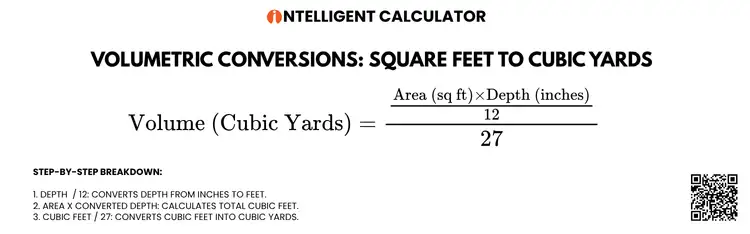
Breaking it down:
- Divide the depth in inches by 12 to convert to feet
- Multiply by the area to get cubic feet
- Divide by 27 to convert cubic feet into cubic yards
Always round up to the nearest whole yard. Minor site variations will consume that extra buffer.
Quick Sizing Reference: 1,000 Square Feet
Here is a quick reference for a standard 1,000-square-foot installation:
| Depth | Cubic Yards Needed |
|---|---|
| 2 inches | ~6.2 cubic yards |
| 3 inches | ~9.3 cubic yards |
| 4 inches | ~12.3 cubic yards |
The standard recommended depth is two to three inches. Never exceed four inches on ornamental beds — doing so limits oxygen flow to the root zone and can trigger root rot.
How to Calculate Mulch in Bags: 1.5, 2.0, and 3.0 Cubic Foot Conversions
If you’re buying retail bags instead of bulk, convert your cubic yards to cubic feet first (multiply by 27), then divide by the bag size:
- 1.5 cu ft bags: Bags = Total Cubic Feet ÷ 1.5
- 2.0 cu ft bags: Bags = Total Cubic Feet ÷ 2.0
- 3.0 cu ft bags: Bags = Total Cubic Feet ÷ 3.0
For example, a 9.3-cubic-yard project equals 251 cubic feet. At 2.0 cubic feet per bag, you would need approximately 126 bags. That’s a lot of trunk trips — and likely a sign that bulk delivery is the smarter option.

Use Card 2: Volume and Depth Calculator to run these conversions instantly and compare bag counts across all three standard retail sizes.
Material Selection: Bark Mulch vs. Wood Chips Density Dynamics
Not all mulch is the same. Each material has a unique dry density, moisture absorption rate, and decomposition speed. Choosing the wrong material for your climate or plant type wastes money and can damage your garden.
Dry Density and Wet Saturation Weights
Here is a complete weight reference for the most common landscape materials:
| Material | Dry Weight (lbs/cu yd) | Wet Multiplier | Best Use |
|---|---|---|---|
| Shredded Hardwood Bark | 800 | ×1.50 | Sloped beds, commercial plantings |
| Pine Bark Nuggets | 600 | ×1.50 | Acid-loving ornamentals, walkways |
| Pine Straw | 350 | ×1.30 | Large reforestation zones, slopes |
| Rubber Mulch | 1,100 | ×1.05 | Playgrounds, high-traffic areas |
| Gravel / River Rock | 2,700 | ×1.05 | Xeriscape, permanent drainage beds |
| Enriched Compost | 1,000 | ×1.40 | Annual flower beds, nutrient-poor soils |
Wet weights matter for transport planning. A yard of shredded hardwood bark weighs 800 pounds when dry. After heavy rain, that same yard can weigh up to 1,200 pounds. Always calculate saturated weights before loading a vehicle or scheduling delivery.
Lignocellulosic Biomass: What Wood Mulches Are Made Of
Wood-based mulches are composed of three core chemical compounds: cellulose, hemicellulose, and lignin. Lignin is the tough structural fiber that resists decay — this is why pine bark nuggets break down more slowly than shredded hardwood. Understanding this chemistry helps you predict how long your mulch will last before it needs topping up.
The Albedo Effect: How Mulch Color Affects Soil Temperature
Mulch color has a measurable impact on your soil microclimate. This is called the albedo effect — the degree to which a surface reflects solar radiation.
- Black dyed wood chips absorb more heat, warming soil faster in spring
- Light-colored straw or gravel reflects more light, keeping soil cooler in summer
In desert or high-heat climates, choose lighter-colored materials to prevent root dehydration. In cool northern climates, darker materials extend the growing season by warming the soil earlier.
Use Card 3: Mulch Material and Weight Selector to calculate the dry and wet shipping weight of your chosen material before you buy.
The Financial Tipping Point: Is Bulk or Bagged Mulch Cheaper?
This is one of the most common questions homeowners ask — and the answer depends entirely on project scale. Both options have real advantages depending on how many cubic yards you need.
The 3 Cubic Yard Rule
The standard economic tipping point is 3 cubic yards of total volume. Below that threshold, retail bags are often cheaper and easier to handle. Above that threshold, bulk delivery almost always wins on cost per yard.
Here’s why:
- Bagged mulch carries a retail markup of 30% to 50% above wholesale prices. It’s convenient for small jobs and leaves no delivery mess.
- Bulk mulch comes at a much lower cost per cubic yard, but includes a flat delivery fee (typically $50–$100). That fee disappears into savings once your project is large enough.
A Concrete Financial Example
Assume bagged mulch costs $8.00 per 2-cubic-foot bag and bulk mulch costs $35.00 per cubic yard with a $75 delivery fee.
| Project Size | Bagged Total | Bulk Total |
|---|---|---|
| 2 cubic yards (~27 bags) | $216 | $145 |
| 5 cubic yards (~68 bags) | $544 | $250 |
| 10 cubic yards (~135 bags) | $1,080 | $425 |
At 5 cubic yards, bulk delivery saves over $290. At 10 yards, the savings exceed $650. Always include local sales tax in your bagged estimate, as it can add 6% to 10% to the final cost.
Use Card 4: Cost and Budget Estimator to enter your local material and delivery prices and find your personal tipping point.
Logistical Planning: Can Your Vehicle Haul the Load?
Transport safety is non-negotiable. Overloading a vehicle damages the suspension, degrades braking performance, and creates serious road hazards. Know your vehicle’s payload limit before you load.
Standard Vehicle Payload Capacities
| Vehicle Type | Maximum Safe Payload |
|---|---|
| Sedan or Coupe | ~800 lbs |
| Mid-Size SUV | ~1,100 lbs |
| Half-Ton Pickup (F-150, Ram 1500) | ~1,800 lbs |
| Three-Quarter Ton Pickup (F-250, Ram 2500) | ~3,500 lbs |
Remember: always use the wet weight of your material for transport calculations. One cubic yard of shredded hardwood bark after a rainstorm weighs 1,200 pounds — already over the limit of a mid-size SUV.
DIY Hauling vs. Professional Delivery
To compare self-hauling against delivery costs, use these equations:
Total mileage = 2 × Distance × Number of trips
DIY cost = (Total miles ÷ MPG) × Fuel price + (Total miles × $0.20)
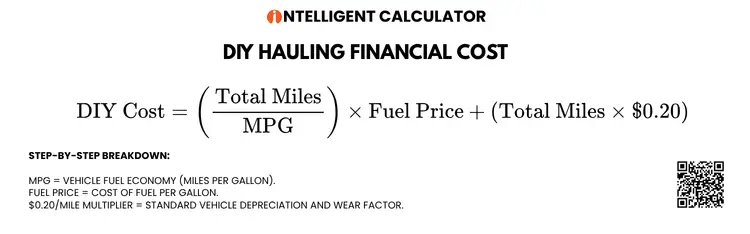
The $0.20 per mile accounts for standard vehicle depreciation and wear. If your calculated DIY cost exceeds the commercial delivery quote, hire the truck. Professional delivery also shifts liability away from you during transport.
Use Card 5: Delivery vs. Pickup Logistics Planner to compare your haul costs against local delivery quotes with your actual vehicle specs.
Installation Labor: Estimating DIY Hours vs. Professional Crew Costs
Physical effort is often the most underestimated part of a mulching project. What looks like a simple weekend task can quickly become a multi-day endurance challenge.
Work Rate Benchmarks
- Average homeowner: ~0.5 cubic yards per hour under normal conditions
- Experienced landscape laborer: ~1.0 to 1.5 cubic yards per hour per person
Work rate drops significantly after the first two hours due to fatigue, especially when spreading dense materials like rubber mulch or wet hardwood.
Effort Scale by Project Size
Use this guide to plan your day:
- Under 2 cubic yards — Easy solo project, 2 to 4 hours
- 2 to 5 cubic yards — Moderate; best tackled with a partner over one full day
- Over 5 cubic yards — Strenuous multi-day work; strongly consider hiring a professional crew
Professional labor costs are calculated as: Crew size × Hourly rate × Total hours on site. In most U.S. markets, professional landscape crews charge $45 to $75 per person per hour. For a 10-cubic-yard project with a 3-person crew working at 1.2 yards per hour per person, expect approximately 3 hours of billable time.
Use Card 6: Installation Labor and Time Estimator to calculate your total hours, plan your work schedule, and compare DIY sweat equity against professional crew pricing.
Weed Suppression: Designing a Multi-Layered Sub-Surface Barrier
Mulch alone suppresses weeds — but a properly designed barrier system eliminates up to 90% of weed pressure. The key is combining physical and chemical layers into one integrated defense.
Using Landscape Fabric
High-grade woven geotextile fabric blocks sunlight from reaching dormant weed seeds while still allowing water, air, and nutrients to pass through to the soil. Choose woven fabric over solid plastic sheeting — plastic traps water and starves roots of oxygen.
Securing the Barrier Properly
Installation steps for a long-lasting weed barrier:
- Clear the bed completely — remove all existing weeds by root
- Create a clean vertical 3-inch spade edge around the perimeter
- Lay fabric with a minimum 6-inch overlap at all seams
- Drive steel landscape staples every 3 feet along all seams and edges
- Cut X-shaped slits for existing plants — never pull fabric tight against stems
Pre-Emergent Herbicides: The Chemical Layer
Adding a granular pre-emergent herbicide (such as trifluralin or dithiopyr, both mitotic inhibitors) beneath the fabric creates a second line of defense. These compounds stop weed seeds from germinating at the root level. Amortize the herbicide cost across three to five years — it is far cheaper than annual hand-weeding labor.
Use Card 7: Weed Suppression and Barrier Analyzer to calculate the number of fabric rolls, staples, and ounces of herbicide you need for your specific bed dimensions.
Conservation Science: How Mulch Lowers Water Bills and Protects Roots
A uniform mulch layer is one of the most cost-effective water-saving tools available to any homeowner. It works by physically blocking direct solar evaporation from the exposed soil surface.
Water Savings by Depth
A three-inch layer of organic mulch can reduce irrigation needs by 50% to 75% depending on your climate and sun exposure. In arid climates, that savings can translate to thousands of gallons per season.
To estimate your savings, use this framework:
Gallons Saved = Total Sq Ft × Evaporation Coefficient × Irrigation Weeks
Over a five-year horizon, these water savings often offset a significant percentage of your original material investment — making mulch both an aesthetic improvement and a financial strategy.
Thermal Insulation: R-Values for Landscape Materials
Every mulch material has a unique thermal resistance value (R-value) per inch of depth. Higher R-values mean better insulation from temperature extremes.
| Material | R-Value per Inch |
|---|---|
| Pine Straw | 2.0 (best insulator) |
| Shredded Hardwood Bark | 1.5 |
| Rubber Mulch | 1.2 |
| Gravel / River Rock | 0.5 (lowest — holds heat) |
Total insulation value is calculated as:
R-total = Depth (inches) × R-value per inch
A 3-inch pine straw bed delivers an R-value of 6.0 — enough to protect perennial root zones from severe frost in most growing zones. Clay soils trap temperature extremes and need higher R-values. Sandy soils drain heat quickly and benefit from any stable organic layer.
Use Card 8: Soil Moisture Savings and Card 9: Soil Temperature Planner to model your utility savings and select the optimal depth for your climate.
Why Over-Mulching Kills Trees: The Science of “Mulch Volcanoes”
This is one of the most common and damaging mistakes in residential landscaping. A “mulch volcano” is exactly what it sounds like — a tall cone of mulch piled against a tree trunk. It looks tidy. It is actually deadly.
The Pathological Consequences of Bark-Contact Moisture Retention
When mulch contacts tree bark, it keeps the cambium layer — the living tissue just under the bark — continuously wet. This softens the bark, invites wood-boring insects, and creates the perfect environment for collar rot fungi like Phytophthora. Once Phytophthora establishes in the cambium, it spreads rapidly and can kill a mature tree within two to three growing seasons.
Additional damage caused by mulch volcanoes:
- Root girdling — roots grow in circles around the trunk base and eventually strangle it
- Oxygen depletion — deep mulch piles block air from reaching the root flare
- Vole habitat — rodents nest inside the warm, moist mulch cone and chew the bark
The Correct Application Standard
Always maintain a clear, mulch-free zone of at least 3 to 6 inches around the trunk. Mulch should form a flat “donut” ring, not a cone. The correct radius of a protective mulch ring is calculated based on trunk diameter:
Safe Ring Radius = Trunk Diameter × 18
For a tree with a 4-inch trunk diameter, the mulch ring should extend at least 72 inches (6 feet) from the trunk center — with the trunk itself completely clear. Use Card 6 alongside the geometry tool in Card 1 to calculate the area of this ring for material ordering.
Slope Stabilization: Choosing the Right Mulch for Hillsides and Drainage Runs
Not all mulch holds its position on a slope. The wrong material on a hillside washes downhill in the first heavy rainstorm and clogs your drainage runs. Material selection for sloped beds is a physics problem — not just an aesthetic choice.
The Physics of Interlocking Fibers: Shredded Hardwood vs. Nuggets
Shredded hardwood bark has long, irregular fibers that physically lock together when compressed. This interlocking structure resists sliding forces on slopes up to approximately 45 degrees. Pine bark nuggets, by contrast, are smooth and rounded — they slide freely under water pressure and are prone to floating. Pine bark nuggets fail on slopes greater than about 15 degrees.
Material recommendations by slope angle:
- 0 to 15 degrees — Any material works; pine bark nuggets are acceptable
- 15 to 30 degrees — Use shredded hardwood or pine straw (which mats down)
- Over 30 degrees — Shredded hardwood only, or consider erosion control blankets beneath the mulch layer
Calculating the Angle of Repose and Shear Stress Resistance
The maximum safe slope angle for any mulch material is governed by:
θ-max = arctan(μs)
Where θ is the maximum slope angle and μs is the static friction coefficient of the material. Shredded hardwood has a μs of approximately 1.0 (45 degrees). Pine bark nuggets have a μs closer to 0.27 (about 15 degrees). Always select a material whose angle of repose exceeds your actual bed slope.
Soil Chemistry: How Mulch Decomposition Affects Nitrogen Availability
This is an advanced topic that most gardening blogs skip entirely — but it directly affects whether your plants thrive or struggle after mulching. The Carbon-to-Nitrogen (C:N) ratio of your mulch determines what happens to your soil chemistry as it breaks down.
The Carbon-to-Nitrogen (C:N) Ratio of Common Materials
| Material | C:N Ratio | Nitrogen Impact |
|---|---|---|
| Wood Chips / Sawdust | ~400:1 | High nitrogen drawdown risk |
| Shredded Hardwood Bark | ~100:1 | Moderate nitrogen drawdown |
| Pine Straw | ~80:1 | Low to moderate drawdown |
| Compost | ~20:1 | Releases nitrogen (net positive) |
When wood chips with a 400:1 carbon ratio are applied, soil microbes must consume large amounts of nitrogen to break down all that carbon. They pull this nitrogen directly from the surrounding soil, creating a temporary shortage called nitrogen immobilization.
How to Prevent Nitrogen Immobilization in Annual Flower Beds
Annual flower beds and vegetable gardens are most vulnerable because they have shallow root systems. Deep-rooted trees and shrubs are generally unaffected.
Prevention strategies:
- Apply wood chip mulch above the soil only — never mix it into the soil
- Add a nitrogen supplement (blood meal or granular urea) at the rate of 1 lb per 100 sq ft when using high-carbon wood chips on annual beds
- Choose compost or pine straw for vegetable gardens, where nutrient availability is critical
- Monitor plant foliage for yellowing — a sign of nitrogen deficiency — in the first four to six weeks after application
Mycorrhizal Fungi: The Hidden Benefit of Organic Mulch
Organic mulch layers also support mycorrhizal fungi — symbiotic biological networks that colonize mulch and extend plant root systems. These fungi transfer phosphorus, water, and micronutrients to host plants in exchange for carbon sugars. Maintaining a continuous organic mulch layer keeps mycorrhizal communities active year-round, improving plant health without any additional input.
Decomposition and Replenishment: Planning Your 5-Year Maintenance Budget
Organic mulch is not a permanent installation. It decomposes over time — which is both its weakness (requires replacement) and its strength (enriches the soil with organic matter). Smart planning accounts for replenishment costs from day one.
Annual Decomposition Rates by Material
| Material | Annual Volume Loss | Notes |
|---|---|---|
| Enriched Compost | ~40% | Fastest breakdown; needs frequent top-ups |
| Shredded Hardwood | ~35% | Moderate decay; ideal 3-year replenishment cycle |
| Pine Bark Nuggets | ~25% | Slower decay; resistant lignin structure |
| Pine Straw | ~30% | Mats and compacts; may need less material per top-up |
| Rubber Mulch | ~0% | No decomposition; one-time cost |
| Gravel / River Rock | ~0% | Permanent; only labor cost is cleaning |
Annual rainfall significantly affects decomposition speed. Wet tropical climates accelerate organic breakdown by up to 20% above the baseline. Arid climates slow it by a similar margin.
When to Replenish
Trigger a top-up application when mulch depth falls more than 1 inch below your target depth. For a 3-inch target, that means replenishing when the bed reads 2 inches or less. Budget a replenishment application every 2 to 3 years for shredded hardwood, and every 1 to 2 years for compost-based beds.
Use Card 10: Decomposition and Replenishment Scheduler to build a full five-year maintenance cost model for your specific material choice and climate zone.
The Ecological Balance: Carbon Sequestration vs. Transport Emissions
Modern landscape projects are increasingly evaluated on their ecological footprint alongside their financial return. Organic mulches offer a genuine environmental benefit — but transport emissions can partially offset that gain.
Mulch as a Carbon Sink
Organic mulches lock atmospheric carbon dioxide into the soil as they decompose. This makes them reliable carbon sinks when sourced locally.
| Material | Net CO2 Impact per Cubic Yard |
|---|---|
| Shredded Hardwood Bark | Sequesters ~180 kg CO2 |
| Pine Straw / Pine Bark | Sequesters ~120 kg CO2 |
| Enriched Compost | Sequesters ~100 kg CO2 |
| Rubber Mulch | Generates ~150 kg CO2 (manufacturing) |
Sourcing arborist wood chips directly from local tree care operations — rather than purchasing commercially dyed products — maximizes carbon benefit and eliminates transport emissions almost entirely. Arborist chips are often available free or at minimal cost from urban tree service companies.
Calculating Transport Emissions
- Standard pickup truck: ~0.404 kg CO2 per mile under typical hauling loads
- Commercial delivery truck: Higher per-mile emissions, but offset by consolidating large volumes into one trip
To minimize your project’s carbon footprint:
- Choose local or regional suppliers over national distributors
- Consolidate all material into one delivery rather than multiple small loads
- Select organic materials over inorganic rubber alternatives
Use Card 11: Carbon Footprint and Eco-Impact Tracker to calculate whether your project is carbon-negative and what changes would improve your ecological score.
The Financial Return on Investment of Premium Mulching
A complete mulching project is both a capital expenditure and a long-term investment. The true financial picture only emerges when you subtract ongoing utility savings and maintenance cost reductions from the upfront spend.
Five-Year Cost-Benefit Framework
Total Upfront Investment = Materials + Delivery + Fabric + Labor
Net Five-Year Cost = Upfront Investment − (Annual Water Savings × 5) − (Annual Weed Labor Savings × 5)
For a well-designed 1,000-square-foot commercial bed using shredded hardwood at 3 inches deep:
| Cost Item | Estimated Amount |
|---|---|
| Materials (bulk, 9.3 yds) | ~$325 |
| Delivery | ~$75 |
| Landscape fabric | ~$80 |
| Labor (DIY, 10 hrs) | $0 |
| Total Upfront | ~$480 |
| Annual water savings | ~$120 |
| Annual weeding savings | ~$150 |
| 5-Year Net Savings | ~$1,350 |
| Net 5-Year Gain | ~$870 |
The cost per square foot for this project is $0.48 — a benchmark figure for corporate landscape budgeting. High-performance projects consistently show full ROI recovery within 18 to 36 months.
Use Card 12: Total Project ROI and Summary Dashboard to generate a personalized financial, logistical, and environmental report for your complete project.
Frequently Asked Questions
Does wood mulch attract termites?
Wood mulch does not feed termites, but it retains moisture — and termites are drawn to moist environments. Keep all mulch at least 6 inches from your home’s foundation and never pile it against wood siding or deck posts.
Can I put new mulch over old mulch?
Yes — as long as the old layer is not already at your target depth and is not showing signs of rot or fungal growth. Lightly rake the old layer to aerate it before applying a thin topcoat. If Artillery Fungi (Sphaerobolus stellatus) are present — recognizable as tiny black spore clusters stuck to nearby surfaces — remove and dispose of the old mulch before applying new material. Artillery Fungi eject sticky spores onto house siding and vehicles, causing permanent staining.
Should I use landscape fabric under wood mulch?
Landscape fabric is excellent in permanent shrub beds where the soil will not be disturbed. Avoid it in annual vegetable and flower beds where you dig and replant every season — fabric degrades quickly under repeated cultivation and becomes a weed-trapping nuisance. Slime molds (Physarum polycephalum) can also develop under fabric in humid conditions if the layer traps too much moisture.
What is the best mulch for acid-loving plants?
Pine bark nuggets and pine straw are ideal for acid-loving species such as Rhododendron, Azalea, Blueberry (Vaccinium), and Gardenia. These materials lower soil pH slightly as they decompose. Hardwood bark and compost are better choices for alkaline-tolerant plants and most ornamental shrubs.
How do I prevent nitrogen starvation after applying wood chips?
Keep wood chips on top of the soil surface — never mix them in. For annual beds, add a nitrogen supplement such as blood meal (12-0-0) or granular urea at 1 pound per 100 square feet immediately after application. Monitor plants for yellowing leaves in the first four to six weeks.
Related Calculators
- Cubic Yard Calculator — Convert volume units before ordering bulk materials
- Square Footage of a Circle Calculator — Calculate circular tree ring areas using the pi formula
- Gravel Calculator — Compare organic bark with permanent stone mulch options
- River Rock Calculator — Plan inorganic xeriscaping with accurate weight and volume data
- Mowing Cost and Landscape Maintenance Calculator — Budget annual maintenance alongside mulch replenishment
These tools work together as an integrated landscape planning toolkit. Use the mulch guide’s geometry results to feed directly into the cubic yard converter and the gravel comparison tool.
Summary: Building a Data-Driven Mulching Strategy
The best landscape mulching decisions are built on math, material science, and long-term financial modeling — not guesswork. Here is a quick-reference checklist for any project:
Before You Buy:
- Measure all bed zones using the correct geometric formula
- Calculate total cubic yards using the volumetric conversion formula
- Compare bagged vs. bulk pricing at your specific project volume
- Check wet material weight against your vehicle’s payload limit
- Select material based on slope angle, plant type, and climate
During Installation:
- Install woven landscape fabric with overlapping seams and steel staples
- Apply pre-emergent herbicide beneath the fabric layer
- Keep all mulch at least 3 to 6 inches clear of tree trunks
- Maintain a uniform 2 to 3 inch depth — never exceed 4 inches on ornamental beds
- Leave a clear mulch-free ring at the root flare of every tree
For Long-Term Planning:
- Schedule replenishment when depth drops 1 inch below target
- Track annual water savings against utility bills
- Build a 5-year maintenance budget using decomposition rates
- Evaluate carbon impact when choosing between organic and inorganic materials
A properly planned and executed mulching project is one of the highest-return investments in landscape management. It pays dividends in reduced water bills, eliminated weeding labor, improved plant health, and measurable ecological benefit — year after year.