
Last updated: May 08, 2026
CFM Calculator

CFM = (Length x Width x Height x ACH) / 60---
---
---
Rated CFM = Required CFM x 1.20 (safety factor)ACH = (CFM x 60) / Room Volume (ft3)Area (ft2) = CFM / Velocity (FPM) | Diameter = sqrt(Area x 4 / pi) x 12Tons = CFM / 400 | BTU/hr = Tons x 12,000 | kW = BTU/hr / 3412CFM = Area (ft2) x Velocity (FPM) | Area = pi x (D/24)^2 for roundTESP = Duct Loss + Filter Drop + Coil Drop + Fitting LossesCFM = (Bedrooms + 1) x 7.5 + (Floor Area x 0.03)kWh = HP x 0.746 x Hours/day x Days/yr / Motor EfficiencyCFM, or Cubic Feet Per Minute, is the standard unit used to measure the volume of air moved by a fan, blower, HVAC system, or ventilation unit in one minute. Whether you are sizing a bathroom exhaust fan, calculating the airflow requirements of a server room, or selecting the right air handler for a commercial building, CFM is the foundational measurement that determines whether a space receives adequate ventilation, proper air exchange, and efficient climate control.
A room measuring 500 square feet with an 8-foot ceiling holds 4,000 cubic feet of air. If your ventilation target is 6 air changes per hour, the required CFM is 400 CFM — meaning the system must move 400 cubic feet of fresh air every minute. Getting this number right determines whether occupants breathe comfortably, whether equipment operates safely, and whether energy is used efficiently.
Use this free CFM Calculator to instantly compute airflow requirements for rooms, ducts, fans, and HVAC systems. Enter your space dimensions, select an air change target, and get your CFM result in seconds — no sign-up required.
What Is CFM?
CFM Definition
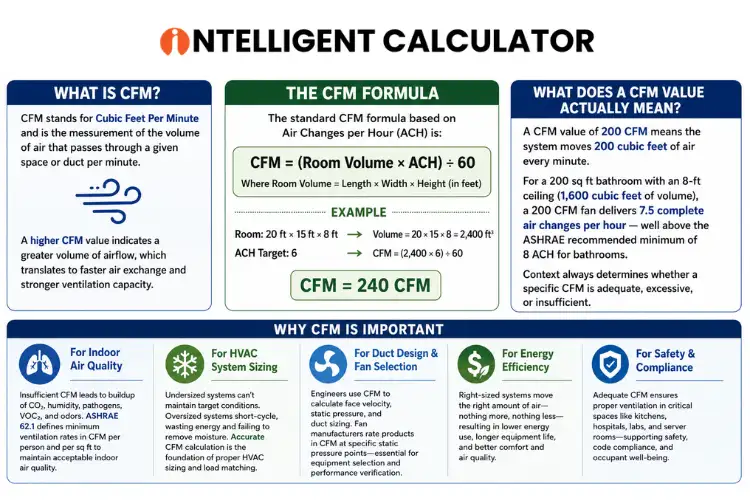
CFM stands for Cubic Feet Per Minute and is the measurement of the volume of air that passes through a given space or duct per minute. It is the most commonly used airflow unit in the United States for HVAC engineering, ventilation system design, fan selection, and indoor air quality analysis.
CFM (Cubic Feet Per Minute) measures the volume of air moved through a system, duct, or space in one minute. A higher CFM value indicates a greater volume of airflow, which translates to faster air exchange and stronger ventilation capacity.
The CFM Formula
The standard CFM formula based on Air Changes per Hour (ACH) is:
|
CFM = (Room Volume × ACH) ÷ 60 Where Room Volume = Length × Width × Height (in feet) |
What Does a CFM Value Actually Mean?
A CFM value of 200 CFM means the system moves 200 cubic feet of air every minute. For a 200 sq ft bathroom with an 8-foot ceiling (1,600 cubic feet of volume), a 200 CFM fan delivers 7.5 complete air changes per hour — well above the ASHRAE recommended minimum of 8 ACH for bathrooms. Context always determines whether a specific CFM is adequate, excessive, or insufficient.
Why CFM Is Important
For Indoor Air Quality
Insufficient CFM in occupied spaces leads to a buildup of carbon dioxide, humidity, airborne pathogens, volatile organic compounds (VOCs), and odors. ASHRAE Standard 62.1 defines minimum ventilation rates in CFM per person and CFM per square foot to maintain acceptable indoor air quality in commercial buildings. Residential applications follow similar principles, with bathroom fans, kitchen range hoods, and whole-house ventilation systems each requiring specific minimum CFM ratings.
For HVAC System Sizing
Undersized HVAC systems — those delivering insufficient CFM — cannot maintain target temperatures or humidity levels, leading to occupant discomfort and equipment overloading. Oversized systems short-cycle, wasting energy and failing to remove moisture effectively. Accurate CFM calculation is the foundation of proper HVAC sizing and load matching.
For Duct Design and Fan Selection
Duct engineers use CFM to calculate face velocity, static pressure, and duct sizing. A duct carrying 500 CFM through a 10-inch round duct produces a face velocity of approximately 917 feet per minute — within the acceptable range for residential systems. Fan manufacturers rate their products in CFM at specific static pressure points, making CFM the essential unit for equipment selection and performance verification.
How to Use the CFM Calculator (Step-by-Step)
Step 1 — Measure Your Room Dimensions
Measure the length, width, and ceiling height of the space in feet. Multiply all three to determine the room volume in cubic feet. For irregular spaces, calculate each rectangular zone separately and sum the volumes.
Step 2 — Select Your Target Air Changes per Hour (ACH)
Choose an ACH target appropriate to the application. Residential bedrooms typically require 4 to 6 ACH. Bathrooms require 8 ACH minimum. Commercial kitchens, hospitals, and server rooms require significantly higher values. The calculator includes industry-standard ACH presets for common space types.
Step 3 — Enter Values and Calculate
Enter your room dimensions and ACH target. The calculator automatically computes room volume and applies the CFM formula. The result represents the minimum airflow your ventilation system, fan, or HVAC unit must deliver continuously.
Step 4 — Apply Safety Factors and Equipment Ratings
Fan and HVAC equipment ratings are measured under ideal laboratory conditions. Real installations include duct losses, filter resistance, and static pressure drops that reduce effective CFM by 15 to 30 percent. Always select equipment rated at 20 to 30 percent above the calculated CFM requirement to account for these real-world losses.
CFM Formula — Multiple Calculation Methods
Method 1: Room Volume × ACH (Most Common)
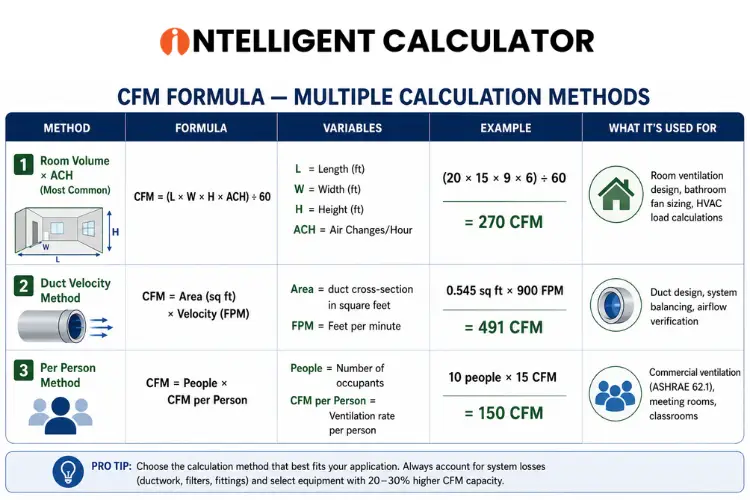
This method is used for room ventilation design, bathroom fan sizing, and HVAC load calculations. It determines the CFM required to achieve a target number of complete air changes per hour.
| Formula | Variables | Result |
| CFM = (L × W × H × ACH) ÷ 60 | L = Length (ft), W = Width (ft), H = Height (ft), ACH = Air Changes/Hour | Required CFM for target ventilation |
| Example: (20 × 15 × 9 × 6) ÷ 60 | 20 ft × 15 ft × 9 ft ceiling, 6 ACH target | 270 CFM required |
Method 2: Duct Velocity Method
Used in duct design to determine the CFM a duct carries based on its cross-sectional area and the air velocity inside it. This method is essential for balancing multi-zone HVAC systems.
| Formula | Variables |
| CFM = Area (sq ft) × Velocity (FPM) | Area = duct cross-section in square feet, FPM = feet per minute |
| Example: 0.545 sq ft × 900 FPM | 10-inch round duct (0.545 sq ft area), 900 FPM velocity = 491 CFM |
Method 3: ASHRAE Occupancy-Based Calculation
Commercial buildings use ASHRAE Standard 62.1 which calculates required CFM based on the number of occupants and the floor area, combining a per-person component with an area-based component.
| Formula | Example |
| CFM = (People × CFM/Person) + (Area × CFM/sq ft) | 50 people at 5 CFM/person + 1,000 sq ft at 0.06 CFM/sq ft |
| Result = 250 + 60 = 310 CFM | ASHRAE 62.1 office zone calculation |
CFM Calculation Example
Example: Master Bedroom Ventilation
Consider a master bedroom measuring 14 feet by 16 feet with a 9-foot ceiling. The homeowner wants to achieve 5 air changes per hour as recommended by ASHRAE for bedrooms.
| Step | Calculation | Result |
| Room Length | 14 feet | — |
| Room Width | 16 feet | — |
| Ceiling Height | 9 feet | — |
| Room Volume | 14 × 16 × 9 | 2,016 cubic feet |
| Target ACH | 5 air changes per hour | — |
| Required CFM | (2,016 × 5) ÷ 60 | 168 CFM |
| Equipment Selection | 168 CFM + 25% safety factor | 210 CFM fan/unit minimum |
The bedroom requires at least 168 CFM of continuous mechanical ventilation to achieve 5 ACH. When selecting a fan or HVAC zone damper, the recommended equipment CFM rating is 210 CFM or higher to account for duct resistance and real-world performance losses.
CFM Requirements by Application — Industry Benchmarks
Residential ACH Benchmarks by Room Type
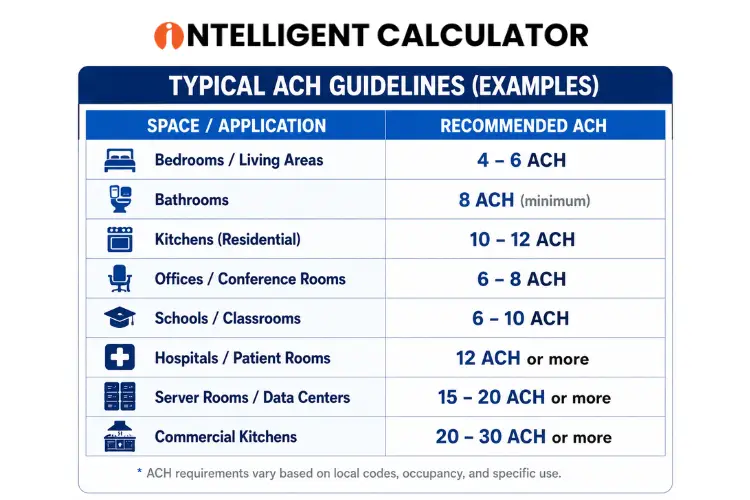
| Room / Space | Recommended ACH | Typical CFM (Average Room) | Standard |
| Living Room | 4 – 6 ACH | 80 – 160 CFM | ASHRAE 62.2 |
| Bedroom | 4 – 6 ACH | 60 – 140 CFM | ASHRAE 62.2 |
| Bathroom | 8 ACH minimum | 50 – 110 CFM | HVI / IRC |
| Kitchen | 15 ACH recommended | 100 – 400 CFM | HVI Standard |
| Basement / Utility | 4 – 8 ACH | 80 – 200 CFM | IRC 2021 |
| Garage (attached) | 4 ACH minimum | 100 – 300 CFM | IBC / IRC |
Commercial and Industrial CFM Requirements
| Application | Required ACH | Ventilation Rationale |
| Office (general) | 4 – 10 ACH | CO₂ dilution, occupant comfort |
| Server Room / Data Center | 20 – 60 ACH | Heat dissipation from equipment |
| Hospital Operating Room | 15 – 25 ACH | Infection control, sterile environment |
| Commercial Kitchen | 30 – 60 ACH | Heat, smoke, and grease exhaust |
| Spray Paint Booth | 60 – 100 ACH | Solvent vapor dilution to safe levels |
| Laboratory (general) | 6 – 10 ACH | Chemical fume management |
Why Server Rooms Need Extremely High CFM
Modern server racks generate 5 to 25 kilowatts of heat per rack. Converting heat load to CFM: every 1 kW of heat requires approximately 160 CFM to maintain a 10°F temperature rise. A room with 10 server racks generating 100 kW total requires a minimum of 16,000 CFM — achieved through precision air conditioning units, raised floor cooling, or in-row cooling systems designed specifically for high-density data environments.
Benefits of Using This CFM Calculator
- Instant calculation — enter room dimensions and ACH target for an immediate CFM result
- Multiple calculation methods — room volume method, duct velocity method, and occupancy-based ASHRAE method
- Application presets — select from residential, commercial, industrial, or server room profiles with appropriate ACH defaults
- Unit conversion — convert between CFM, CMH, LPS, and other international airflow units
- Equipment sizing guidance — results include recommended equipment CFM ratings with safety factor applied
- Multi-room analysis — calculate total building CFM across multiple zones simultaneously
- No registration required — completely free to use immediately
Common CFM Calculation Mistakes to Avoid
Mistake 1 — Using Floor Area Instead of Room Volume
CFM requirements are based on air volume, not floor area. A room with 400 square feet and an 8-foot ceiling contains 3,200 cubic feet. The same floor area with a 12-foot ceiling contains 4,800 cubic feet — 50 percent more air requiring proportionally more CFM to achieve the same ACH target. Always include ceiling height in your calculation.
Mistake 2 — Ignoring Static Pressure Losses
Fan CFM ratings are measured at zero static pressure in laboratory conditions. Every foot of ductwork, every elbow, every filter, and every grille adds resistance that reduces the effective CFM delivered to the space. A fan rated at 300 CFM may deliver only 210 CFM in a typical residential installation with 25 feet of ductwork and two 90-degree elbows. Always size for installed performance, not rated performance.
Mistake 3 — Applying Residential ACH to Commercial Spaces
Commercial buildings have fundamentally different ventilation requirements than residential spaces. An office space requires 5 CFM per person plus 0.06 CFM per square foot under ASHRAE 62.1 — requirements that are tied to occupant load and space function, not simple ACH targets. Applying a residential 4 to 6 ACH calculation to a densely occupied commercial space will significantly under-ventilate the space.
Mistake 4 — Forgetting to Account for Makeup Air
Every cubic foot of air exhausted from a building must be replaced by an equal volume of makeup air. Exhaust-only ventilation systems that move 500 CFM out of a tightly sealed building without providing 500 CFM of incoming fresh air create negative pressure, causing back-drafting of combustion appliances and reducing the effectiveness of the exhaust system. CFM calculations must always balance supply and exhaust.
Real-World Applications of CFM Calculations
Residential Bathroom Fan Sizing
The Home Ventilating Institute (HVI) recommends 1 CFM per square foot for bathrooms up to 100 square feet, and 8 ACH for larger bathrooms. A 120 square foot master bathroom with a 9-foot ceiling (1,080 cubic feet) requires 144 CFM minimum — meaning a standard 110 CFM bathroom fan is undersized and a 150 CFM or 200 CFM unit is the appropriate selection.
Kitchen Range Hood Sizing
Range hood CFM requirements depend on the type of cooking equipment and the BTU output of the stove. The general rule is 100 CFM per 10,000 BTU of burner output for gas ranges. A 48,000 BTU professional range requires a minimum of 480 CFM hood capacity. Wall-mounted hoods lose approximately 20 to 30 percent of rated CFM due to duct resistance, so a 600 CFM hood is the appropriate selection for this application.
Industrial Spray Booth Ventilation
OSHA and NFPA 33 require spray paint booths to maintain airflow sufficient to dilute solvent vapors to below 25 percent of the Lower Explosive Limit (LEL). For a typical downdraft spray booth measuring 14 feet wide by 24 feet long, the required face velocity is 100 feet per minute across the full booth cross-section — producing a CFM requirement of 33,600 CFM. Proper CFM calculation in these industrial settings is not just an efficiency concern but a critical safety requirement.
Frequently Asked Questions
What is a good CFM for a room?
A good CFM depends on the room size and use. For a typical 200 sq ft bedroom with an 8-foot ceiling, 107 CFM achieves 4 ACH — the minimum recommended for sleeping areas. Bathrooms should have at least 50 to 110 CFM. The key metric is not the absolute CFM number but whether it achieves the target ACH for the specific room type.
How do I convert CFM to ACH?
To convert CFM to ACH: ACH = (CFM × 60) ÷ Room Volume. A 300 CFM unit in a room with 2,400 cubic feet of volume produces 7.5 air changes per hour. This conversion is useful for verifying whether existing equipment meets ventilation standards for a specific space.
What is the difference between CFM and SCFM?
CFM (Cubic Feet Per Minute) measures actual airflow volume at the operating conditions of temperature and pressure. SCFM (Standard Cubic Feet Per Minute) normalizes the measurement to standard conditions — typically 68°F (20°C) and 14.696 psia (1 atmosphere). For compressed air systems and pneumatic equipment, SCFM is more useful because it accounts for air density changes with pressure. For HVAC ventilation design, CFM is the appropriate unit.
How do I calculate CFM for a duct?
CFM for a duct is calculated as: CFM = Duct Area (sq ft) × Air Velocity (FPM). For a 10-inch round duct (area = 0.545 sq ft) with an air velocity of 800 FPM, the CFM carried is 436 CFM. Residential ducts typically target 600 to 900 FPM face velocity to balance noise and efficiency.
Is more CFM always better?
Not always. Excessive CFM in a space creates noise, drafts, and energy waste. In commercial kitchens, excessive exhaust CFM without adequate makeup air creates negative pressure that interferes with cooking equipment and makes doors difficult to open. The goal is to match CFM precisely to the ventilation requirement — neither under-ventilating nor over-ventilating.
What CFM do I need for a 1,000 square foot house?
For a 1,000 square foot home with 8-foot ceilings (8,000 cubic feet of volume) targeting 4 air changes per hour, the required whole-house ventilation CFM is (8,000 × 4) ÷ 60 = 533 CFM. ASHRAE 62.2 also allows a simplified calculation: 0.01 CFM per square foot plus 7.5 CFM per bedroom, which for a 1,000 sq ft, 3-bedroom home equals 10 + 22.5 = 32.5 CFM of continuous mechanical ventilation — significantly lower, as this standard targets minimum outdoor air introduction rather than total air exchange.
Final Thoughts
CFM is the universal language of air movement. Whether you are selecting a bathroom fan, sizing a commercial HVAC system, designing ductwork for a multi-zone building, or ensuring a server room stays cool enough to protect millions of dollars in equipment, every decision starts with an accurate CFM calculation. Use the calculator above to measure your airflow requirements, compare them against industry benchmarks, and select equipment with the confidence that your ventilation system will perform exactly as designed.