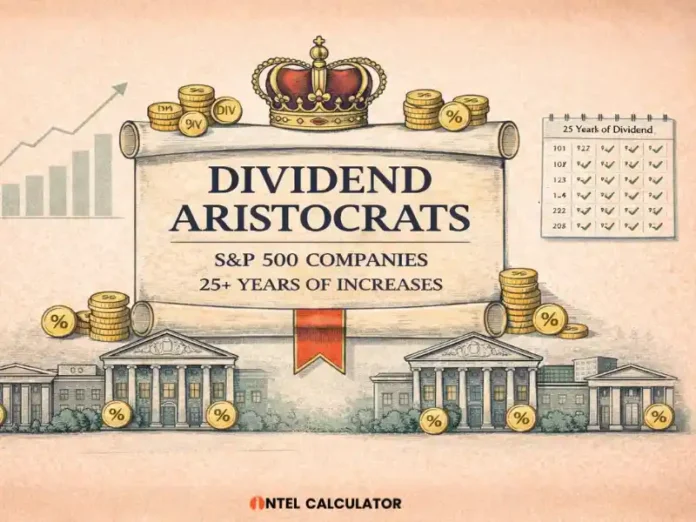
Dividend Aristocrats are S&P 500 companies that have increased their dividend every single year for at least 25 consecutive years. This is one of the most demanding criteria in dividend investing — only companies with genuinely durable business models, consistent profitability, and shareholder-friendly management survive this long without cutting. This page lists every current Aristocrat with yield and sector data.
What makes this list remarkable is not just the length of the streak — it is the quality of the businesses behind it. These are companies that maintained dividend growth through the dot-com crash, the 2008 financial crisis, the COVID-19 pandemic, and multiple recessionary periods. That kind of durability does not happen by accident. It requires pricing power, balance sheet discipline, and management teams that treat the dividend as a long-term commitment to shareholders.
What Qualifies as a Dividend Aristocrat
Not every company with a long dividend history earns the Aristocrat designation. S&P Dow Jones Indices maintains the official index and applies a specific set of rules that must all be satisfied simultaneously. As of 2026, the qualification criteria are as follows:
- Must be a current constituent of the S&P 500 index at the time of the annual rebalancing.
- Must have increased its total annual dividend per share for at least 25 consecutive calendar years.
- Must meet the minimum float-adjusted market capitalization threshold set by S&P (generally $3 billion or above).
- Must meet minimum average daily trading volume requirements for liquidity purposes.
- The list is maintained exclusively by S&P Dow Jones Indices and is updated annually each January.
Importantly, maintaining the same dividend does not count — only an actual increase preserves Aristocrat status. A company that holds its dividend flat for even one year loses eligibility and must restart the 25-year clock. This strict interpretation ensures that only genuinely shareholder-committed businesses remain on the list.
Complete Dividend Aristocrats List 2026
The table below lists all 66 Dividend Aristocrats as of January 2026, grouped by sector for easy scanning. Approximate yield figures are based on early 2026 price data. Use the Dividend Yield Calculator to verify current yield before investing, as yields change daily with stock price movement.
| Company Name | Ticker | Sector | ~Yield | Consec. Years |
| Procter & Gamble | PG | Consumer Staples | 2.4% | 68 |
| Coca-Cola | KO | Consumer Staples | 3.1% | 62 |
| PepsiCo | PEP | Consumer Staples | 3.4% | 52 |
| Colgate-Palmolive | CL | Consumer Staples | 2.3% | 61 |
| Walmart | WMT | Consumer Staples | 1.1% | 51 |
| Sysco | SYY | Consumer Staples | 2.7% | 54 |
| Hormel Foods | HRL | Consumer Staples | 3.8% | 58 |
| Church & Dwight | CHD | Consumer Staples | 1.1% | 27 |
| Brown-Forman | BF.B | Consumer Staples | 2.2% | 40 |
| Archer-Daniels-Midland | ADM | Consumer Staples | 4.1% | 49 |
| McCormick & Company | MKC | Consumer Staples | 2.0% | 37 |
| Clorox | CLX | Consumer Staples | 3.3% | 46 |
| Kimberly-Clark | KMB | Consumer Staples | 3.7% | 51 |
| Albemarle | ALB | Consumer Staples | 1.8% | 29 |
| Genuine Parts | GPC | Consumer Discretionary | 3.2% | 68 |
| 3M Company | MMM | Industrials | 5.8% | 65 |
| Emerson Electric | EMR | Industrials | 2.1% | 67 |
| Illinois Tool Works | ITW | Industrials | 2.3% | 60 |
| Cintas | CTAS | Industrials | 1.0% | 40 |
| A.O. Smith | AOS | Industrials | 1.8% | 30 |
| Dover Corporation | DOV | Industrials | 1.3% | 68 |
| W.W. Grainger | GWW | Industrials | 0.9% | 53 |
| Parker Hannifin | PH | Industrials | 1.4% | 67 |
| Fastenal | FAST | Industrials | 2.3% | 25 |
| Nordson | NDSN | Industrials | 1.3% | 60 |
| Roper Technologies | ROP | Industrials | 0.5% | 30 |
| Expeditors International | EXPD | Industrials | 1.2% | 28 |
| T. Rowe Price | TROW | Financials | 4.8% | 37 |
| Aflac | AFL | Financials | 2.3% | 41 |
| Cincinnati Financial | CINF | Financials | 3.0% | 63 |
| Franklin Resources | BEN | Financials | 4.9% | 43 |
| S&P Global | SPGI | Financials | 0.8% | 51 |
| BlackRock | BLK | Financials | 2.8% | 15 |
| Automatic Data Processing | ADP | Financials | 2.1% | 49 |
| Erie Indemnity | ERIE | Financials | 2.0% | 33 |
| Johnson & Johnson | JNJ | Health Care | 3.2% | 62 |
| Abbott Laboratories | ABT | Health Care | 1.9% | 52 |
| Becton Dickinson | BDX | Health Care | 1.8% | 52 |
| Medtronic | MDT | Health Care | 3.5% | 46 |
| Cardinal Health | CAH | Health Care | 1.8% | 37 |
| West Pharmaceutical Services | WST | Health Care | 0.4% | 29 |
| Baxter International | BAX | Health Care | 4.2% | 27 |
| Air Products & Chemicals | APD | Materials | 2.8% | 41 |
| PPG Industries | PPG | Materials | 2.2% | 52 |
| Nucor | NUE | Materials | 1.6% | 50 |
| Ecolab | ECL | Materials | 1.0% | 32 |
| Sherwin-Williams | SHW | Materials | 0.9% | 44 |
| Linde | LIN | Materials | 1.3% | 30 |
| Consolidated Edison | ED | Utilities | 3.8% | 49 |
| NextEra Energy | NEE | Utilities | 3.0% | 28 |
| Atmos Energy | ATO | Utilities | 2.5% | 38 |
| Essential Utilities | WTRG | Utilities | 3.2% | 31 |
| Federal Realty Investment Trust | FRT | Real Estate | 4.2% | 56 |
| Realty Income | O | Real Estate | 5.7% | 29 |
| Essex Property Trust | ESS | Real Estate | 3.7% | 29 |
| Texas Instruments | TXN | Info Technology | 3.0% | 19 |
| Accenture | ACN | Info Technology | 1.7% | 14 |
| ExxonMobil | XOM | Energy | 3.5% | 41 |
| Chevron | CVX | Energy | 4.3% | 36 |
| National Fuel Gas | NFG | Energy | 3.1% | 53 |
| Leggett & Platt | LEG | Energy | 5.2% | 51 |
| Lowe’s Companies | LOW | Consumer Discretionary | 1.8% | 61 |
| Target Corporation | TGT | Consumer Discretionary | 3.5% | 56 |
| McDonald’s | MCD | Consumer Discretionary | 2.3% | 48 |
| Stanley Black & Decker | SWK | Consumer Discretionary | 4.0% | 56 |
Note: Yields are approximate and change daily as stock prices fluctuate. Always verify the current yield using real-time data before making any investment decisions. Consecutive years data reflects the streak as of the January 2026 index update.
Dividend Aristocrats by Sector Breakdown
One of the most instructive ways to analyze the Dividend Aristocrats list is through sector concentration. The distribution reveals which types of businesses have historically been most capable of sustaining uninterrupted dividend growth across multiple economic cycles.
| Sector | # of Aristocrats | Why This Sector Qualifies |
| Consumer Staples | 14 | Recession-resistant brands with predictable demand |
| Industrials | 12 | Diversified manufacturing with long operating histories |
| Financials | 8 | Insurance and asset managers with fee-based income |
| Health Care | 7 | Steady demand driven by aging demographics |
| Consumer Discretionary | 5 | Market leaders with strong brand moats |
| Materials | 6 | Specialty chemicals and industrial gases |
| Energy | 4 | Integrated majors with dividend-first cultures |
| Utilities | 4 | Regulated businesses with guaranteed returns |
| Real Estate (REITs) | 3 | High-yield property income with steady growth |
| Information Technology | 3 | Newest entrants; historically underrepresented |
Consumer Staples leads all sectors because companies selling everyday necessities — food, beverages, cleaning products, personal care items — generate cash flows that are structurally resistant to recessions. Demand does not disappear when consumers cut back; it simply shifts to lower-priced alternatives within the same category. This predictability gives management the confidence to commit to annual dividend increases even during downturns.
Technology, by contrast, is underrepresented precisely because the sector’s rapid innovation cycles create business risk that makes 25-year dividend commitments difficult to sustain. A technology business that was dominant in 1999 might be irrelevant by 2010. The few technology companies that do qualify tend to be mature, diversified businesses with recurring revenue models rather than pure growth plays.
Highest Yielding Dividend Aristocrats
Yield is the most visible metric on any dividend list, but it is also one of the most misunderstood. The ten highest-yielding Aristocrats below offer attractive income today, but require additional screening before investing. Always use the Dividend Payout Ratio Calculator to verify that the dividend is well-covered before committing capital.
| Company | Ticker | ~Yield | Payout Ratio | Key Consideration |
| 3M Company | MMM | 5.8% | ~75% | High yield reflects valuation compression |
| Realty Income | O | 5.7% | ~78% | Monthly dividend REIT; AFFO-based payout |
| Leggett & Platt | LEG | 5.2% | ~85% | Monitor payout ratio carefully |
| Franklin Resources | BEN | 4.9% | ~65% | Asset manager under AUM pressure |
| T. Rowe Price | TROW | 4.8% | ~55% | Well-covered; strong balance sheet |
| Chevron | CVX | 4.3% | ~60% | Oil major; commodity exposure |
| Baxter International | BAX | 4.2% | ~58% | Medical device recovery story |
| Federal Realty Investment Trust | FRT | 4.2% | ~72% | Oldest REIT Aristocrat |
| Archer-Daniels-Midland | ADM | 4.1% | ~50% | Agricultural commodities exposure |
| Stanley Black & Decker | SWK | 4.0% | ~70% | Tools & storage turnaround phase |
High yield among Aristocrats often reflects market skepticism about the business rather than exceptional generosity from management. When a stock price falls faster than the dividend grows, yield rises — which looks attractive but may signal fundamental concerns. Before purchasing any high-yield Aristocrat, verify that the payout ratio leaves room for continued increases, that earnings or free cash flow cover the dividend comfortably, and that the elevated yield reflects a temporary dislocation rather than a structural decline in the business.
Fastest Growing Dividend Aristocrats
Dividend growth rate is arguably more important than current yield for long-term income investors. An Aristocrat growing its dividend at 15% annually will double the income stream in approximately five years. Use the Dividend Aristocrat Yield Calculator to model how a lower-yield, high-growth Aristocrat compares to a higher-yield, slow-growth alternative over your investment horizon.
| Company | Ticker | 5-Yr DGR | ~Yield | Growth Driver |
| Cintas | CTAS | 18.2% | 1.0% | Uniform services compounder |
| Lowe’s Companies | LOW | 17.1% | 1.8% | Aggressive buybacks boost per-share growth |
| Illinois Tool Works | ITW | 14.8% | 2.3% | Segment restructuring drives efficiency |
| S&P Global | SPGI | 14.5% | 0.8% | Ratings and data network effects |
| W.W. Grainger | GWW | 13.7% | 0.9% | Industrial distribution market leader |
| Roper Technologies | ROP | 13.1% | 0.5% | Software acquisitions driving cash flow |
| Sherwin-Williams | SHW | 12.9% | 0.9% | Paint market dominance with pricing power |
| Parker Hannifin | PH | 12.4% | 1.4% | Aerospace and industrial automation |
| A.O. Smith | AOS | 11.8% | 1.8% | Water heater market leader; Asia growth |
| Fastenal | FAST | 11.2% | 2.3% | Direct sales model supports high margins |
These are the compounders of the Aristocrats universe. Their current yields appear modest compared to the highest-yielding names on the list, but an investor who purchased Cintas a decade ago at a 1% yield is now receiving a yield on cost that vastly exceeds what many bond and fixed-income investments offer. The lower entry yield is the price you pay for explosive future income growth. For investors with a time horizon of 10 years or more, allocating a meaningful portion of an Aristocrat portfolio to high-growth names tends to produce superior outcomes.
Dividend Aristocrats vs Dividend Kings
The Dividend Aristocrats and Dividend Kings represent two tiers of the same concept, but the distinction matters for investors who prioritize the absolute highest standard of dividend consistency.
Dividend Aristocrats require 25 or more consecutive years of dividend increases and membership in the S&P 500. This is the official index maintained by S&P Dow Jones Indices. The 2026 list contains 66 companies.
Dividend Kings require 50 or more consecutive years of dividend increases. Critically, Dividend Kings do not need to be S&P 500 members — some are smaller companies that have maintained their streak while remaining outside the large-cap benchmark. As of 2026, there are approximately 50 Dividend Kings in existence.
Every Dividend King that is also an S&P 500 member qualifies as a Dividend Aristocrat. Companies like Coca-Cola (KO), Procter & Gamble (PG), Johnson & Johnson (JNJ), Colgate-Palmolive (CL), and Emerson Electric (EMR) sit at the very pinnacle of dividend consistency — some with streaks extending over 60 years. These companies maintained dividend growth through wars, energy crises, technology disruptions, financial crises, and global pandemics. They represent the absolute elite of dividend investing.
For most investors, focusing on Dividend Aristocrats (the official S&P 500-based index) provides more than sufficient quality and depth. The Dividend Kings list is useful for building an even more conservative, recession-resistant core. See every King with yield and sector data in our complete Dividend Kings list.
How to Use This List
The Dividend Aristocrats list is a starting point, not a buy list. With 66 companies spanning ten sectors, building an effective portfolio requires disciplined screening. Here is a practical five-step process for working through the list effectively:
- Step 1 — Screen by sector first. Identify which sectors you want exposure to and how many positions per sector fit your allocation targets. Consumer Staples and Industrials offer the most choices; Technology and Real Estate offer fewer.
- Step 2 — Filter by yield target. Match yield expectations to your income goals. If you need 3%+ current income, eliminate sub-2% Aristocrats from your shortlist. If you are 20+ years from needing the income, favor growth over yield.
- Step 3 — Check payout ratio. A payout ratio above 75% for industrial companies (or above 85% for REITs using AFFO) warrants extra scrutiny. Lower ratios provide more room to continue growing the dividend without stress.
- Step 4 — Check the 5-year dividend growth rate. An Aristocrat growing its dividend at 3% is only barely keeping pace with inflation. Favor companies growing dividends at 8% or more unless you specifically need maximum current income today.
- Step 5 — Build a concentrated, diversified portfolio. Most income investors do not need all 66 Aristocrats. A portfolio of 15 to 25 companies spread across at least 5 different sectors captures the essential benefits of the Aristocrats universe without unnecessary overlap or dilution of your best positions.
Review your Aristocrat holdings at least annually. Remove any companies that cut or freeze their dividend — they have violated the core premise of the strategy. Replace them with qualified candidates from the current list.
Frequently Asked Questions
1. How many Dividend Aristocrats are there in 2026?
There are 66 Dividend Aristocrats on the 2026 list. The number changes annually each January when S&P Dow Jones Indices updates the index. Companies that cut their dividends are removed, while new companies that reach 25 consecutive years of increases are added. The count has ranged between 60 and 70 in recent years.
2. Which Dividend Aristocrat has the highest yield?
As of early 2026, 3M Company (MMM) offers one of the highest yields among Aristocrats at approximately 5.8%, followed closely by Realty Income (O) at around 5.7%. However, high yield alone is not sufficient reason to invest — you must also evaluate payout ratio, dividend growth rate, and underlying business fundamentals before making any decision.
3. How often is the Dividend Aristocrats list updated?
The Dividend Aristocrats list is reviewed and updated once per year, in January, by S&P Dow Jones Indices. The annual rebalancing reflects any companies that were removed from the S&P 500, cut their dividend, or failed to raise their dividend during the prior year. New entrants that crossed the 25-year threshold are also added at that time.
4. Can a Dividend Aristocrat lose its status?
Yes. A Dividend Aristocrat loses its status the moment it fails to increase its dividend in a given calendar year — even if it maintains the same dividend without cutting. Being removed from the S&P 500 index itself will also result in removal from the Aristocrats list. Several companies have lost Aristocrat status during recessions when business conditions forced dividend freezes or cuts.
5. Are Dividend Aristocrats good for retirement income?
Dividend Aristocrats are widely regarded as a strong foundation for retirement income portfolios. Their long track record of annual increases means income tends to keep pace with or exceed inflation over time. The combination of relatively stable stock prices, rising income, and diversified sector exposure makes them attractive for income-focused retirees. That said, diversification beyond just Aristocrats is still advisable.
6. What is the difference between Dividend Aristocrats and Dividend Kings?
Dividend Aristocrats have increased their dividends for at least 25 consecutive years and must be members of the S&P 500. Dividend Kings have a stricter requirement of 50 or more consecutive years of dividend increases, but are not required to be S&P 500 members. All Dividend Kings are effectively a subset of the Aristocrats’ spirit, though some Kings are smaller companies not in the S&P 500.
7. Which sector has the most Dividend Aristocrats?
Consumer Staples has the highest representation with approximately 14 companies on the 2026 list. This makes intuitive sense — companies selling everyday necessities like food, beverages, and household products generate stable, recession-resistant cash flows that make it easier to sustain uninterrupted dividend growth over multiple decades. Industrials is the second most represented sector with around 12 companies.
8. Should I just buy all Dividend Aristocrats?
Buying all 66 Aristocrats is generally not recommended. Over-diversification dilutes your best ideas and forces exposure to Aristocrats at various stages of their business cycles. A more effective approach is to screen the list by sector allocation first, then filter by yield target, payout ratio, and 5-year dividend growth rate. Most income investors can build a well-diversified portfolio of 15 to 25 carefully selected Aristocrats across five or more sectors.
Free Dividend Calculator | Use our free Dividend Calculator to calculate dividend income, yield, and reinvestment returns.