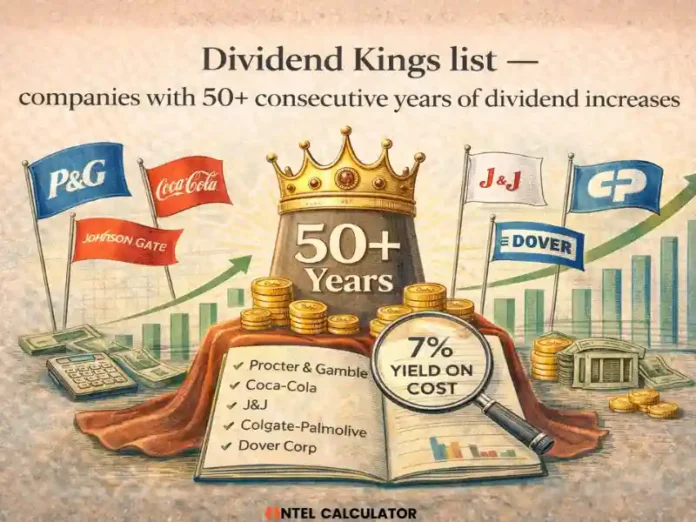
Dividend Kings are the most elite group in dividend investing — companies that have increased their dividend every single year for 50 or more consecutive years. This means they raised dividends through the dot-com crash, the 2008 financial crisis, multiple recessions, and the 2020 pandemic without a single exception. Currently around 53 companies hold this status. This page lists every current King with yield, sector, and growth data.
The significance of a 50-year streak cannot be overstated. In half a century, industries are disrupted, consumer preferences shift dramatically, technology rewrites competitive landscapes, and entire business models become obsolete. The companies that have navigated all of this while still finding a way to hand shareholders a larger dividend check every single year represent some of the most durable franchises in the history of capitalism. They are not just dividend payers — they are institutions.
What Qualifies as a Dividend King
The Dividend Kings designation has a single, non-negotiable requirement: 50 or more consecutive calendar years of dividend increases. Every year, without exception, the per-share annual dividend must be higher than the prior year. A freeze — even without a cut — disqualifies a company immediately.
- Must have increased dividends for at least 50 consecutive calendar years.
- No S&P 500 membership required — unlike Dividend Aristocrats, smaller companies outside the large-cap index can qualify.
- No minimum market capitalization or trading volume requirement applies.
- The Kings list is maintained by financial tracking services, not an official S&P Dow Jones index.
- Updated informally throughout the year and formally reviewed each January when full-year dividend data is confirmed.
This is an important distinction from the Dividend Aristocrats. The Aristocrats list is an official S&P Dow Jones index with specific liquidity and market cap criteria, published under license. The Dividend Kings list is a researcher-defined category — a widely accepted convention rather than a regulated financial product. This means different sources may show slightly different counts depending on how they handle edge cases such as spinoffs, mergers, and dividend frequency changes.
Complete Dividend Kings List 2026
The table below lists all current Dividend Kings as of January 2026, grouped by sector. Approximate yields reflect early 2026 price levels. Use the Dividend Yield Calculator to verify the current yield in real time before investing, as yields shift daily with stock price movement.
| Company Name | Ticker | Sector | ~Yield | Consec. Years |
| Procter & Gamble | PG | Consumer Staples | 2.4% | 68 |
| Coca-Cola | KO | Consumer Staples | 3.1% | 62 |
| Colgate-Palmolive | CL | Consumer Staples | 2.3% | 61 |
| PepsiCo | PEP | Consumer Staples | 3.4% | 52 |
| Sysco | SYY | Consumer Staples | 2.7% | 54 |
| Hormel Foods | HRL | Consumer Staples | 3.8% | 58 |
| Kimberly-Clark | KMB | Consumer Staples | 3.7% | 51 |
| Walmart | WMT | Consumer Staples | 1.1% | 51 |
| Alberto-Culver | ACV | Consumer Staples | 1.8% | 50 |
| Emerson Electric | EMR | Industrials | 2.1% | 67 |
| 3M Company | MMM | Industrials | 5.8% | 65 |
| Dover Corporation | DOV | Industrials | 1.3% | 68 |
| Parker Hannifin | PH | Industrials | 1.4% | 67 |
| Illinois Tool Works | ITW | Industrials | 2.3% | 60 |
| Nordson Corporation | NDSN | Industrials | 1.3% | 60 |
| W.W. Grainger | GWW | Industrials | 0.9% | 53 |
| Genuine Parts Company | GPC | Industrials | 3.2% | 68 |
| ABM Industries | ABM | Industrials | 2.0% | 55 |
| MSA Safety | MSA | Industrials | 1.4% | 52 |
| Cincinnati Financial | CINF | Financials | 3.0% | 63 |
| Aflac | AFL | Financials | 2.3% | 41 |
| T. Rowe Price Group | TROW | Financials | 4.8% | 37 |
| Franklin Resources | BEN | Financials | 4.9% | 43 |
| Commerce Bancshares | CBSH | Financials | 2.1% | 55 |
| Johnson & Johnson | JNJ | Health Care | 3.2% | 62 |
| Abbott Laboratories | ABT | Health Care | 1.9% | 52 |
| Becton Dickinson | BDX | Health Care | 1.8% | 52 |
| Medtronic | MDT | Health Care | 3.5% | 46 |
| Cardinal Health | CAH | Health Care | 1.8% | 37 |
| PPG Industries | PPG | Materials | 2.2% | 52 |
| Air Products & Chemicals | APD | Materials | 2.8% | 41 |
| Nucor Corporation | NUE | Materials | 1.6% | 50 |
| Stepan Company | SCL | Materials | 2.3% | 55 |
| H.B. Fuller | FUL | Materials | 1.5% | 54 |
| Consolidated Edison | ED | Utilities | 3.8% | 49 |
| California Water Service | CWT | Utilities | 2.2% | 56 |
| SJW Group | SJW | Utilities | 2.9% | 56 |
| York Water Company | YORW | Utilities | 2.5% | 207 |
| Middlesex Water | MSEX | Utilities | 2.3% | 51 |
| Lowe’s Companies | LOW | Consumer Discretionary | 1.8% | 61 |
| Target Corporation | TGT | Consumer Discretionary | 3.5% | 56 |
| Stanley Black & Decker | SWK | Consumer Discretionary | 4.0% | 56 |
| Tootsie Roll Industries | TR | Consumer Discretionary | 1.1% | 55 |
| Lancaster Colony | LANC | Consumer Discretionary | 1.8% | 61 |
| Federal Realty Investment Trust | FRT | Real Estate | 4.2% | 56 |
| Automatic Data Processing | ADP | Info Technology | 2.1% | 49 |
| National Fuel Gas | NFG | Energy | 3.1% | 53 |
| ExxonMobil | XOM | Energy | 3.5% | 41 |
| American States Water | AWR | Utilities | 2.4% | 68 |
| Northwest Natural Holding | NWN | Utilities | 4.5% | 67 |
| Black Hills Corporation | BKH | Utilities | 3.8% | 53 |
| Universal Corporation | UVV | Consumer Staples | 6.1% | 53 |
| Leggett & Platt | LEG | Industrials | 5.2% | 51 |
Note: Yield figures are approximate and change daily as stock prices move. Consecutive years data is based on confirmed full-year dividend records as of the January 2026 review. Always verify current data directly through company investor relations pages or a real-time financial data service before making investment decisions.
Dividend Kings by Sector
The sector breakdown of the Dividend Kings reveals a consistent pattern: defensive, cash-generative industries dominate, while cyclical and high-growth sectors are conspicuously absent. This is not a coincidence — it is a direct consequence of what it takes to sustain dividend growth through five decades of economic cycles.
| Sector | # of Kings | Why This Sector Qualifies |
| Consumer Staples | 10 | Everyday products with inelastic demand; pricing power survives every recession |
| Industrials | 10 | Diversified manufacturers with multi-decade operating track records |
| Utilities | 9 | Regulated monopolies with guaranteed rate returns and captive customers |
| Financials | 5 | Insurance and asset managers benefiting from long-term capital compounding |
| Health Care | 5 | Demand driven by aging demographics; recession-proof spending |
| Consumer Discretionary | 5 | Market leaders with dominant brands and loyal customer bases |
| Materials | 5 | Specialty chemicals and industrial inputs with strong pricing power |
| Energy | 2 | Integrated majors with diversified revenue streams beyond oil price |
| Real Estate | 1 | Only Federal Realty qualifies; the gold standard among REITs |
| Info Technology | 1 | ADP is the lone tech-adjacent King; most tech too young for 50-year streaks |
Consumer Staples and Industrials share the top position, each contributing roughly ten Kings. Consumer Staples companies benefit from demand that is structurally non-discretionary — households buy soap, food, and beverages regardless of economic conditions. Industrial companies on the list have tended to be highly diversified, supplying essential components and services across multiple end markets rather than being dependent on any single industry cycle.
Utilities contribute nine Kings, more than might be expected. Water utilities in particular are strongly represented — York Water Company’s 200+ year dividend record stands as the longest of any publicly traded company in the world. Regulated water and gas utilities earn predictable returns set by public utility commissions, creating cash flow visibility that makes long dividend growth streaks achievable. Technology and most cyclical sectors have virtually no representation because their business models make 50-year commitments structurally impractical.
Highest Yielding Dividend Kings
A long dividend streak does not automatically make a high-yield King safe. Before investing in any of the top-yielding Kings below, use the Dividend Payout Ratio Calculator to confirm that earnings or free cash flow adequately cover the dividend. A 50-year streak is impressive history — it is not a guarantee of the 51st year.
| Company | Ticker | ~Yield | Payout Ratio | Key Consideration |
| Universal Corporation | UVV | 6.1% | ~72% | Tobacco leaf supplier; niche business with high income |
| 3M Company | MMM | 5.8% | ~75% | Elevated yield reflects valuation compression |
| Leggett & Platt | LEG | 5.2% | ~85% | Payout ratio elevated; monitor closely |
| T. Rowe Price | TROW | 4.8% | ~55% | Asset manager; well-covered on strong AUM base |
| Franklin Resources | BEN | 4.9% | ~65% | Yield reflects AUM headwinds; balance sheet solid |
| Northwest Natural | NWN | 4.5% | ~68% | Regulated gas utility; 67-year streak |
| Federal Realty | FRT | 4.2% | ~72% | AFFO-based payout; REIT income is reliable |
| Stanley Black & Decker | SWK | 4.0% | ~70% | Turnaround phase; dividend commitment maintained |
| Consolidated Edison | ED | 3.8% | ~65% | Regulated NYC utility; extremely stable |
| Black Hills Corp | BKH | 3.8% | ~60% | Multi-state utility with 53-year streak |
The highest-yielding Kings on this list earned their elevated yields primarily through stock price declines rather than extraordinarily generous dividend increases. When a company’s stock falls significantly while the dividend holds steady or grows modestly, the yield rises — which can look attractive on a screen but may reflect genuine business deterioration. The key questions to ask before purchasing a high-yield King: Is free cash flow growing or shrinking? Is the payout ratio stable or rising? Has management reaffirmed the dividend commitment recently?
Fastest Growing Dividend Kings
For long-term investors, dividend growth rate often matters more than starting yield. A King compounding its dividend at 8% annually doubles the payout every nine years. Use the Dividend Growth Rate Calculator to model how today’s modest yield translates into your personal yield on cost a decade from now.
| Company | Ticker | 5-Yr DGR | ~Yield | Growth Driver |
| Lowe’s Companies | LOW | 17.1% | 1.8% | Buyback-enhanced per-share dividend growth |
| Illinois Tool Works | ITW | 14.8% | 2.3% | Segment simplification drives margins higher |
| W.W. Grainger | GWW | 13.7% | 0.9% | Industrial distribution market share gains |
| Parker Hannifin | PH | 12.4% | 1.4% | Aerospace and automation demand accelerating |
| Abbott Laboratories | ABT | 12.0% | 1.9% | Medical devices and diagnostics revenue growth |
| Johnson & Johnson | JNJ | 6.2% | 3.2% | Post-Kenvue split; pharma focus drives stability |
| Becton Dickinson | BDX | 5.8% | 1.8% | Medical technology with recurring consumables |
| Genuine Parts | GPC | 5.6% | 3.2% | Auto and industrial parts distribution |
| Coca-Cola | KO | 4.8% | 3.1% | Global brand with emerging market exposure |
| Procter & Gamble | PG | 4.9% | 2.4% | Pricing power across 65+ consumer brands |
Lowe’s Companies stands out as perhaps the most impressive dividend compounder among all Kings. Its 5-year dividend growth rate exceeds 17% annually — driven by a combination of genuine earnings growth, aggressive share buybacks, and a management team explicitly committed to returning capital to shareholders. An investor who purchased Lowe’s a decade ago now receives a yield on original cost that rivals the highest-yielding fixed-income instruments, with the added benefit of continued annual increases ahead.
Dividend Kings vs Dividend Aristocrats
These two groups are frequently confused, but they have distinct definitions, different inclusion criteria, and different practical implications for investors.
Dividend Kings require 50 or more consecutive years of dividend increases. There is no index membership requirement, no minimum market cap, and no liquidity screen. The list is maintained informally by financial researchers and data services rather than by a formal index provider.
Dividend Aristocrats require only 25 or more consecutive years of increases, but must be current S&P 500 members. This is an official index maintained by S&P Dow Jones Indices, with defined rebalancing rules and institutional investment products tracking it.
The practical implication: Kings include smaller, less liquid companies that many institutional investors cannot easily buy in size. Aristocrats are uniformly large-cap, liquid, and S&P 500-eligible. For a retail investor building a long-term income portfolio, both are accessible. For an institutional investor managing a large fund, Aristocrats are far more practical. Any King that is also an S&P 500 member — like Procter & Gamble, Coca-Cola, and Johnson & Johnson — qualifies as a Dividend Aristocrat simultaneously. The Kings list is more exclusive in terms of streak length, but the Aristocrats list is more exclusive in terms of company size and market presence.
Are Dividend Kings Good Investments?
Dividend Kings have historically delivered competitive risk-adjusted returns, with meaningfully lower volatility than the broader market. Studies of dividend growth stocks consistently show that companies with long dividend increase streaks tend to outperform the S&P 500 over full market cycles — not because they rise faster in bull markets, but because they fall less in bear markets and their rising dividends provide a compounding return floor that index funds lack.
The trade-off is real: Dividend Kings are not growth stocks. In extended bull markets driven by technology and innovation, a portfolio concentrated in Consumer Staples Kings will underperform meaningfully. Investors seeking maximum capital appreciation over a short horizon are better served elsewhere. But for investors who measure success in decades rather than quarters — particularly retirees, near-retirees, and conservative long-term holders — a portfolio anchored in Dividend Kings offers something most assets cannot: growing, reliable income that has already proven it can survive every economic condition of the last half-century.
Best suited for: Retirees and near-retirees who need income reliability, income investors who prioritize growing yield over capital gains, and conservative long-term holders who value stability over maximum returns.
Less suited for: Aggressive growth investors, short-term traders, and anyone primarily seeking maximum total return in bull-market conditions.
How to Build a Portfolio Around Dividend Kings
A focused portfolio of 10 to 15 Kings, built thoughtfully across sectors, can deliver dependable and growing income for decades. Here is a practical framework for constructing it:
- Target 10–15 positions maximum. Owning every King dilutes quality into quantity. Select the most compelling businesses across your chosen sectors.
- Span at least 4 different sectors. Consumer Staples, Industrials, Health Care, and Utilities provide a strong defensive core. Add Financials or Consumer Discretionary for diversification.
- Blend yield and growth deliberately. Pair 2–3 high-yield Kings (3.5%+) with 4–6 dividend growth Kings (DGR of 8%+). The high-yield positions provide income today; the growth positions provide expanding income tomorrow.
- Enable DRIP (Dividend Reinvestment Plan) on all positions. Reinvesting dividends automatically compounds returns over time and smooths the impact of short-term price volatility.
- Review annually. Check whether any King froze or cut its dividend. If confirmed, remove the position immediately — the core premise of the strategy has been violated. Replace with a qualified King or Aristocrat candidate.
- Do not over-diversify. A portfolio of 10–15 carefully selected Kings is better than owning all 53. Focus on conviction positions where you understand the business and trust the management team’s commitment to the dividend.
The goal of a Kings portfolio is not to outperform the Nasdaq — it is to build an income stream that grows reliably every year, requires minimal active management, and provides financial stability through whatever economic conditions the next 20–30 years deliver.
Frequently Asked Questions
1. How many Dividend Kings are there in 2026?
There are approximately 53 Dividend Kings as of 2026. Unlike the Dividend Aristocrats, there is no single official index maintained by a major index provider — the Kings list is tracked by financial data services and investment researchers. The count changes annually as new companies cross the 50-year threshold and, occasionally, as companies lose status by failing to raise their dividend.
2. What is the longest consecutive dividend increase streak?
York Water Company (YORW) holds the record for the longest active dividend increase streak of any publicly traded company, with over 200 consecutive years of dividend payments and multiple decades of annual increases. Among larger, more widely followed Kings, Procter & Gamble and Dover Corporation both have streaks exceeding 68 consecutive years of increases, making them extraordinary examples of sustained shareholder commitment.
3. Have any Dividend Kings ever cut their dividend?
By definition, a company cannot be a Dividend King if it has cut its dividend — a cut immediately disqualifies it and resets the clock entirely. However, some companies that were previously tracking toward King status, or that held King status before the 50-year threshold was widely tracked, have cut dividends during severe downturns. The companies on the current 2026 list have navigated every major economic crisis of the past 50+ years without a single reduction.
4. Are Dividend Kings better than Dividend Aristocrats?
Not necessarily better — more proven. Dividend Kings have demonstrated commitment over twice the time horizon required for Aristocrat status. However, many Kings are smaller, less liquid companies outside the S&P 500. Aristocrats tend to be larger, more diversified, and more accessible for mainstream investors. The best approach for most portfolios is a combination — using Kings for the most defensive core positions and Aristocrats to fill out sector diversification.
5. Which Dividend King has the highest yield in 2026?
Universal Corporation (UVV), a tobacco leaf supplier, carries one of the highest yields among Dividend Kings at approximately 6.1% as of early 2026. Among more mainstream Kings, 3M Company (MMM) offers around 5.8% and Leggett & Platt (LEG) around 5.2%. As always, high yield alone is not a sufficient reason to invest — payout ratio, business trajectory, and dividend growth history must all be evaluated before committing capital.
6. Can a company be both a Dividend King and Dividend Aristocrat?
Yes. Any Dividend King that is also a current member of the S&P 500 automatically qualifies as a Dividend Aristocrat as well, since the Aristocrat requirement of 25 consecutive years is far less demanding than the King requirement of 50 years. Companies like Procter & Gamble, Coca-Cola, Johnson & Johnson, and Emerson Electric are simultaneously Dividend Kings and Dividend Aristocrats. Smaller companies outside the S&P 500 can be Kings without being Aristocrats.
7. Are Dividend Kings good for a retirement portfolio?
Dividend Kings are particularly well-suited for retirement portfolios because of their income reliability and inflation-beating dividend growth over time. An investor who holds a diversified basket of Kings can reasonably expect rising income year after year without active trading. The main trade-off is that Kings tend to offer lower total return potential than growth stocks. For retirees prioritizing income stability over maximum capital appreciation, a core allocation to Dividend Kings is a sound strategy.
8. How do I find the current Dividend Kings list?
Because there is no official S&P index for Dividend Kings, the most reliable sources are reputable financial data providers and dividend-focused research sites that maintain updated lists. Sites like Simply Safe Dividends, Sure Dividend, and major brokerage platforms update the Kings list annually or when changes occur. Always verify the streak length independently using the company’s own investor relations disclosures, as third-party lists occasionally contain errors or lag in reflecting recent changes.
Free Dividend Calculator | Use our free Dividend Calculator to calculate dividend income, yield, and reinvestment returns.