
Last updated: Oct 20, 2026
Payroll Tax Calculator

Payroll Tax Calculator (2026): Employee Net Pay and Employer Taxes
In 2026 an employee pays 7.65% FICA (6.2% Social Security on the first $184,500 of wages plus 1.45% Medicare) and federal and state income tax withholding. An employer pays a matching 7.65%, plus FUTA of $42 per employee and a state unemployment tax (SUTA). On a $60,000 salary in Texas, employer payroll taxes are about $4,875 a year, or 8.1% of wages.
A payroll tax calculator estimates the taxes taken from an employee’s paycheck and the taxes an employer owes on top of wages. This payroll tax calculator shows both sides on one page. Employees see their take-home pay. Employers see what a worker really costs.
Payroll taxes are also called employment taxes. They include FICA (Social Security and Medicare), federal income tax withholding, state income tax withholding and the unemployment taxes FUTA and SUTA. The same tool works as an employee payroll tax calculator, an employer payroll tax calculator and a payroll tax withholding calculator. It is also an employment tax calculator for small employers.
This page is the parent of our payroll and paycheck calculators. The paycheck calculator, the bonus tax calculator, the overtime pay calculator and the 401(k) calculator each zoom in on one part. You can browse every tool in our finance calculators hub.
Payroll tax calculator
Use the calculator below. It is a free online payroll calculator with no sign-up. It has twelve cards, and each card works on its own. Results from one card pre-fill the next card, and you can overwrite any value.
What each of the 12 cards calculates
Each card answers one question, so you can start with the question you have.
| Card | What it answers | Key inputs | Key outputs |
|---|---|---|---|
| 1. Paycheck (gross to net) | What do I take home each check? | Gross pay, frequency, filing status, state, 401(k) % | Net pay, federal, FICA, state tax |
| 2. Federal withholding | How much federal tax do I owe? | Annual wages, filing status, W-4 steps 3 and 4 | Bracket table, marginal and effective rate |
| 3. FICA and Medicare | What do Social Security and Medicare cost? | Annual wages, pre-tax benefits | Employee and employer FICA |
| 4. Pre-tax savings | What do my deductions really cost? | 401(k), HSA, Section 125 | Tax saved, net cost |
| 5. Employer true cost | What does this hire cost? | Wages, benefits, match, workers comp | Total cost, burden rate |
| 6. FUTA and SUTA | What are my unemployment taxes? | State, team size, wage | Tax per employee and total |
| 7. Hourly and overtime | What is my gross pay? | Rate, hours, overtime multiplier | Weekly and annual gross |
| 8. Bonus tax | What do I keep from a bonus? | Bonus, wages, method | Flat versus aggregate withholding |
| 9. Annual projection | How does pay change by month? | Salary, 401(k) % | Monthly net, Social Security cap month |
| 10. Employee vs 1099 | Which route pays more? | Gross, expenses | Net pay, break-even rate |
| 11. 401(k) optimizer | How much should I contribute? | Salary, match, age | Take-home versus savings |
| 12. Deposit schedule | When must I deposit taxes? | Monthly liability, lookback | Monthly or semi-weekly schedule |
The calculator has 12 cards: paycheck, federal withholding, FICA, pre-tax savings, employer true cost, FUTA and SUTA, hourly and overtime, bonus tax, annual projection, employee versus 1099, 401(k) optimizer and deposit schedule.
Employers: go straight to Card 5 (employer true cost), Card 6 (FUTA and SUTA) and Card 12 (deposit schedule). Employees: start with Card 1, which also works as a net pay calculator, a take-home pay calculator and a salary-after-tax calculator.
Need only one part of the picture? These single-purpose tools go deeper:
- Take-home pay only: the paycheck calculator and the gross to net calculator.
- Federal tax only: the federal tax bracket calculator and the income tax calculator.
- Bonus only: the bonus tax calculator.
- Retirement only: the 401(k) calculator.
What you need before you start
Gather these seven items first:
- Gross pay per pay period, or your annual salary.
- Pay frequency: weekly, bi-weekly, semi-monthly or monthly.
- Filing status from your W-4.
- Your work state.
- Pre-tax deductions, such as 401(k), health premiums or HSA.
- Year-to-date (YTD) wages, if you are mid-year.
- Post-tax deductions, such as garnishments.
Who should use it: employees who want to calculate net pay before accepting a job or a raise; small business owners who need a small business payroll calculator to price a new hire; bookkeepers who check payroll runs and deposits; and anyone asking, “Why is my check smaller than I expected?”
How to read your results
Every result has a number and a short plain-English explanation. The main box shows your headline answer. A progress bar shows the share of pay you keep, and a chart sits below the numbers. Tap or hover over the chart to see exact values. Use the plus and minus buttons to zoom. Open the “Formula, concept and expert note” section under each result to see the math.
Why it matters: payroll mistakes are costly. A wrong wage base, a missed deposit or a misclassified worker can lead to IRS penalties. The penalties section shows the exact percentages.
What are payroll taxes?
Payroll taxes are taxes calculated on wages and paid to the government by the employer, the employee or both. The IRS groups the federal ones under the name employment taxes (IRS Publication 15).
Six taxes make up payroll tax in practice: Social Security, Medicare, federal income tax withholding, state income tax withholding, the Federal Unemployment Tax Act (FUTA) tax and the State Unemployment Tax Act (SUTA) tax.
Employee share versus employer share
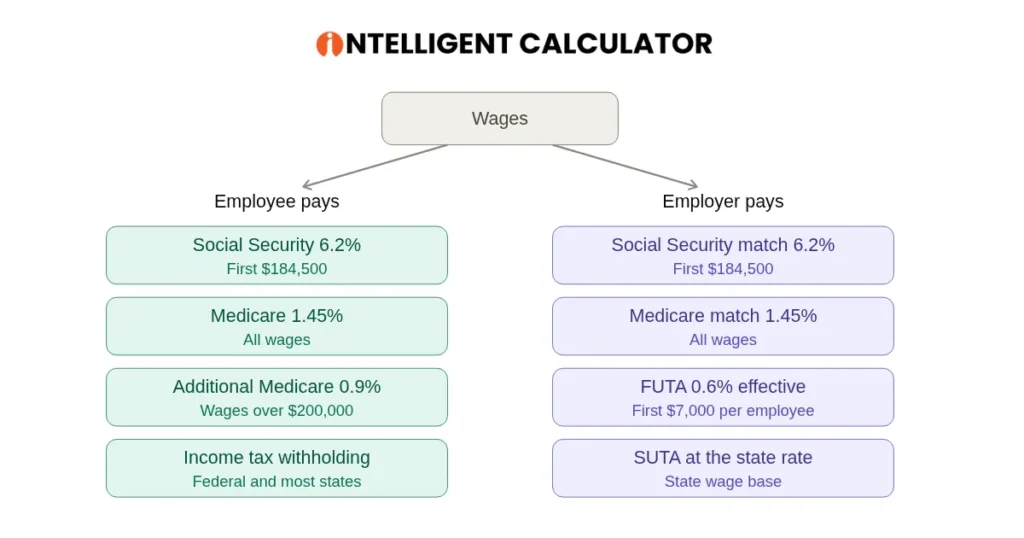
Here is who pays each tax:
- Social Security: 6.2% from the employee and 6.2% from the employer.
- Medicare: 1.45% from each.
- Additional Medicare Tax: 0.9% from the employee only, on wages above $200,000.
- Federal income tax: withheld from the employee. The employer collects it and sends it to the IRS.
- State income tax: withheld from the employee in most states.
- FUTA: paid by the employer only.
- SUTA: paid by the employer in most states. A few states, for example Alaska, New Jersey and Pennsylvania, also withhold a small amount from employees.
The drawing below shows the same split at a glance.
Gross pay by pay frequency
Gross pay is your pay before anything is removed. Pay frequency decides how big each check is.
| Pay frequency | Pay periods per year | Gross per check on $60,000 |
|---|---|---|
| Weekly | 52 | $1,153.85 |
| Bi-weekly | 26 | $2,307.69 |
| Semi-monthly | 24 | $2,500.00 |
| Monthly | 12 | $5,000.00 |
On a $60,000 salary, a weekly check is $1,153.85, a bi-weekly check $2,307.69, a semi-monthly check $2,500.00 and a monthly check $5,000.00.
Bi-weekly (also written biweekly) means every two weeks. Semi-monthly means twice a month, such as the 15th and the last day. Do not confuse either with bi-monthly, which can mean twice a month or every two months. Bi-weekly pay produces 26 checks. Semi-monthly pay produces 24 larger checks. Annual pay is the same either way.
The 27th paycheck. A 26-check year has 364 days. So a 27th bi-weekly payday happens only when the first payday falls on January 1, or on January 1 or 2 in a leap year. The same rule applies to a 53rd weekly payday. A leap year alone does not create one.
Pay frequency also drives withholding. The payroll system multiplies each check by the number of periods to estimate annual wages. Then it applies tax tables and divides the result back down.
Which pay frequency should an employer choose? Bi-weekly pay lines up with weekly overtime calculations for hourly staff and produces two “extra” paydays in some years. Semi-monthly pay keeps 24 identical periods, which many salaried teams prefer. Both are lawful in most places, but some states set a minimum pay frequency, so check your state before you choose.
To convert between pay bases, use the salary to hourly calculator or the annual salary calculator. For a mid-year start date, use the prorated salary calculator. For bi-weekly hourly staff, see the biweekly overtime calculator.
Pre-tax deductions and the FICA matrix
Pre-tax deductions come out before income tax. Common examples are 401(k) deferrals, health insurance premiums, HSA contributions and flexible spending accounts. They lower your taxable wages. But not every pre-tax deduction lowers every tax. Treatment varies by deduction type, so check IRS Publication 15-B and Publication 15 for your plan.
| Deduction | Reduces federal income tax wages? | Reduces FICA wages? |
|---|---|---|
| Traditional 401(k) deferral | Yes | No |
| Roth 401(k) contribution | No | No |
| Health premiums (Section 125 plan) | Yes | Yes |
| HSA through payroll (cafeteria plan) | Yes | Yes |
| Health FSA (2026 limit $3,400) | Yes | Yes |
| Commuter benefits (qualified) | Yes | Yes |
| Wage garnishment | No | No |
Health premiums through a Section 125 plan, payroll HSA, health FSA and qualified commuter benefits reduce both income tax and FICA wages. A traditional 401(k) reduces income tax only. Roth 401(k) contributions and garnishments reduce neither.
Pro tip: where an employer offers an HSA, a health FSA or commuter benefits through a Section 125 plan, those dollars avoid both income tax and the 7.65% FICA tax. A 401(k) dollar avoids only income tax. These benefits differ in eligibility and limits, so they are not interchangeable.
Warning: state rules differ. Some states tax 401(k) deferrals or HSA contributions that the federal government does not. Card 4 compares each choice and shows the real cost after tax savings. For retirement planning, see the 401(k) calculator and the Roth IRA calculator.
2026 401(k) limits. The employee deferral limit is $24,500. The catch-up for age 50 and older is $8,000, and the catch-up for ages 60 to 63 is $11,250. Employees age 50 or older whose prior-year FICA wages from the employer were above $150,000 must make catch-up contributions as Roth contributions starting January 1, 2026 (IRS Notice 2025-67 and the final SECURE 2.0 regulations).
FICA: Social Security and Medicare
FICA stands for the Federal Insurance Contributions Act. It funds Social Security and Medicare. The Social Security part is also called OASDI, for Old-Age, Survivors, and Disability Insurance.
| Tax | Employee rate | Employer rate | 2026 limit |
|---|---|---|---|
| Social Security | 6.2% | 6.2% | First $184,500 of wages |
| Medicare | 1.45% | 1.45% | No limit |
| Additional Medicare | 0.9% | None | Wages over $200,000 |
In 2026 the employee and the employer each pay 6.2% Social Security tax on the first $184,500 of wages and 1.45% Medicare tax on all wages. Only the employee pays the extra 0.9% above $200,000.
The most any worker pays in Social Security tax in 2026 is $11,439. The employer pays the same amount. These figures follow the Social Security Administration’s wage base table.
High earners. Employers must withhold the 0.9% Additional Medicare Tax once wages pass $200,000. This applies to every filer, whether single or married. Married joint filers settle any difference on their tax return (Form 8959), where the threshold is $250,000.
Two employers. If you work for two employers and your combined Social Security wages pass $184,500, each employer still withholds up to the base. You claim the excess as a credit on your tax return. Publication 505 explains how withholding credits work.
Federal income tax withholding (W-4 and Pub 15-T)
Federal income tax is not FICA. The employee’s Form W-4 (often searched as W4) tells the employer how much to withhold. The IRS method appears in Publication 15-T. Card 2 works as a payroll tax withholding calculator for these rules.
Payroll tax applies to wages from the first dollar. Income tax applies after the standard deduction and your bracket. The Net Investment Income Tax is not a payroll tax. It applies to investment income at high income levels and is never withheld from wages.
Here are the 2026 rates for single filers, from IRS Revenue Procedure 2025-32:
| Rate | Taxable income |
|---|---|
| 10% | Up to $12,400 |
| 12% | $12,401 to $50,400 |
| 22% | $50,401 to $105,700 |
| 24% | $105,701 to $201,775 |
| 32% | $201,776 to $256,225 |
| 35% | $256,226 to $640,600 |
| 37% | Over $640,600 |
For a single filer in 2026, federal income tax rates are 10% up to $12,400, 12% to $50,400, 22% to $105,700, 24% to $201,775, 32% to $256,225, 35% to $640,600 and 37% above that.
The 2026 standard deduction is $16,100 for single filers, $32,200 for married couples filing jointly and $24,150 for heads of household. Your marginal rate applies only to the last dollars you earn. It never applies to all your pay. To see every filing status, use the federal tax bracket calculator or the income tax calculator.
Claiming “exempt” on a W-4. Some workers claim exemption from withholding. This is allowed only if they owed no federal tax last year and expect none this year. A low income alone does not qualify. The employee must renew this claim every year.
No W-4 on file. Without a W-4, the employer must withhold as if the worker is single with no adjustments.
Bonuses and supplemental wages
Bonus tax withholding follows the supplemental wage rules. A bonus is supplemental wages, which are pay outside regular wages. Employers can withhold a flat 22% on bonuses instead of using the regular tables. Withholding rises to 37% on supplemental wages above $1 million in a year. The employer may also use the aggregate method, which adds the bonus to regular pay and withholds on the total.
The 22% is withholding, not the final tax. Your real tax is settled on your return. Card 8 compares flat and aggregate withholding, and the bonus tax calculator goes deeper on bonuses alone.
Overtime, tips and the 2026 deductions
Overtime pay is regular wages for payroll tax purposes. Income tax withholding and FICA apply to it like any other pay. Card 7 calculates gross pay with overtime. The overtime pay calculator and the overtime tax calculator go further.
New for 2026. Under Public Law 119-21 (the One Big Beautiful Bill Act), employees may deduct up to $12,500 of qualified overtime ($25,000 on a joint return) and up to $25,000 of qualified tips for tax years 2025 through 2028. Both deductions phase out above $150,000 of modified adjusted gross income ($300,000 joint).
The deduction is claimed on the tax return, not through payroll. Employers do not reduce withholding for it. Starting with 2026 Forms W-2, employers report qualified overtime in Box 12 with code TT and qualified tips with code TP. Only overtime required under the Fair Labor Standards Act (FLSA) qualifies, so some state-law overtime, such as daily overtime in California, may not. Try the no tax on overtime calculator and the California overtime calculator.
State and local payroll taxes
Most states tax wages. Nine states do not: Alaska, Florida, Nevada, New Hampshire, South Dakota, Tennessee, Texas, Washington and Wyoming.
Several states add payroll programs beyond income tax and SUTA, such as state disability insurance (SDI) and paid family and medical leave. Examples include California, New Jersey, New York, Rhode Island and Washington. These programs can reduce net pay, and the calculator does not include them. Some cities and school districts also add local earned-income or wage taxes, for example in Pennsylvania, Ohio and New York City.
Employees who work in more than one state. Withholding can depend on where the work happens and where the employee lives. Reciprocity agreements between some states change the rules. Check each state’s revenue department before you run payroll. See the remote-employee section below.
To run the payroll tax calculator by state, pick your work state in Card 1 or Card 6. The calculator estimates state income tax with an effective rate for each state. Treat that number as a guide, not a filing figure.
Post-tax deductions and net pay
Post-tax deductions come out after taxes. Examples are Roth 401(k) contributions, union dues and wage garnishments. Garnishments are court-ordered or agency-ordered payments. They do not reduce taxable wages, and each one follows legal limits set by federal and state law.
Withholding versus final tax liability
Withholding is a prepayment of your income tax. Your final tax liability is settled when you file your return. If too little was withheld you owe a balance, and if too much was withheld you receive a refund, even when payroll did everything correctly. Update your W-4 if the gap surprises you.
How to read a pay stub line by line
Your pay stub lists every step of the gross-to-net path. Read it in this order:
- Pay period and pay date. Confirms the period the check covers.
- Gross pay. Your pay before anything is removed (Card 1).
- Pre-tax deductions. 401(k), health premiums, HSA, FSA (Card 4).
- Federal income tax. Withholding based on your W-4 (Card 2).
- Social Security and Medicare. Your 6.2% and 1.45% shares (Card 3).
- State and local items. State income tax and any state programs.
- Post-tax deductions. Roth contributions, dues, garnishments.
- Net pay. What is deposited in your account.
- Year-to-date totals. Show when you reach the Social Security wage base (Card 9).
Employer payroll taxes: FICA match, FUTA and SUTA
Employers pay four taxes on wages: the Social Security match, the Medicare match, FUTA and SUTA. These taxes never appear on the employee’s pay stub. Card 5 works as an employer payroll tax calculator, and Card 6 covers unemployment taxes. Employer payroll taxes are generally deductible as a business expense (see IRS Publication 535).
Employer FICA match
The employer matches the employee’s Social Security and Medicare tax dollar for dollar. That adds 7.65% on wages up to the Social Security wage base. Above the base, the employer pays only the 1.45% Medicare match. Employers do not match the 0.9% Additional Medicare Tax.
FUTA: the federal unemployment tax
FUTA is the Federal Unemployment Tax Act tax. Employers pay it. Employees never do. The rate is 6.0% on the first $7,000 of each employee’s wages. Most employers receive a credit of up to 5.4% for paying state unemployment tax on time. That leaves 0.6%, or $42 per employee.
FUTA credit reduction states. If a state owes money to the federal unemployment loan fund, its employers lose part of the credit. Their FUTA bill rises each year the loan stays unpaid. The U.S. Department of Labor publishes the affected states after year-end, so check the DOL credit reduction page each November.
Worked example. With a 1.2% credit reduction, FUTA becomes 0.6% + 1.2% = 1.8% of $7,000, which is $126 per employee instead of $42 (the Card 6 example for California).
Form 940 is the annual FUTA return, due January 31. FUTA deposits are due quarterly once your liability passes $500.
SUTA and SUI: state unemployment tax
SUTA means State Unemployment Tax Act. Many states call it SUI, for state unemployment insurance. Each state sets its own wage base and its own rate for new employers. After the first year, your rate depends on your layoff history.
The formula is simple: SUTA = taxable wages up to the state base × your tax rate. Michigan shows how it works. Its new-employer rate of 2.7% applies to the first $9,500 of wages. So 2.7% × $9,500 = $256.50 per employee.
SUTA rates by state (2026 calculator defaults)
The table lists the calculator’s default payroll tax rates for state unemployment: the new-employer rate and wage base for all 50 states and the District of Columbia. The last column multiplies the two to show the most SUTA a new employer would pay per employee.
| State | New-employer rate | Wage base | SUTA per employee at base |
|---|---|---|---|
| Alabama | 2.7% | $8,000 | $216.00 |
| Alaska | 1% | $54,200 | $542.00 |
| Arizona | 2% | $8,000 | $160.00 |
| Arkansas | 3.1% | $7,000 | $217.00 |
| California | 3.4% | $7,000 | $238.00 |
| Colorado | 1.7% | $27,200 | $462.40 |
| Connecticut | 2.8% | $26,100 | $730.80 |
| Delaware | 1.8% | $16,500 | $297.00 |
| District of Columbia | 2.7% | $9,000 | $243.00 |
| Florida | 2.7% | $7,000 | $189.00 |
| Georgia | 2.64% | $9,500 | $250.80 |
| Hawaii | 2.4% | $64,500 | $1,548.00 |
| Idaho | 1% | $55,300 | $553.00 |
| Illinois | 3.45% | $13,916 | $480.10 |
| Indiana | 2.5% | $9,500 | $237.50 |
| Iowa | 1% | $38,200 | $382.00 |
| Kansas | 2.7% | $14,000 | $378.00 |
| Kentucky | 2.7% | $11,400 | $307.80 |
| Louisiana | 1.21% | $7,700 | $93.17 |
| Maine | 2% | $12,000 | $240.00 |
| Maryland | 2.6% | $8,500 | $221.00 |
| Massachusetts | 2.42% | $15,000 | $363.00 |
| Michigan | 2.7% | $9,500 | $256.50 |
| Minnesota | 1% | $45,000 | $450.00 |
| Mississippi | 1% | $14,000 | $140.00 |
| Missouri | 2.38% | $9,000 | $214.20 |
| Montana | 1% | $45,300 | $453.00 |
| Nebraska | 1.25% | $9,000 | $112.50 |
| Nevada | 2.95% | $41,800 | $1,233.10 |
| New Hampshire | 1.7% | $14,000 | $238.00 |
| New Jersey | 2.8% | $43,300 | $1,212.40 |
| New Mexico | 1% | $33,200 | $332.00 |
| New York | 4.1% | $17,600 | $721.60 |
| North Carolina | 1% | $32,600 | $326.00 |
| North Dakota | 1.02% | $45,100 | $460.02 |
| Ohio | 2.7% | $9,000 | $243.00 |
| Oklahoma | 1.5% | $27,700 | $415.50 |
| Oregon | 2.4% | $54,300 | $1,303.20 |
| Pennsylvania | 3.8% | $10,000 | $380.00 |
| Rhode Island | 1.1% | $29,200 | $321.20 |
| South Carolina | 1.2% | $14,000 | $168.00 |
| South Dakota | 1.2% | $15,000 | $180.00 |
| Tennessee | 2.7% | $7,000 | $189.00 |
| Texas | 2.7% | $9,000 | $243.00 |
| Utah | 0.3% | $47,000 | $141.00 |
| Vermont | 1% | $14,800 | $148.00 |
| Virginia | 2.5% | $8,000 | $200.00 |
| Washington | 1% | $78,200 | $782.00 |
| West Virginia | 2.7% | $9,500 | $256.50 |
| Wisconsin | 3.05% | $14,000 | $427.00 |
| Wyoming | 1.2% | $32,400 | $388.80 |
New-employer defaults range from 0.3% in Utah to 4.1% in New York. Wage bases start at $7,000 in four jurisdictions (Arkansas, California, Florida, Tennessee) and reach $78,200 in Washington. The largest default cost per employee is $1,548.00 in Hawaii, and the smallest is $93.17 in Louisiana.
These are the calculator’s default estimates, not official notices. Rates change often, and your own rate depends on layoff history. Confirm your rate and wage base with your state workforce agency before you file. You can override the rate in Card 6.
Who should run payroll: you, a provider or a PEO?
Many small employers use a payroll provider or a professional employer organization (PEO) to run payroll and make deposits. Using a provider does not remove the employer’s responsibility for payroll taxes. A PEO shares some responsibilities by contract, so read the agreement. Either way, check that every deposit is made on time through EFTPS or your IRS online account.
What a new hire really costs at four salaries
Card 5 is a cost of an employee calculator. The true cost of an employee, also called the fully loaded cost or the labor burden, is wages plus employer payroll taxes, benefits, retirement match and insurance. Payroll tax is a smaller share of wages at higher pay because FUTA and SUTA are flat-dollar amounts and Social Security stops at the wage base.
This table uses the Texas defaults (FUTA $42, SUTA 2.7% × $9,000 = $243), before benefits:
| Salary | Employer FICA | FUTA | SUTA | Total payroll tax | Share of wages |
|---|---|---|---|---|---|
| $40,000 | $3,060 | $42 | $243 | $3,345 | 8.4% |
| $60,000 | $4,590 | $42 | $243 | $4,875 | 8.1% |
| $100,000 | $7,650 | $42 | $243 | $7,935 | 7.9% |
| $250,000 | $15,064 | $42 | $243 | $15,349 | 6.1% |
Employer payroll taxes are $3,345 on a $40,000 salary (8.4%), $4,875 on $60,000 (8.1%), $7,935 on $100,000 (7.9%) and $15,349 on $250,000 (6.1%).
A full budget. Card 5 with its defaults ($65,000 wage in Texas, $6,000 health benefits, a 3% retirement match and 1% workers’ compensation) returns a total annual cost of $78,857.50. That is $5,257.50 of employer payroll taxes and $8,600 of benefits and insurance, a burden rate of 21.3%, or $37.91 per hour over 2,080 hours. To price the insurance line, use the workers’ compensation insurance cost calculator.
To budget a first hire, follow these six steps:
- Start with the gross wage.
- Add 7.65% FICA up to the wage base.
- Add FUTA, $42 per employee unless the state is a credit reduction state.
- Add SUTA at the new-employer rate times the state wage base.
- Add workers’ compensation, health benefits and any retirement match.
- Add the cost of running payroll and a small buffer for rate changes after year one.
Rules of thumb such as “1.2 to 1.4 times salary” are only a guide. Use Card 5 to see the real number.
Why costs and paychecks change during the year
Three events change payroll tax during a year. First, the wage-base effect: an employee paid $210,000 reaches the Social Security wage base in November (the Card 9 default), so take-home pay rises and the employer’s cost falls for the rest of the year.
Second, front-loading: FUTA is fully paid once an employee has earned $7,000, which happens in the second month for a $60,000 salary. SUTA front-loads the same way until each state’s wage base is reached. Third, the January reset: wage bases restart, new rates take effect, and the employer should update the wage base, SUTA rate and deposit schedule.
Card 9 shows the month-by-month effect. To see how a raise changes the picture, use the pay raise calculator.
Worked examples
Each example shows every line. Use the calculator to check the numbers.
Example 1: $60,000 salary, bi-weekly, no state income tax
Maria earns $60,000 a year, paid bi-weekly in Texas. She is single and has no pre-tax deductions.
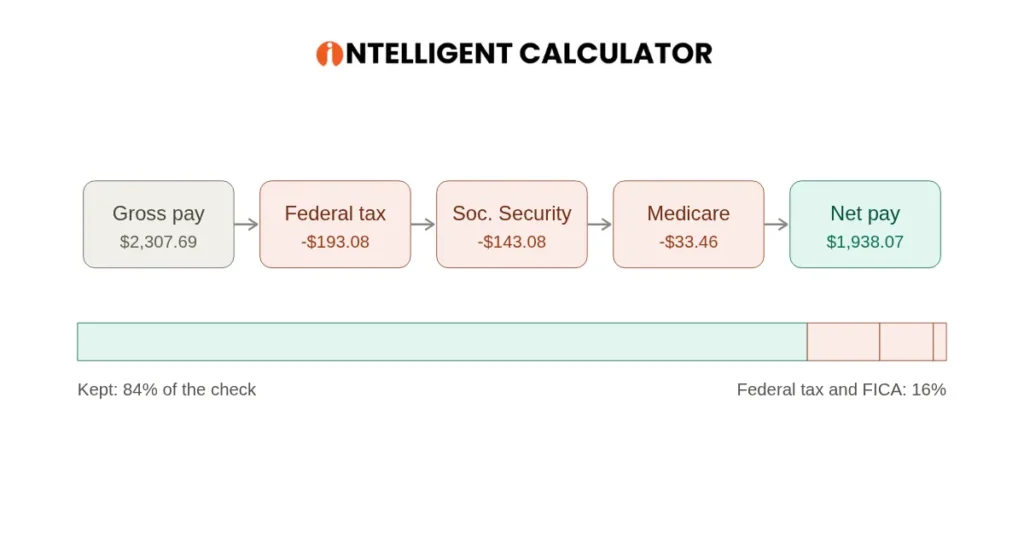
- Gross per check: $60,000 ÷ 26 = $2,307.69.
- Taxable annual wages: $60,000 − $16,100 = $43,900.
- Annual federal tax: 10% × $12,400 = $1,240, plus 12% × $31,500 = $3,780. Total $5,020, or $193.08 per check.
- Social Security: 6.2% × $2,307.69 = $143.08.
- Medicare: 1.45% × $2,307.69 = $33.46.
- Net pay: $2,307.69 − $193.08 − $143.08 − $33.46 = $1,938.07.
Maria’s annual take-home is about $50,390. About 16% of each check, $369.62, goes to federal income tax and FICA.
Rounding note. The calculator carries unrounded values, so Card 1 shows $1,938.08 for the same inputs. Rounding each line first, as above, gives $1,938.07.
The employer’s side:
| Item | Annual cost |
|---|---|
| Wages | $60,000 |
| Employer Social Security and Medicare | $4,590 |
| FUTA | $42 |
| SUTA (Texas default, 2.7% × $9,000) | $243 |
| Total before benefits | $64,875 |
Maria’s $60,000 salary costs her employer $64,875 before benefits: $4,590 FICA match, $42 FUTA and $243 Texas SUTA. Payroll taxes add about 8.1% to Maria’s wage cost.
Expert note: the 7.65% employer match comes from IRS Publication 15, and the withholding method comes from Publication 15-T. Compare this result with the paycheck calculator.
Example 2: same salary in a taxed state with pre-tax deductions
Now take a worker in Michigan with the same $60,000 salary, paid bi-weekly. She defers 5% to a 401(k) and pays $100 per check for health insurance through a Section 125 plan. We estimate state tax at a flat 4.25% for illustration.
- Gross per check: $2,307.69.
- 401(k): 5% × $2,307.69 = $115.38. Health premium: $100.00.
- FICA wages: $2,307.69 − $100 = $2,207.69. The 401(k) does not reduce them.
- Social Security: 6.2% × $2,207.69 = $136.88. Medicare: 1.45% × $2,207.69 = $32.01.
- Income tax wages: $2,307.69 − $115.38 − $100 = $2,092.31. Annualized, that is about $54,400.
- Annual federal tax: ($54,400 − $16,100) taxed through the 10% and 12% brackets = $4,348, or $167.23 per check.
- State tax: 4.25% × $2,092.31 = $88.92.
- Net pay: $2,307.69 − $115.38 − $100 − $167.23 − $136.88 − $32.01 − $88.92 = $1,667.27.
Compare this to Example 1. Her check is smaller because of the savings she chose and the state tax. But the premium alone saves $198.90 in FICA each year ($100 × 26 × 7.65%), because it lowers FICA wages.
Expert note: this example follows the cafeteria-plan rules in IRS Publication 15-B. Model other contribution levels with the 401(k) calculator.
Example 3: a high earner who hits the wage base
Daniel earns $250,000. He reaches the 2026 Social Security wage base of $184,500 in the fall.
- Social Security: 6.2% × $184,500 = $11,439.
- Medicare: 1.45% × $250,000 = $3,625.
- Additional Medicare: 0.9% × ($250,000 − $200,000) = $450.
- Employee FICA total: $15,514.
- Employer FICA total: $11,439 + $3,625 = $15,064.
After he reaches the cap, Social Security stops. His paychecks get bigger for the rest of the year. Card 9 shows this jump month by month.
Deposit schedules, deadlines and penalties
Employers must deposit withheld taxes on time. The monthly schedule and the semi-weekly deposit schedule are the two options. The IRS sets one of them, based on a lookback period. The lookback period is the four quarters ending June 30 of the prior year. For 2027, that means July 1, 2025 through June 30, 2026.
Monthly or semi-weekly depositor
| Lookback tax liability | Deposit schedule | Rule |
|---|---|---|
| $50,000 or less | Monthly | Deposit by the 15th of the next month |
| More than $50,000 | Semi-weekly | See next table |
| $100,000 or more owed on any day | Next business day | Deposit by the next business day |
With $50,000 or less of lookback liability an employer deposits monthly by the 15th of the next month. Above $50,000 it deposits semi-weekly. Owing $100,000 or more on any day requires a next-business-day deposit.
| Payday falls on | Deposit due |
|---|---|
| Wednesday, Thursday or Friday | The following Wednesday |
| Saturday, Sunday, Monday or Tuesday | The following Friday |
Wages paid Wednesday through Friday are deposited by the following Wednesday. Wages paid Saturday through Tuesday are deposited by the following Friday.
New employers are monthly depositors in their first year. Make deposits electronically through EFTPS or your IRS online account. Card 12 finds your monthly or semi-weekly schedule from your lookback liability.
Key payroll tax forms and due dates
- Form 941: quarterly return, due April 30, July 31, October 31 and January 31. Employers with less than $2,500 in liability for a quarter may pay with the return.
- Form 944: an annual return for very small employers. The IRS must notify you to use it.
- Form 940: annual FUTA return, due January 31. FUTA deposits are due quarterly once your liability passes $500.
- Forms W-2 and W-3: wage statements for employees and a transmittal for the Social Security Administration, due January 31.
- Forms 1099-NEC and 1096: report payments to contractors. They are also generally due January 31. For payments made in 2026, the 1099-NEC threshold is $2,000, up from $600 (Public Law 119-21).
If a due date falls on a weekend or holiday, it moves to the next business day. Deadlines shift slightly each year, so confirm the dates on IRS.gov.
Payroll tax due dates for 2026 and early 2027:
- Form 941 for the third quarter of 2026: October 31, 2026 is a Saturday, so the due date moves to Monday, November 2, 2026.
- Form 941 for the fourth quarter, Form 940, Forms W-2 and W-3 and Forms 1099-NEC: January 31, 2027 is a Sunday, so the due date moves to Monday, February 1, 2027.
- Form 941 for the first quarter of 2027: Friday, April 30, 2027.
Penalties for late or missed payroll tax deposits
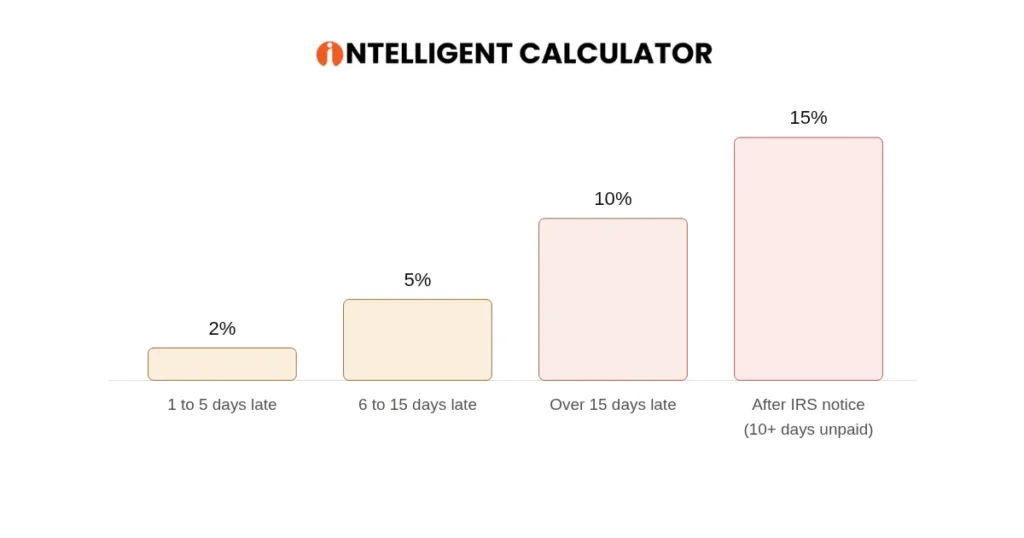
The payroll tax penalty for a late deposit is a failure-to-deposit penalty that rises with the number of calendar days a deposit is late. The tiers below come from the IRS failure to deposit penalty page.
| Days the deposit is late | Penalty (percent of the unpaid deposit) |
|---|---|
| 1 to 5 calendar days | 2% |
| 6 to 15 calendar days | 5% |
| More than 15 calendar days | 10% |
| More than 10 days after the first IRS notice, or on the day of a demand for immediate payment | 15% |
A deposit that is 1 to 5 days late costs 2% of the unpaid amount, 6 to 15 days late costs 5%, more than 15 days late costs 10%, and 15% applies if the amount is still unpaid more than 10 days after the first IRS notice. The tiers do not add together. A deposit more than 15 days late is charged 10%, not 17%.
The drawing below shows how fast the penalty climbs.
Example. An employer deposits $10,000 eight days late. The penalty is 5% of $10,000, which is $500, plus interest. Penalties do not apply when the failure was due to reasonable cause and not willful neglect.
Late returns cost more. A late Form 941 can add a failure-to-file penalty of generally 5% of the unpaid tax for each whole or partial month, up to a 25% maximum (IRS Publication 15).
Personal liability. If the people responsible for paying trust fund taxes willfully fail to do so, the IRS can assess the trust fund recovery penalty. It can equal 100% of the unpaid trust fund taxes and can be charged to owners and officers personally (Internal Revenue Code section 6672).
Prevent penalties with three habits: automate deposits, calendar a lookback check each July, and reconcile each quarter before you file Form 941.
Employee or contractor: which costs the business more?
An employee works under the employer’s direction, and a contractor controls how, when and where the work is done. The IRS looks at three categories of evidence: behavioral control, financial control and the type of relationship. Misclassification is one of the costliest payroll errors.
Misclassified workers can leave the employer owing back payroll taxes and penalties. Contractors are paid with Form 1099-NEC when payments reach $2,000 in 2026, and they pay both halves of FICA through self-employment tax.
Card 10 example. A worker with $90,000 of income and $6,000 of business expenses in Texas, filing single, takes home $72,145 as a W-2 employee and $66,430.48 as a 1099 contractor. The W-2 route pays $5,714.52 more a year, or $476.21 a month. A contractor would need about $98,101.65 of revenue to match the employee’s take-home.
For the business, the contractor route avoids the employer FICA match, FUTA, SUTA and workers’ compensation, but only if the worker is truly independent. To price contractor work, see the bill rate calculator and the billable hours calculator.
Hiring a remote employee in another state
A remote employee can create payroll obligations in the state where the work is performed. Income tax withholding depends on where the work happens and where the employee lives, and reciprocity agreements between some states change the answer. Unemployment tax generally follows the state where the employee does the work.
Before the first paycheck, register with the state revenue department and the state workforce agency, collect the state withholding form, and confirm the new-employer SUTA rate. The calculator treats one state at a time, so run each state separately and check the SUTA table. Then confirm the details with the state agency.
Common payroll tax mistakes and how to avoid them
Avoid these ten errors:
- Using the wrong wage base. The Social Security cap changes every year. Using last year’s figure creates errors on high earners.
- Missing a deposit. Late deposits trigger penalties of 2% to 15%. See the penalty table.
- Forgetting the 0.9% Additional Medicare Tax. Withholding starts at $200,000.
- Treating all pre-tax deductions alike. A 401(k) does not reduce FICA wages.
- Ignoring state unemployment rates. New-employer defaults change after your first year.
- Mixing up bi-weekly and semi-monthly math. This changes withholding on each check.
- Skipping the W-4. Without one, the employer must withhold as if the worker is single with no adjustments.
- Misclassifying a worker. Back taxes and penalties can follow.
- Missing the 1099-NEC threshold change. For 2026 payments it is $2,000, not $600.
- Treating catch-up contributions the old way. Higher earners age 50 and older must make catch-up contributions as Roth in 2026.
Pro tip: build a yearly checklist. Update the Social Security wage base, FUTA status, state SUTA rates and deposit schedule every January.
What changed for payroll in 2026 and what is coming in 2027
Several payroll figures and rules changed for 2026, and the 2027 Social Security wage base is already announced.
| Item | 2026 | 2027 | Source |
|---|---|---|---|
| Social Security wage base | $184,500 | $192,300 | Social Security Administration |
| Maximum Social Security tax (each of employee and employer) | $11,439.00 | $11,922.60 | Social Security Administration |
| Medicare rate (each of employee and employer) | 1.45%, no cap | 1.45%, no cap | IRS Publication 15 |
| Additional Medicare Tax threshold (withholding) | $200,000 | $200,000 | IRS Publication 15 |
| 401(k) employee deferral limit | $24,500 | Not yet announced | IRS Notice 2025-67 |
| 401(k) catch-up, age 50 and older (ages 60 to 63) | $8,000 ($11,250) | Not yet announced | IRS Notice 2025-67 |
| Roth catch-up required above this prior-year FICA wage | $150,000 | Indexed yearly | IRS Notice 2025-67 |
| Form 1099-NEC reporting threshold | $2,000 (payments made in 2026) | Indexed for inflation after 2026 | Public Law 119-21 |
| Standard deduction, single | $16,100 | Not yet published | IRS Revenue Procedure 2025-32 |
The Social Security wage base is $184,500 in 2026 and $192,300 in 2027, so the maximum Social Security tax rises from $11,439.00 to $11,922.60 for each of the employee and the employer. The Social Security Administration announced the 2027 figure on October 14, 2026 (Journal of Accountancy report).
The 2027 impact. A worker at or above the cap pays $483.60 more Social Security tax in 2027 (6.2% × the $7,800 increase), and so does the employer. Medicare stays at 1.45% with no cap, and the 0.9% Additional Medicare Tax still starts at $200,000.
Other 2026 changes. The 1099-NEC threshold rose to $2,000. The qualified overtime and tips deductions began affecting 2026 Form W-2 reporting. Catch-up contributions became Roth-only for higher earners.
As of October 20, 2026 the IRS had not published its 2027 inflation adjustments. It released the 2026 set in Revenue Procedure 2025-32 on October 9, 2025. This page uses 2026 figures and will be updated within days of the 2027 release.
For payroll professionals: method notes and limits
How this calculator differs from Publication 15-T
The calculator uses an annualized bracket method. It multiplies a pay period by the number of periods, subtracts the standard deduction, applies the 2026 brackets and divides back down. Publication 15-T publishes percentage-method worksheets and tables that can differ from this shortcut by small amounts. The calculator is built for estimates, not payroll filings.
Assumptions and limitations
- It assumes one job per worker and no W-4 Step 2 (multiple jobs) adjustment. Step 3 and Step 4 inputs are supported in Card 2.
- It uses an annualized bracket method, not the exact Pub 15-T lookup tables.
- State income tax uses an effective-rate estimate. Local taxes, state disability insurance and paid family leave are not included.
- SUTA rates and wage bases are defaults. Your actual rate will differ.
- Card 4 estimates state savings from contributions with an effective rate, not a marginal rate.
- It does not process payroll, file forms or make deposits.
- It does not store your pay data. Calculations run in your browser, and nothing is saved to cookies or local storage.
Other expert points
- Supplemental wages: the aggregate method adds the bonus to regular pay and withholds on the total. Any supplemental wages above $1 million in a year are withheld at 37% under either method.
- Successor employers: when an employer acquires a business, wages paid by the predecessor may count toward wage bases. See Publication 15.
- Roth catch-up: payroll must track prior-year FICA wages to find employees above $150,000 who can only make Roth catch-up contributions.
- Form 8959: reconciles the Additional Medicare Tax on the individual return.
Payroll tax glossary
- Gross pay: pay before any deduction or tax.
- Net pay: pay after taxes and deductions, also called take-home pay.
- FICA wages: the wages subject to Social Security and Medicare tax.
- Wage base: the annual wage limit for a tax. For Social Security it is $184,500 in 2026.
- Supplemental wages: pay outside regular wages, such as bonuses and commissions.
- Lookback period: the four quarters ending June 30 of the prior year, used to set the deposit schedule.
- Section 125 plan: a cafeteria plan that lets employees pay for certain benefits before tax.
- FUTA: the Federal Unemployment Tax Act tax, paid by employers.
- SUTA or SUI: the state unemployment tax, also called state unemployment insurance.
- YTD: year-to-date, the total since January 1.
Payroll tax calculator FAQ
What is a payroll tax calculator?
A payroll tax calculator estimates the taxes taken from an employee’s pay and the taxes an employer owes. It covers FICA, federal income tax withholding, state tax, FUTA and SUTA. Some also project employer cost.
How do I calculate net pay?
Start with gross pay. Subtract pre-tax deductions, then federal, FICA and state taxes, then post-tax deductions. The result is your take-home pay.
What is the difference between gross pay and net pay?
Gross pay is what you earn before any deduction. Net pay is what lands in your bank account. The gap is taxes plus deductions.
What is FICA on my paycheck?
FICA is the Federal Insurance Contributions Act tax. It includes 6.2% for Social Security (up to $184,500 in 2026, per the Social Security Administration) and 1.45% for Medicare. Your employer pays a matching amount.
What payroll taxes does an employer pay, and how much per employee?
Employers pay the 6.2% and 1.45% FICA match, FUTA and state SUTA. For a $60,000 worker in Texas, that comes to about $4,875 a year. The total depends on your state and your own SUTA rate.
Which pre-tax deductions reduce FICA?
Section 125 health premiums, HSA contributions through payroll, health FSAs and qualified commuter benefits reduce FICA wages. Traditional 401(k) deferrals do not. See IRS Publication 15-B for details.
What are pre-tax and post-tax deductions?
Pre-tax deductions come out before income tax and lower taxable wages. Post-tax deductions, such as Roth contributions and garnishments, come out after taxes are calculated.
What is the difference between bi-weekly and semi-monthly pay, and how does pay frequency affect payroll?
Bi-weekly pay arrives every two weeks, for 26 checks. Semi-monthly pay arrives twice a month, for 24 checks. Payroll systems multiply each check by the number of periods to estimate annual wages, then withhold tax from that figure.
What is the difference between FUTA and SUTA?
FUTA is the federal unemployment tax, at an effective 0.6% on the first $7,000 for most employers. SUTA is each state’s unemployment tax, with its own rate and wage base. Employers pay both.
What is the Social Security wage base for 2026 and 2027?
The 2026 wage base is $184,500. The 2027 wage base will be $192,300, as announced by the Social Security Administration on October 14, 2026.
Is payroll tax the same as income tax?
No. Payroll taxes fund Social Security, Medicare and unemployment insurance. Income tax is a separate tax on taxable income and is withheld using your W-4.
Does the payroll tax calculator on Intel Calculator store my pay information?
No. The payroll tax calculator on Intel Calculator runs in your browser and does not save your numbers. It does not use cookies or local storage for your pay data.
How much of my paycheck goes to payroll taxes?
For a single employee earning $60,000 and paid bi-weekly in Texas, about 16% of each $2,307.69 check goes to federal income tax and FICA, which is $369.62. Add state income tax and any state programs where they apply. The share changes with filing status, deductions and state.
Do employers pay payroll taxes on top of wages?
Yes. Employers pay a 7.65% FICA match, FUTA and state unemployment tax in addition to wages. These taxes do not come out of the employee’s pay, according to IRS Publication 15.
Who pays FUTA, the employer or the employee?
Only the employer pays FUTA. The federal rate is 6.0% on the first $7,000 of each employee’s wages, reduced by a credit of up to 5.4% for most employers. That leaves 0.6%, or $42 per employee.
Why did my paycheck get bigger in November?
Social Security tax stops once your wages reach the annual wage base, which is $184,500 in 2026. A worker paid $210,000 reaches it in November, so the 6.2% deduction ends and take-home pay rises for the rest of the year.
How often do I have to deposit payroll taxes?
Employers deposit monthly or semi-weekly. The schedule is monthly if the lookback liability is $50,000 or less, with deposits due by the 15th of the next month. It is semi-weekly above $50,000, and next-business-day once $100,000 is owed on any day, per IRS Publication 15.
What is the extra 0.9% Medicare tax on my paycheck?
The Additional Medicare Tax is 0.9% on wages above $200,000, and only the employee pays it. Employers withhold it once wages pass $200,000, whatever the filing status. Married joint filers settle the $250,000 threshold on their tax return.
Why is my bonus taxed at 22%?
A bonus is supplemental wages, and employers may withhold a flat 22% federal rate instead of using the regular tables. The 22% is withholding, not the final tax, which is settled on your return. Above $1 million of supplemental wages in a year the rate is 37%.
Are 401(k) contributions subject to Social Security tax?
Yes. A traditional 401(k) deferral lowers income tax wages but not FICA wages, so Social Security and Medicare tax still apply. Roth 401(k) contributions reduce neither, according to IRS Publication 15.
Do I have to send a 1099-NEC to a contractor I paid $1,500 in 2026?
No. For payments made in 2026 the Form 1099-NEC reporting threshold is $2,000, up from $600 under Public Law 119-21. Payments of $2,000 or more to a contractor require the form, due January 31 of the following year.
How much does it cost to hire an employee on top of salary?
Expect about 6% to 8.5% of wages in employer payroll taxes at common salaries, plus benefits. In Texas a $60,000 salary adds $4,875 in payroll taxes (8.1%). With benefits, insurance and a retirement match, the Card 5 default shows $78,857.50 for $65,000 of wages, a burden rate of 21.3%.
What is the difference between bi-weekly, semi-monthly and bi-monthly pay?
Bi-weekly means every two weeks, for 26 paychecks a year. Semi-monthly means twice a month, for 24 paychecks. Bi-monthly is ambiguous because it can mean twice a month or every two months, so confirm the schedule with the employer.
Are payroll taxes the same as employment taxes?
Largely yes. The IRS uses the name employment taxes for Social Security, Medicare, federal income tax withholding and FUTA. State unemployment tax is the state-level counterpart, according to IRS Publication 15.
What is the difference between SUTA, SUI and SDI?
SUTA (State Unemployment Tax Act) and SUI (state unemployment insurance) are two names for the same state unemployment tax, paid by employers in most states. SDI (state disability insurance) is a different program that some states, such as California, New Jersey and Rhode Island, fund with employee deductions.
What is OASDI on my pay stub?
OASDI stands for Old-Age, Survivors, and Disability Insurance. It is the formal name of the Social Security tax, which is 6.2% of wages for the employee up to the wage base.
What is the penalty for a late payroll tax deposit?
The IRS charges 2% of the unpaid deposit if it is 1 to 5 calendar days late, 5% if 6 to 15 days late and 10% if more than 15 days late. The rate rises to 15% if the deposit is still unpaid more than 10 days after the first IRS notice.
Are employer payroll taxes tax deductible?
Employer payroll taxes are generally deductible as an ordinary business expense. IRS Publication 535 covers business expenses, including taxes paid on behalf of employees.
Sources, methodology and change log
Sources:
- IRS Publication 15-T, federal income tax withholding methods.
- IRS Publication 15, employer tax guide (deposits, penalties, supplemental wages).
- IRS Publication 15-B, fringe benefit treatment.
- IRS Publication 505, tax withholding and estimated tax.
- IRS Publication 535, business expenses.
- IRS failure to deposit penalty page.
- Social Security Administration contribution and benefit base, including the 2027 announcement of October 14, 2026.
- U.S. Department of Labor FUTA credit reduction.
- IRS Revenue Procedure 2025-32 (2026 inflation adjustments), IRS Notice 2025-67 (2026 retirement plan limits) and Public Law 119-21 (the One Big Beautiful Bill Act).
- Your state workforce agency, for SUTA rates and wage bases.
Methodology: the calculator uses the annualized bracket method with 2026 brackets and standard deductions. It applies FICA rules in full, including the wage base and Additional Medicare Tax. State income tax uses an effective-rate estimate. State unemployment figures are editable defaults.
Accuracy checks: Examples 1, 2 and 3 on this page were recomputed by hand and with the calculator. They match to within one cent. We have not yet published a line-by-line comparison with the Publication 15-T tables, so treat results as estimates and confirm final figures with your payroll provider or a licensed tax professional.
Who reviewed this page
This page was written by [AUTHOR NAME, CREDENTIAL] and reviewed by [REVIEWER NAME, CREDENTIAL] on [REVIEW DATE]. Our process is described in our editorial policies, and you can learn more about Intel Calculator.
Conclusion
Payroll taxes affect both sides of every paycheck. Employees lose a share of pay. Employers add a share of cost.
This payroll tax calculator shows the whole picture in one place. It follows gross-to-net math, explains each result in plain English, and covers FICA, FUTA, SUTA, deposits, deadlines and penalties. Run your numbers in the calculator, compare the scenarios and review the worked examples. Then confirm final figures with your payroll provider or a licensed tax professional.
This calculator is for informational purposes only and does not constitute professional advice. Consult a licensed advisor before making decisions.