A dividend yield represents the financial ratio showing how much a company pays out in dividends each year relative to its stock price. A good dividend yield ranges between 2% and 6%, depending on the market sector and the underlying business quality. A 2% yield from Microsoft—a multinational technology corporation—represents an excellent return due to the company’s 20-year history of earnings growth. A 2% yield from a utility company—a business providing basic amenities like electricity—falls below the 3% to 5.5% sector average. Investors evaluate yields by accounting for sector norms to avoid poor capital allocation. This guide provides accepted yield ranges for 9 major sectors, establishes a framework for matching yield targets to investment goals, and identifies warning signs of yield traps.
What Do General Dividend Yield Ranges Mean for Investors?
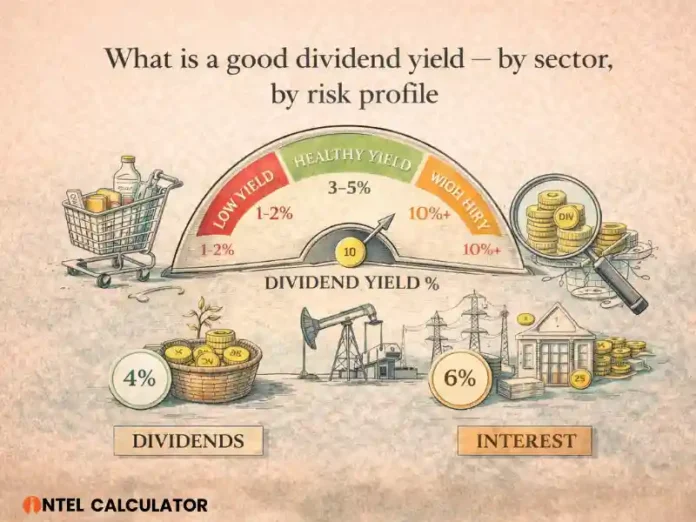
General dividend yield ranges signal the growth profile and risk level of an investment. Yields below 2% indicate growth-focused companies. Yields between 2% and 6% represent sustainable income. Yields above 7% flag potential distress requiring immediate fundamental analysis.
The 2% to 6% band contains 85% of reliable, dividend-paying companies. Yields below 2% reflect companies prioritizing capital appreciation over income distribution. Yields above 7% demand strict financial scrutiny. A yield exceeding 7% represents either a mispriced asset or an impending dividend cut.
| Yield Range | Market Signal | Investor Profile |
| Below 1% | Growth-focused, minimal income | Long-term growth investor |
| 1% to 2% | Low yield, high-growth tech orientation | Growth with light income |
| 2% to 4% | Solid, sustainable yield | Balanced income and growth |
| 4% to 6% | Higher income, high payout ratio | Income-focused investor |
| Above 7% | Danger zone, yield trap risk | High-risk investor |
What Is a Good Dividend Yield by Market Sector?
A good dividend yield varies strictly by market sector. Technology stocks yield 0.5% to 2%. Consumer staples yield 2% to 4%. Utility companies yield 3% to 5.5%. Real Estate Investment Trusts (REITs) yield 4% to 7% due to legal distribution requirements.
Technology stocks pay low yields because these businesses reinvest cash flows into product development, acquisitions, and share buybacks. Real Estate Investment Trusts (REITs)—companies owning and operating income-generating real estate—pass 90% of taxable income to shareholders, making 4% to 7% yields standard. Consumer staples—companies producing essential products like food and hygiene goods—provide stable 2% to 4% yields. Investors evaluate individual stock yields against specific sector medians to ensure accurate benchmarking.
| Sector | Typical Yield Range | Sector Characteristics |
| Technology | 0.5% to 2% | Prioritizes capital appreciation over yield |
| Consumer Staples | 2% to 4% | Provides stable, consistent dividend histories |
| Healthcare | 1.5% to 3.5% | Offers defensive positioning with strong balance sheets |
| Financials | 2% to 5% | Carries cyclical exposure requiring payout ratio monitoring |
| Utilities | 3% to 5.5% | Generates regulated revenue for core income holdings |
| REITs | 4% to 7% | Distributes 90% of taxable income to shareholders legally |
| Energy | 3% to 6% | Experiences high volatility from commodity price cycles |
| Industrials | 1.5% to 3% | Delivers moderate growth with consistent track records |
| Telecom | 4% to 7% | Produces high current yield with slow organic growth |
Why Do High Dividend Yields Indicate Investment Traps?
High dividend yields indicate investment traps because the yield formula divides the annual dividend by the current stock price. A collapsing stock price artificially inflates the yield percentage, signaling deteriorating business fundamentals and an imminent reduction in dividend payments.
A yield trap—a high-yield stock masking underlying financial distress—destroys investment capital. The mathematical formula dictates this relationship: Dividend Yield = (Annual Dividend Per Share / Current Stock Price) x 100. A company paying $2.00 per share at a $40 stock price yields 5%. A stock price collapse to $20 pushes the yield to 10%. The market prices in deteriorating fundamentals before the company announces a dividend cut.
- Investigate yields above 7% for payout sustainability and recent stock price declines.
- Calculate the payout ratio to ensure the company distributes less than 80% of earnings.
- Analyze free cash flow trends to confirm the company generates enough cash to cover dividend obligations.
A yield exceeding sector peers by 3% or more signals financial distress. Use our Dividend Payout Ratio Calculator to check this for any stock in seconds.
What Is the Difference Between Forward Dividend Yield and Trailing Dividend Yield?
Trailing dividend yield measures the actual dividends paid over the previous 12 months divided by the current share price. Forward dividend yield annualizes the most recently declared dividend divided by the current share price, projecting future income accurately.
Trailing dividend yield—a metric measuring actual dividends paid over the previous 12 months—understates real income when a company raises its dividend. A company raising its quarterly dividend from $0.40 to $0.50 creates a blended trailing yield lower than the actual forward rate. Forward dividend yield—a metric annualizing the most recently declared dividend—reflects the exact payment the company intends to distribute over the next 12 months. Investors use forward yield to calculate precise income projections after a company announces a dividend increase or decrease. Use our Forward Dividend Yield Calculator to calculate the precise forward yield based on a stock’s latest declared dividend
What Dividend Yield Targets Align With Specific Investment Goals?
Dividend yield targets align with investment goals based on time horizons and income requirements. Wealth builders target 2% to 3.5% yields with 10% annual growth. Retirees target 4% to 6% yields to generate immediate, sustainable cash flow.
Investors building long-term wealth prioritize the dividend growth rate over the current yield. A stock yielding 2.5% today with a 10% annual dividend growth rate yields 6.5% on the original cost basis after 10 years. This metric represents the yield on cost—the annual dividend income divided by the original purchase price of the investment. Investors living off dividends prioritize current yield. These investors target a blended portfolio yield of 4% to 6% across 5 diversified sectors. Diversification across utilities, consumer staples, financials, and REITs mitigates the financial impact of an individual dividend cut.
| Investment Goal | Yield Target | Annual Dividend Growth | Time Horizon |
| Building wealth | 2% to 3.5% | 8% to 12% | 20+ years |
| Balanced income and growth | 3% to 5% | 5% to 8% | 10 to 20 years |
| Living off dividends | 4% to 6% | 3% to 6% | Immediate income |
| Maximum current income | 5% to 7% | 1% to 4% | Immediate income |
How Does the Chowder Rule Identify High-Quality Dividend Stocks?
The Chowder Rule identifies high-quality dividend stocks by adding the current dividend yield to the 5-year dividend growth rate. A total score above 12 indicates a strong investment candidate combining sustainable current income with robust historical dividend growth.
The Chowder Rule—a quantitative screening metric combining current yield and dividend growth rate—filters stocks rapidly. The formula requires adding the Current Dividend Yield to the 5-Year Dividend Growth Rate.
- Target scores above 12 to identify strong candidates for dividend growth portfolios.
- Accept scores above 8 for stocks yielding 3% or more in slower-growth sectors like utilities.
- Reject scores below 8 to avoid stagnant income and slow-growth businesses.
A stock with a 3% current yield and a 10% 5-year dividend growth rate generates a Chowder Number of 13. A stock yielding 6% with a 1% growth rate scores 7. The Chowder Rule applies exclusively to companies with 5 years of consecutive dividend growth. Investors exclude REITs from this calculation due to their structurally different yield and growth profiles.
How Do Investors Verify the Safety of a Dividend Yield?
Investors verify dividend yield safety by confirming the payout ratio remains below 65%, ensuring free cash flow covers the dividend by 1.5 times, and verifying the company has paid and grown its dividend for 5 consecutive years.
The payout ratio—the percentage of earnings paid to shareholders in dividends—dictates dividend safety. Free cash flow—the cash a company generates after accounting for cash outflows to support operations—funds the actual dividend payments.
- Keep the payout ratio below 65% to ensure the company retains earnings for reinvestment.
- Verify annual free cash flow exceeds the total annual dividend payout by at least 1.5 times.
- Confirm the company has paid and grown its dividend for 5 or more consecutive years.
A company generating $300 million in free cash flow and paying $150 million in dividends maintains a 2x coverage ratio. A company generating $150 million with a $140 million dividend obligation faces an imminent dividend cut during an earnings decline. A stock failing any one of these 3 checks requires immediate investigation. . Use our Dividend Coverage Ratio Calculator to run this check instantly.
Frequently Asked Questions
What Is a Good Dividend Yield for a Beginner Investor?
A good dividend yield for a beginner investor ranges from 2% to 4%. This range includes high-quality, established companies in the consumer staples, healthcare, and industrial sectors that possess long records of payment consistency and low volatility.
Beginners target the 2% to 4% range to build a foundation of reliable income. Investors avoid stocks yielding above 6% until they master the evaluation of payout ratios and free cash flow coverage.
Why Is a 7% Dividend Yield Considered High Risk?
A 7% dividend yield carries high risk because it significantly exceeds the market average. This elevated yield indicates either a structurally high-yield sector like REITs or a collapsing stock price driven by severe underlying business deterioration.
Investors analyze the payout ratio, free cash flow trend, and earnings stability before purchasing a 7% yield. A 7% yield requires immediate fundamental analysis to rule out an impending dividend suspension.
What Is a Good Dividend Yield for Real Estate Investment Trusts?
A good dividend yield for Real Estate Investment Trusts (REITs) ranges between 4% and 6%. This higher baseline reflects the legal mandate requiring REITs to distribute at least 90% of their taxable income directly to shareholders.
Yields above 7% in the REIT sector require strict payout coverage checks. Investors evaluate the specific REIT type and the stability of its underlying property cash flows to confirm dividend sustainability.
Why Do Investors Buy Stocks With a 1% Dividend Yield?
Investors buy stocks with a 1% dividend yield to capture rapid annual dividend growth and capital appreciation. A 1% yield growing at 15% annually produces a yield on cost above 4% within a 10-year investment horizon.
Technology companies like Apple and Microsoft initiated dividends below 1% and now generate substantial income for long-term shareholders. The trajectory of dividend growth dictates long-term returns more than the initial starting yield.
What Is the Difference Between a Good Yield and a Safe Yield?
A good yield meets specific income goals based on an investor’s strategy. A safe yield represents a dividend the company sustains and grows using robust free cash flow without exceeding a 65% payout ratio.
An attractive yield failing the payout ratio or free cash flow checks constitutes a financial liability. Investors execute the three-step safety check to convert a mathematically good yield into a verified safe yield.
Why Does a Higher Dividend Yield Not Guarantee a Better Investment?
A higher dividend yield does not guarantee a better investment because the yield mathematically increases when the stock price falls. High yields frequently reflect deteriorating business fundamentals and market expectations of an upcoming dividend cut.
The optimal dividend investments combine a 2% to 4% current yield with consistent annual dividend growth. Companies with strong balance sheets and free cash flow exceeding dividend obligations outperform artificially high-yielding distressed assets.
What Is a Good Dividend Yield for Retirement Income?
A good dividend yield for retirement income averages 4% to 5% across a diversified portfolio. Retirees achieve this by combining 3% to 5% yields from utilities and consumer staples with 4% to 7% yields from REITs.
Retirees build core income positions in defensive sectors to generate cash flow without selling shares. Investors maintain a cash buffer equal to 6 months of living expenses to navigate temporary dividend reductions during economic downturns.
How Do Investors Determine the Sustainability of a Dividend Yield?
Investors determine dividend yield sustainability by verifying the payout ratio remains below 65%. Investors also confirm free cash flow covers the dividend by 1.5 times and validate 5 consecutive years of historical dividend growth.
A company passing these 3 quantitative checks demonstrates the financial capacity and management commitment to sustain its dividend. A company failing 2 or more checks represents a high-risk yield trap.
Free Dividend Tools
Use our free Dividend Calculator to calculate dividend income, yield, and reinvestment returns.