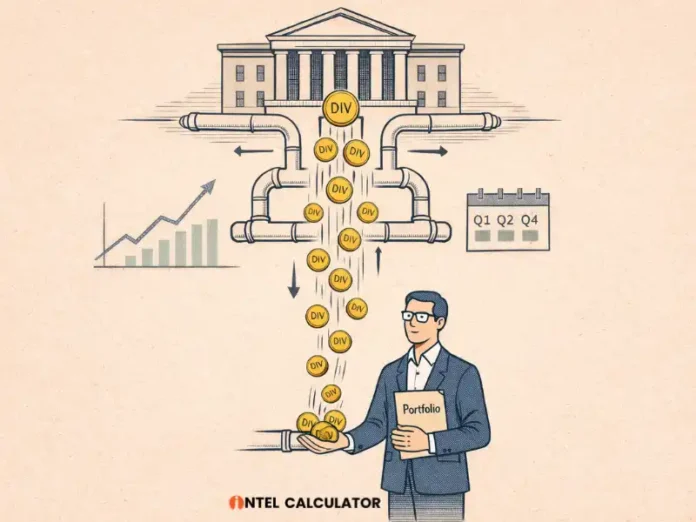
You’ve probably seen the word “dividend” in a brokerage account, on a financial news headline, or buried in a company’s earnings report. Most explanations stop at the definition — something like “a dividend is a payment a company makes to its shareholders.” But that leaves out everything that actually matters: how does the money flow from a company’s bank account to yours? Who decides how much gets paid, and when? What role does your brokerage play? And what happens if you reinvest instead of pocketing the cash? This guide covers the mechanics — not the definition. If you want to skip ahead and start running numbers, our Dividend Calculator can help you estimate income and yield right away.
Think of a dividend as the end result of a chain of financial decisions. A company earns money, decides how much to reinvest in its own operations, and distributes what’s left to the people who own shares. That distribution follows a strict sequence of dates — and understanding that sequence is the key to understanding whether you’ll actually receive a payment, why the stock price moves the way it does on certain days, and how your money compounds over time when you reinvest. Whether you’re brand new to investing or just want to understand what’s happening in your account, this guide breaks it down clearly and completely.
How a Company Decides to Pay a Dividend
Dividends don’t just happen automatically. Every dividend payment starts with a decision made by a company’s board of directors — a group of elected representatives responsible for governing the company on behalf of shareholders. The board typically meets on a regular schedule (often quarterly) to review the company’s financial performance, and one of the agenda items is what to do with the company’s earnings.
The decision process works like this: the company generates revenue, then subtracts its operating costs, taxes, debt payments, and capital expenditure needs. What remains is called free cash flow — the money that’s truly available without harming future operations. The board then weighs several options for that cash:
- Reinvest it into the business — new equipment, more staff, research and development, acquisitions.
- Buy back shares — repurchasing the company’s own stock, which can increase value for remaining shareholders.
- Pay down debt — reducing financial risk.
- Distribute it to shareholders as a dividend.
Many companies do a combination of all four. But the dividend decision is significant because once a company establishes a pattern of paying dividends, investors begin to rely on it. Companies that cut or cancel dividends often see their stock price fall sharply — not just because the income is gone, but because investors interpret the cut as a signal that the business is in trouble.
This is why dividend-paying companies tend to be mature, established businesses — think utilities, consumer staples, financial companies, and large industrials. Fast-growing companies like early-stage tech firms typically reinvest every dollar back into growth and pay no dividends. Neither approach is inherently better; they serve different investor needs.
Once the board approves a dividend, they formally declare it — announcing the amount per share, the payment date, and a key cutoff date. That announcement triggers the four-date sequence that every dividend investor needs to understand. You can use our Dividend Income Calculator to see how varying dividend amounts and yields translate into real annual income.
The 4 Dividend Dates Explained
Every dividend payment involves exactly four dates, in a fixed sequence. Missing one of these — specifically the second one — means you miss the payment entirely, no matter how long you’ve owned the stock otherwise.
Declaration Date
The declaration date is when the company’s board of directors officially announces the dividend. In the announcement, they specify: (1) the dividend amount per share, (2) the record date, and (3) the payment date. This is public information — it gets filed with regulators and published via press release. Just because the dividend is declared does not mean you’ve earned it yet. You’re simply being notified that it exists.
Ex-Dividend Date
This is the most important date for investors. The ex-dividend date is the cutoff: you must own shares before this date to qualify for the dividend. If you buy shares on or after the ex-dividend date, you will not receive the upcoming payment — it belongs to the previous owner. The “ex” in ex-dividend literally means “without” — after this date, the shares trade without the entitlement to the upcoming dividend. This is also the date the stock price typically drops (more on that in Section 5).
Record Date
The record date is when the company officially confirms which shareholders are on its books. In practice, this is almost always one business day after the ex-dividend date. If you owned shares before the ex-dividend date, your ownership has been settled and recorded by the record date. The record date is largely a backend administrative checkpoint — for most investors, the ex-dividend date is the one that matters.
Payment Date
The payment date is when the company actually transfers the dividend to shareholders. It typically falls two to four weeks after the record date. On this day, the cash shows up directly in your brokerage account (or new shares are added if you have DRIP enabled — covered in Section 4).
| Real-World Example with Illustrative Dates: Suppose a company called IntelCorp announces a $0.50 per share quarterly dividend. Declaration Date: March 1 — Board votes to pay the dividend. Ex-Dividend Date: March 15 — You must own shares BEFORE this date. Record Date: March 16 — Company confirms its shareholder list. Payment Date: April 5 — Cash (or reinvested shares) arrives in your account. If you buy IntelCorp shares on March 14: You receive $0.50 per share on April 5. If you buy IntelCorp shares on March 15: You do NOT receive this dividend. |
How the Money Actually Reaches You
Most investors never think about the plumbing behind dividend payments — the cash just appears in the account. But understanding the mechanics helps explain why payments arrive when they do and how reinvestment works.
The Role of Your Brokerage
When you buy stock, you don’t usually hold a paper certificate. Instead, your brokerage holds shares on your behalf, registered through a clearinghouse. Your account shows your ownership, but the actual settlement happens through an intermediary layer.
The DTC — The Invisible Backbone
Most U.S. equity trades settle through the Depository Trust Company (DTC), a subsidiary of DTCC (Depository Trust & Clearing Corporation). The DTC acts as a centralized holder of the actual shares for virtually every publicly traded U.S. stock. Your brokerage has an account at DTC, and when a company pays a dividend, it wires the total dividend pool to DTC. DTC then distributes those funds to member brokerages based on how many shares each brokerage’s clients hold. Your brokerage then credits your individual account.
This is why the record date matters — the DTC reconciles share counts against that date to determine who gets what. The process is highly automated, which is why dividend payments typically arrive on or very close to the official payment date.
Cash vs. DRIP: Your Two Options
Once the dividend is credited to your account, you have two paths:
- Cash dividend: The money lands in your account as cash. You can spend it, save it, or manually reinvest it in any stock you choose.
- DRIP (Dividend Reinvestment Plan): The dividend is automatically used to purchase more shares of the same stock — often fractional shares — without any transaction fees. This is covered in detail in Section 4.
Most brokerages let you set DRIP preferences at the account level or per individual holding. You can often change this setting at any time, though changes typically only take effect for the next dividend cycle.
How DRIP Works Mechanically
DRIP stands for Dividend Reinvestment Plan. Instead of receiving your dividend as cash, the money is automatically used to buy more shares — including fractional shares — of the same stock. Over time, this creates a compounding loop: more shares earn more dividends, which buy even more shares, and so on. Our Dividend Reinvestment Plan Calculator lets you model exactly how this growth plays out over any time horizon.
The Mechanics of Reinvestment
When a dividend payment is due and DRIP is enabled, the brokerage takes the cash that would have been credited to your account and uses it to purchase shares at the current market price (often the price on the payment date). Because brokerages now support fractional shares, even a small $12 dividend on a $200 stock would buy 0.06 shares — every cent gets reinvested.
The Compounding Loop — By the Numbers
Dividend Reinvestment Example
| Item | Details |
|---|---|
| Starting Shares | 100 |
| Share Price | $50 |
| Total Initial Investment | $5,000 |
| Annual Dividend Yield | 4% |
| Annual Dividend per Share | $2.00 |
| Quarterly Dividend per Share | $0.50 |
Year 1 – Dividend Reinvestment Growth
| Period | Shares Owned | Dividend Received | Shares Bought (Reinvested) | Total Shares After |
|---|---|---|---|---|
| Start | 100.00 | – | – | 100.00 |
| Q1 | 100.00 | $50.00 | ~1.00 | 101.00 |
| Q2 | 101.00 | $50.50 | ~1.01 | 102.01 |
| Q3 | 102.01 | $51.00 | ~1.02 | 103.03 |
| Q4 | 103.03 | $51.51 | ~1.03 | ~104.06 |
End of Year 1
| Metric | Value |
|---|---|
| Total Shares | ~104.06 |
| Annual Dividend Earned | ~$204 |
Long-Term Projection (Year 20)
| Metric | Value |
|---|---|
| Shares Owned | ~220 |
| Annual Dividend Income | ~$440 |
| Dividend Return vs Initial Investment | ~120% |
If Share Price Also Grows (5% Per Year)
| Metric | Value |
|---|---|
| Initial Investment | $5,000 |
| Estimated Portfolio Value After 20 Years | $18,000+ |
The key insight here is that DRIP doesn’t require you to do anything. There’s no decision, no brokerage fee, no need to decide when to buy more shares. The process is automatic — and the earlier you start, the more compounding cycles you benefit from. A 20-year DRIP investor captures exponentially more growth than one who starts at year 10.
How Dividends Affect Stock Price
Many new investors are surprised to discover that when they wake up on the ex-dividend date, the stock price is already lower — often by almost exactly the dividend amount. This isn’t a coincidence, and it isn’t a bad thing. It’s the natural result of how market pricing works.
Why the Price Drops on the Ex-Dividend Date
Think about it this way: on the day before the ex-dividend date, the stock represents a claim on the company’s assets plus the upcoming dividend payment. When the market opens on the ex-dividend date, buying that stock no longer entitles you to the dividend — the prior owners get it instead. So the stock is worth slightly less. Supply and demand adjust accordingly, and the opening price typically reflects a reduction of roughly the dividend amount per share.
For example, if a stock closed at $100 the evening before the ex-dividend date, and the dividend is $1.00 per share, the stock will typically open near $99 on the ex-dividend date. The $1.00 has effectively separated from the stock’s price and now exists as a cash entitlement to prior owners.
Why This Doesn’t Matter to DRIP Investors
If you’re a DRIP investor, the price drop is irrelevant to your total wealth. Here’s why:
- Before ex-date: You hold 100 shares at $100/share = $10,000 total.
- After ex-date: Stock drops to $99. You receive a $1.00 dividend per share ($100 total).
- DRIP purchases: That $100 buys approximately 1.01 shares at $99.
- New position: ~101.01 shares × $99 = ~$10,000 total. Effectively unchanged.
The wealth hasn’t disappeared — it’s been split between the share price and the dividend cash (or new shares in a DRIP). Over time, as the company grows and its earnings increase, both the share price and dividend amount rise together. The ex-dividend price drop is a short-term bookkeeping adjustment, not a loss.
How to Build Dividend Income Step by Step
Earning meaningful dividend income doesn’t require a complex strategy. It requires picking the right stocks, understanding what you’ll receive, setting up reinvestment, and then tracking your portfolio’s growth over time. Here’s a practical walkthrough.
Step 1 — Pick Dividend Stocks
Look for companies with a long track record of consistent (and ideally growing) dividend payments. Good starting filters: dividend yield between 2–6% (very high yields can signal risk), a payout ratio below 75% (meaning the company isn’t stretching its earnings to cover the dividend), and a history of at least 5–10 consecutive years of payments. Dividend Aristocrats — S&P 500 companies that have raised dividends for 25+ consecutive years — are a widely referenced category of reliable payers.
Step 2 — Calculate Your Expected Income
Before buying, model your expected income. Multiply the annual dividend per share by the number of shares you plan to hold. For example: 200 shares × $2.40 annual dividend = $480/year.
Step 3 — Enable DRIP
Log into your brokerage account and look for DRIP settings — usually found under “account settings,” “dividend preferences,” or by clicking on an individual holding. Enable automatic reinvestment for each dividend-paying position you want to compound. Some brokerages let you set this globally; others require per-holding setup.
Step 4 — Watch for Ex-Dividend Dates
If you want a specific upcoming dividend, make sure you own the shares before the ex-dividend date. You can find ex-dividend dates on financial sites like Nasdaq.com, Yahoo Finance, or directly on your brokerage’s stock detail page. If you’re building a long-term portfolio, you don’t need to time individual payments — just buy and hold, and DRIP handles the rest.
Step 5 — Track and Reinvest Over Time
Review your portfolio periodically — at least annually — to check that dividend yields remain healthy and payout ratios are sustainable. Compare the growth in your share count (thanks to DRIP) against your original investment. The Dividend Reinvestment Plan Calculator allows you to project share count and total value over years or decades, so you can see what your current portfolio is on track to become.
Frequently Asked Questions
How do dividends get paid?
Dividends are paid by the company to its shareholders on the payment date, routed through the Depository Trust Company (DTC) and then distributed to individual brokerage accounts. If you have DRIP enabled, the cash is automatically used to purchase additional shares instead of being deposited as cash. The process is fully automated and typically completes on or by the payment date.
When do I receive my dividend?
You receive your dividend on the payment date, which is announced at the same time as the dividend declaration. Payment dates are typically two to four weeks after the record date. The money or new shares will appear in your brokerage account on or around that date, depending on your broker’s processing schedule.
Do I need to do anything to receive dividends?
No action is required beyond owning the shares before the ex-dividend date. Your brokerage handles everything automatically. If you want to receive future dividends as cash, no setup is needed — that’s typically the default. If you want to reinvest dividends automatically through DRIP, you’ll need to enable that setting in your brokerage account once.
What happens if I sell before the payment date?
As long as you owned the shares before the ex-dividend date, you are entitled to the dividend even if you sell the shares before the payment date. The dividend follows ownership at the time of the ex-dividend date, not at the time of payment. You will receive the dividend in your account on the payment date regardless of whether you still hold the stock.
Can a company cancel a dividend after declaring it?
Technically, yes — a declared dividend can be rescinded, though it is extremely rare and would typically cause a significant drop in the company’s stock price. In practice, once a dividend is declared, companies almost always follow through with payment. Cancellations are far more likely to occur before a declaration, when a company quietly reduces or skips a dividend that investors were anticipating.
How do dividends work in a Roth IRA?
In a Roth IRA, dividends are not taxed when received or reinvested, because qualified withdrawals from a Roth IRA are tax-free. This makes Roth IRAs especially powerful for dividend investors using DRIP — every reinvested dividend compounds without any tax drag. Dividends received in a traditional IRA are tax-deferred, meaning you’ll owe ordinary income tax when you take distributions in retirement.
How do dividends work with ETFs?
ETFs (Exchange-Traded Funds) pass through dividends from their underlying holdings to ETF shareholders. The ETF collects dividends from all the stocks it holds, pools them, and then distributes the total to ETF shareholders — typically on a quarterly basis, though some ETFs pay monthly. Dividend ETFs follow the same ex-dividend and payment date structure as individual stocks, and DRIP can also be enabled for ETF dividends through most brokerages.
What is the difference between dividend yield and dividend income?
Dividend yield is a percentage that expresses the annual dividend relative to the current stock price (for example, a $2.00 annual dividend on a $50 stock = 4% yield). Dividend income is the actual dollar amount you receive based on how many shares you own (for example, 500 shares × $2.00 = $1,000/year). Yield is useful for comparing stocks; income is what you actually take home. Both metrics matter, and a dedicated calculator makes it easy to move between them.