Dividend investing is one of the most beginner-friendly strategies in personal finance — not because it’s simple, but because it rewards patience and consistency far more than it rewards clever stock-picking or perfect market timing.
The core idea is straightforward: you buy shares in profitable companies that distribute a portion of their earnings to shareholders on a regular schedule, and over time, those payments compound into a meaningful stream of income. You don’t need to sell a single share to get paid. Your portfolio works for you while you sleep.
The goal isn’t to get rich overnight. It’s to build a portfolio that pays you regularly — monthly, quarterly, or annually — simply for owning it. Beginners gravitate toward dividend investing because the feedback loop is tangible: every quarter, cash or new shares appear in your account, and you can watch the numbers grow in real time. Whether you’re starting with $500 or $50,000, the principles are exactly the same. This guide covers everything you need — from understanding the basics to building your first real portfolio.
What Is Dividend Investing?
Dividend investing is the practice of buying and holding shares in companies that regularly pay out a portion of their profits to shareholders. When a company earns more money than it needs to fund its operations, expansion, or debt payments, it can return that surplus to investors in the form of a dividend — typically a fixed dollar amount per share, paid on a quarterly schedule. As a dividend investor, you benefit from two distinct return sources simultaneously: the income you receive from dividend payments, and the long-term price appreciation of the shares themselves.
What separates dividend investing from most other strategies is that it doesn’t require you to sell your holdings to realize a return. A growth investor makes money only when they sell shares at a higher price than they paid. A dividend investor gets paid just for holding. This creates a fundamentally different relationship with the market: price volatility becomes less threatening, because even when share prices dip, the dividends keep arriving. For beginners, that psychological stability — knowing your portfolio generates income even in a down market — is one of dividend investing’s most underappreciated advantages.
Why Beginners Choose Dividend Investing
There are several good reasons why dividend investing consistently ranks as one of the best entry points for new investors, and they go beyond just the appeal of getting paid regularly.
- Dividends follow a schedule — most companies pay quarterly, some monthly. This predictability makes it easier to plan, budget, and set realistic income goals. Unlike capital gains, dividend income doesn’t depend on timing the market correctly. Predictable income.
- Because dividend investing rewards holding, not trading, it naturally builds the patience and discipline that beginner investors often struggle with. The longer you hold, the more dividends you collect and the more your DRIP compounds. Forces long-term thinking.
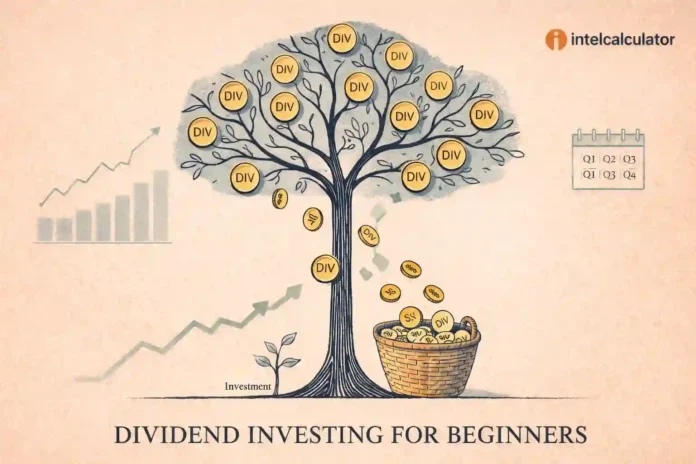
- When you reinvest dividends automatically through a DRIP (Dividend Reinvestment Plan), your share count grows with every payment. More shares earn more dividends, which buy even more shares. This compounding loop accelerates significantly over a 10–30 year horizon. Compounding through reinvestment.
- Dividend investing doesn’t require monitoring stock prices daily or reacting to short-term news. You’re focused on the quality and consistency of income — not on whether the price moved two percent today. Lower stress than growth trading.
- Dividend income can eventually replace a salary. A well-built dividend portfolio in retirement delivers consistent cash flow without requiring you to liquidate assets — an important distinction when you’re no longer adding new money. Ideal for retirement planning.
Key Terms Every Beginner Must Know
These seven terms come up constantly in dividend investing. Understanding them clearly will save you hours of confusion later and help you evaluate any dividend stock with confidence.
| Dividend Yield | The annual dividend as a percentage of the current share price. A $2.00 annual dividend on a $50 stock = 4% yield. Higher isn’t always better — unusually high yields can signal risk. |
| Dividend Per Share | The actual dollar amount paid to each shareholder per share, per payment period. A quarterly dividend of $0.50/share means $2.00 annually per share you own. |
| Payout Ratio | The percentage of a company’s earnings paid out as dividends. A 50% payout ratio means half of earnings go to shareholders. Above 80% may be unsustainable; below 65% is generally healthy. |
| Ex-Dividend Date | The cutoff date for dividend eligibility. Own shares before this date and you receive the payment. Buy on or after this date and the dividend goes to the previous owner. |
| DRIP | Dividend Reinvestment Plan. An automatic setting that uses your dividend cash to buy additional shares (including fractional) instead of depositing cash. The engine of long-term dividend compounding. |
| Dividend Aristocrats | S&P 500 companies that have raised their dividend for 25+ consecutive years. Examples include Procter & Gamble, Coca-Cola, and Johnson & Johnson. A useful shortlist for beginner stock screening. |
| Qualified vs Ordinary | Qualified dividends are taxed at the lower long-term capital gains rate (0%, 15%, or 20%). Ordinary dividends are taxed as regular income. Most dividends from U.S. stocks held 60+ days are qualified. |
How to Pick Your First Dividend Stock
You don’t need to analyze a company’s balance sheet for hours to find a solid dividend stock. A five-step framework covers the essentials for most beginner investors. Use a Dividend Payout Ratio Calculator to verify sustainability at Step 2 before committing capital.
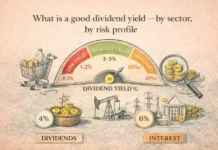
- Check that the yield is between 2% and 6%. Below 2% generates too little income to matter meaningfully at smaller investment sizes. Above 6–7% is a yellow flag — it often means the stock price has fallen sharply, suggesting the market is pricing in a dividend cut or business risk. The sweet spot for most beginners is 3–5%.
- Verify the payout ratio is below 65%. A lower payout ratio means the company retains more earnings for operations and growth — and has room to sustain the dividend if earnings dip temporarily. A payout ratio above 80% is a warning sign that the dividend could be cut if business conditions soften.
- Check for 5+ consecutive years of dividend payments. Consistency matters more than size. A company that has paid (and ideally grown) its dividend for five or more years without interruption has demonstrated the financial discipline and business stability that dividend investors rely on.
- Look at free cash flow coverage. Earnings can be manipulated through accounting; free cash flow is harder to fake. The dividend should be comfortably covered by free cash flow — ideally at a ratio of 1.5x or higher. You can find FCF figures in the company’s most recent earnings report or on any major financial data site.
- Diversify across at least three sectors. Don’t load up entirely on utilities or REITs, even if they offer attractive yields. Spreading across sectors — for example, consumer staples, healthcare, financials, and industrials — reduces the risk that a single sector downturn wipes out your income.
| Quick Screening Checklist Dividend yield: 2%–6% Payout ratio: below 65% Dividend payment history: 5+ consecutive years Free cash flow covers dividend by 1.5x or more Portfolio holds stocks in 3+ different sectors |
How Much Do You Need to Start?
The honest answer is: less than you think. Most major brokerages now support fractional shares, which means you can invest any dollar amount — even $50 — in stocks that trade at hundreds of dollars per share. There’s no minimum barrier to entry for dividend investing. What matters is starting consistently and letting DRIP do the compounding. Use our Dividend Income Calculator to model exactly how your investment size translates into annual income across different yield scenarios.
| Income at a 4% Dividend Yield $500 invested → ~$20/year ($5/quarter) $1,000 invested → ~$40/year ($10/quarter) $5,000 invested → ~$200/year ($50/quarter) $10,000 invested → ~$400/year ($100/quarter) $50,000 invested → ~$2,000/year ($500/quarter) $100,000 invested → ~$4,000/year ($1,000/quarter) |
These numbers seem modest at small balances — and that’s intentional. Dividend investing is a long game, and DRIP is what makes the numbers interesting over time. Below is a simplified projection showing how $10,000 invested at a 4% yield grows with dividends reinvested and a conservative 5% annual price appreciation.
DRIP Compounding Projection — $10,000 Starting Investment
Assumptions:
- Dividend Yield: 4%
- Annual Price Growth: 5%
- Dividends Reinvested: Quarterly
| Year | Portfolio Value | Annual Dividend Income |
|---|---|---|
| 10 | ~$19,500 | ~$780 |
| 20 | ~$38,000 | ~$1,520 |
| 30 | ~$74,000 | ~$2,960 |
With $200 Monthly Contributions (Starting Year 1)
| Year | Portfolio Value | Annual Dividend Income |
|---|---|---|
| 10 | ~$55,000 | ~$2,200 |
| 20 | ~$145,000 | ~$5,800 |
| 30 | ~$340,000 | ~$13,600 |
The contribution column illustrates a crucial point: your savings rate matters as much as your investment returns in the early years. Even $100–$200 per month added consistently to a DRIP-enabled portfolio accelerates growth dramatically because every new dollar immediately starts earning dividends of its own.
Dividend ETFs vs. Individual Stocks for Beginners
One of the first decisions every beginner faces is whether to buy individual dividend stocks or dividend-focused ETFs. Both are legitimate approaches — they just involve different trade-offs.
Dividend ETFs — The Easier Starting Point
A dividend ETF holds dozens or hundreds of dividend-paying stocks in a single fund. When you buy one share of a dividend ETF, you instantly own a slice of every company in that fund. Popular options include SCHD (Schwab U.S. Dividend Equity ETF), VYM (Vanguard High Dividend Yield ETF), and DGRO (iShares Core Dividend Growth ETF). The advantages for beginners are significant: instant diversification, minimal research, low expense ratios (typically 0.06%–0.20%), and built-in dividend reinvestment through most brokerages.
Individual Stocks — More Control, More Work
Buying individual dividend stocks gives you direct control over which companies you own, lets you target higher yields in specific sectors, and can deliver better income per dollar if you pick well. The downside is that it requires ongoing research — you need to monitor each company’s earnings, payout ratio, and business health to catch warning signs before a dividend cut. A single bad holding can drag down your income meaningfully in a small portfolio.
| Recommended Beginner Approach Start with 1 dividend ETF (e.g., SCHD or VYM) as your core holding — 50–60% of your dividend portfolio. Add 3–5 individual dividend stocks from different sectors to supplement yield and gain stock-selection experience. Enable DRIP on all positions from day one. Review holdings quarterly. Replace any stock that cuts its dividend or shows a payout ratio climbing above 80%. |
This hybrid approach gives you the safety and simplicity of an ETF while letting you learn individual stock analysis gradually — without betting your entire portfolio on any single company’s decisions.
Common Beginner Mistakes to Avoid
Most dividend investing mistakes aren’t complicated — they’re predictable. Here are the five that trip up beginners most often, and what to do instead.
- Chasing the highest yield. A 10%+ dividend yield almost always means something is wrong — either the stock price has collapsed because the business is struggling, or the dividend is likely to be cut soon. If a yield looks too good to be true, it usually is. Stick to the 2%–6% range and prioritize sustainability over size.
- Ignoring the payout ratio. The dividend yield tells you what you’re earning; the payout ratio tells you whether it’s sustainable. A company paying out 95% of its earnings as dividends has almost no room for error — one bad quarter and the dividend is at risk. Always check both numbers before investing.
- Concentrating in one sector. Many beginners build portfolios that are 70–80% utilities or REITs because they offer attractive yields. If that sector hits regulatory or interest rate headwinds, your entire income stream suffers at once. Spread across sectors as described in Section 4.
- Not accounting for taxes. Dividend income is taxable (even inside a regular brokerage account), and different dividend types are taxed differently. Qualified dividends benefit from lower tax rates; ordinary dividends don’t. Consider holding higher-yield positions inside tax-advantaged accounts like a Roth IRA or 401(k) where permitted.
- Selling during market dips. When markets fall, share prices drop — but dividends from healthy companies typically keep coming. Panic-selling a solid dividend stock during a downturn locks in a capital loss and ends your income stream from that position. The ability to hold through volatility is the core skill dividend investing develops over time.
Building Your First Dividend Portfolio Step by Step
Here’s a concrete action plan for going from zero to a functioning, income-generating dividend portfolio. Once you enable DRIP in Step 3, use the Dividend Reinvestment Plan Calculator to project how your share count and income grow over 10, 20, and 30 years under different contribution and yield scenarios.
- Open a brokerage account. Choose a brokerage that supports fractional shares and offers DRIP at no extra cost. Fidelity, Schwab, and Vanguard are the most commonly recommended platforms for long-term dividend investors. The account opening process takes 10–15 minutes online.
- Fund your account and make your first purchases. Start with your chosen ETF (SCHD, VYM, or DGRO) as your core position, then add 3–5 individual dividend stocks from different sectors. Use the 5-step screening framework from Section 4 for each individual stock.
- Enable DRIP on every holding. Log into your brokerage, navigate to dividend preferences, and turn on automatic reinvestment for each position. This is a one-time setup that then runs automatically indefinitely.
- Set a monthly contribution amount. Decide how much you’ll add each month — even $100 makes a real difference over time. Many brokerages support automatic recurring investments on a schedule you set. Consistency here is more important than the amount.
- Review your portfolio quarterly. Check that payout ratios are still healthy, dividends have been paid on schedule, and no individual stock has become an outsized portion of your portfolio. Rebalance if any single stock grows to represent more than 15–20% of your total holdings.
$500/Month Dividend Income Plan
Goal: Generate $500 per month in passive dividend income
Investment Plan
| Parameter | Value |
|---|---|
| Starting Capital | $20,000 |
| Monthly Contribution | $400 |
| Average Dividend Yield | 4% |
| Annual Portfolio Growth | 6% |
| Dividend Reinvestment | Yes |
Portfolio Growth Milestones
| Year | Portfolio Value | Annual Dividend Income | Monthly Dividend Income | Progress to Goal |
|---|---|---|---|---|
| 5 | ~$55,000 | ~$2,200 | ~$185 | 37% |
| 10 | ~$105,000 | ~$4,200 | ~$350 | 70% |
| 13 | ~$150,000 | ~$6,000 | ~$500 | Goal Reached |
What This Means
- Consistent investing + reinvesting dividends allows compounding to accelerate income growth.
- The first $100k is the hardest milestone. After that, dividend growth becomes much faster.
- Increasing contributions to $500–$600/month could reduce the timeline to 10–11 years.
Income Rule of Thumb
A common guideline used by dividend investors:
| Monthly Dividend Goal | Required Portfolio (4% Yield) |
|---|---|
| $100/month | $30,000 |
| $250/month | $75,000 |
| $500/month | $150,000 |
| $1,000/month | $300,000 |
Frequently Asked Questions
How much money do I need to start dividend investing?
You can start dividend investing with any amount — most major brokerages support fractional shares, so even $50 or $100 is enough to buy a slice of high-priced dividend stocks or ETFs. The income at small balances will be modest, but the habit of investing consistently and reinvesting dividends matters far more in the early years than the size of your initial deposit.
What is a good dividend yield for beginners?
For beginners, a dividend yield between 3% and 5% represents a healthy balance between income and sustainability. Yields below 2% may not generate meaningful income at smaller investment sizes, while yields above 6–7% often signal elevated risk — either the stock price has fallen due to business problems, or the dividend is likely to be cut. Prioritize consistency and payout ratio health over the headline yield number.
Should beginners buy dividend stocks or dividend ETFs?
For most beginners, starting with a dividend ETF — such as SCHD, VYM, or DGRO — is the lower-risk, lower-research path to dividend income. ETFs provide instant diversification across dozens of companies in a single purchase. Once you’re comfortable with the basics, adding 3–5 individual dividend stocks allows you to build stock-selection skills without putting your full portfolio at risk.
How long does it take to live off dividends?
The timeline depends entirely on how much you invest, how consistently you contribute, and what yield your portfolio produces. As a rough benchmark, reaching $500/month in dividend income from a standing start typically takes 10–15 years with disciplined monthly contributions and DRIP enabled. Reaching full income-replacement levels — say $3,000–$5,000/month — generally requires either a large starting investment, 25–30 years of consistent investing, or both.
Are dividends taxed for beginners?
Yes — dividends are taxable income, even if you reinvest them through DRIP. Qualified dividends (from U.S. stocks held 60+ days) are taxed at the favorable long-term capital gains rate of 0%, 15%, or 20% depending on your income level. Ordinary dividends are taxed as regular income. One common beginner strategy is to hold higher-yielding dividend positions inside a Roth IRA, where qualified distributions are eventually tax-free.
What is the safest dividend stock for beginners?
No stock is entirely “safe,” but Dividend Aristocrats — S&P 500 companies that have raised their dividend for 25+ consecutive years — are a widely used starting point for risk-conscious beginners. Examples include Procter & Gamble, Johnson & Johnson, Coca-Cola, and Realty Income. These companies have demonstrated the financial durability to sustain dividend payments through multiple recessions, making them more reliable than average.
Should I reinvest dividends or take the cash?
In the wealth-building phase — especially if you don’t need the income to cover living expenses — reinvesting dividends through DRIP is almost always the better choice. The compounding effect over 10–20 years is substantial: reinvested dividends can account for 40–60% of total portfolio returns over long periods. Once you reach a point where dividend income is needed for expenses, switching to cash dividends is a natural and straightforward transition.
What is the biggest mistake beginner dividend investors make?
The single most common and costly mistake is chasing the highest available yield without checking whether the dividend is sustainable. A 10% yield on a company with an 95% payout ratio and declining free cash flow is a trap — the dividend will almost certainly be cut, the stock price will fall, and the beginner investor loses on both fronts. Always pair the yield figure with the payout ratio and cash flow coverage before making any investment decision.
Use our free Dividend Calculator to calculate dividend income, yield, and reinvestment returns.