
Last updated: June 9, 2026
Soil Calculator
| Material | Volume | Weight |
|---|
Most people think soil is just dirt. They grab a tape measure, do some simple math, and order a few bags from the hardware store. But soil is one of the most complex materials on the planet — it is a living, breathing system of physics, chemistry, and biology working together.
This guide is built around our advanced 12-Card Agronomic Soil Mechanics Engine. Each module of that calculator unlocks a different layer of understanding, from basic volume math all the way to hydraulic conductivity and cation exchange capacity. By the end of this article, you will know exactly how to calculate every soil need for your project, avoid costly mistakes, and protect your vehicles, plants, and budget.
What Makes Soil So Complex?
Soil is not a fixed, uniform material. Its weight changes based on moisture. Its drainage speed depends on particle size. Its ability to hold nutrients is controlled by electrical charges on clay particles. A single cubic yard of soil can weigh anywhere from 1,200 to over 2,700 pounds depending on its type and water content.
The four major dimensions of soil are:
- Physical Properties — Bulk density, porosity, particle size (sand, silt, clay ratio)
- Chemical Properties — pH levels, cation exchange capacity, nutrient buffer capacity
- Biological Properties — Soil organic matter (SOM), compost, microbial life, humus
- Hydrological Properties — Available Water Capacity (AWC), percolation rates, Saturated Hydraulic Conductivity (Ksat)
Understanding these four dimensions is the foundation of every calculation in this guide. Our 12-card engine addresses all of them in a single, connected workflow.
How to Use This 12-Card Engine
Before diving into the science, here is the recommended workflow:
- Card 1 — Enter bed dimensions to get your basic cubic yard volume
- Card 2 — Input your soil type to get dry and wet weight estimates
- Card 3 — Compare bulk delivery vs. bagged retail pricing
- Card 4 — Enter your sand, silt, and clay percentages to classify your soil texture (this autofills Cards 6, 8, 10, and 11)
- Cards 5 & 6 — Calculate how much compost to add and adjust your soil pH
- Card 7 — Determine your NPK fertilizer deficit and required application rate
- Cards 8, 9 & 10 — Plan irrigation schedules, drainage, and mulch coverage
- Cards 11 & 12 — Evaluate your soil’s nutrient-holding capacity and plan hauling logistics safely
Module 1 & 2: Volumetric Calculations & Density Physics
Getting the right volume of soil is the first step in any project. But most people stop at the basic length-times-width formula and forget about the physics of weight and settling.
Three-Dimensional Volumetric Math for Garden Beds
The foundational formula for soil volume is straightforward. You multiply the length, width, and depth of your planting area together, then convert to cubic yards.
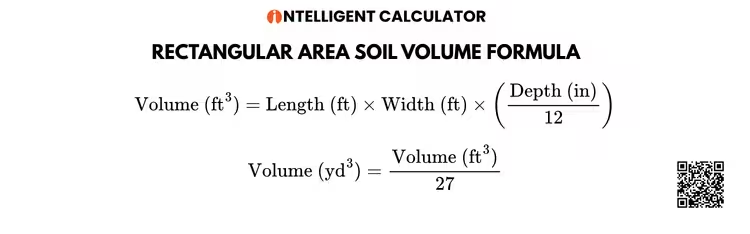
Rectangular Bed Formula:
Volume (ft³) = Length (ft) × Width (ft) × (Depth (in) ÷ 12)
Volume (yd³) = Volume (ft³) ÷ 27
For circular flower beds, you use the standard radius formula:
Volume (ft³) = π × Radius² × (Depth (in) ÷ 12)

For irregular or curved beds, break the layout into smaller rectangles and triangles on graph paper. Calculate the volume of each shape individually, then add them together. This averaging method minimizes calculation errors and gives you a reliable total cubic yard requirement.
Always add a 15–20% settling buffer to your final order. Bulk soil contains large amounts of trapped air that collapses when watered. If you order the exact net volume, your beds will sit noticeably low after the first rain.
| Bed Shape | Formula Used | Key Input |
|---|---|---|
| Rectangular | L × W × D | Three measurements |
| Circular | π × r² × D | Radius and depth |
| Triangular | 0.5 × B × H × D | Base, height, depth |
| Irregular | Grid decomposition | Multiple widths averaged |
Soil Physics: Dry Bulk Density vs. Wet Saturated Weight
Here is where most homeowners make a dangerous and expensive mistake. They assume soil weight is fixed. It is not — water content changes everything.
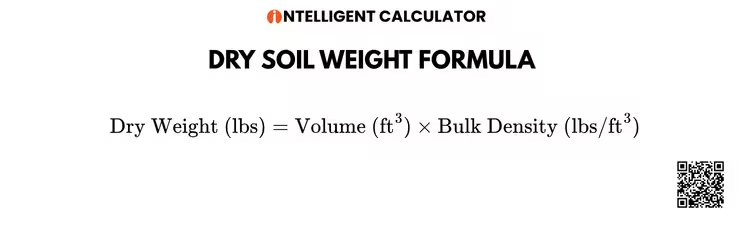
Dry Weight Formula:
Dry Weight (lbs) = Volume (ft³) × Bulk Density (lbs/ft³)
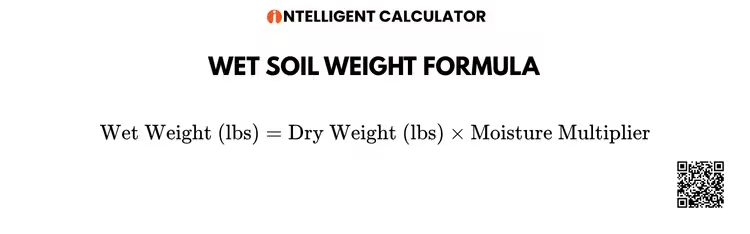
Wet Weight Formula:
Wet Weight (lbs) = Dry Weight (lbs) × Moisture Multiplier
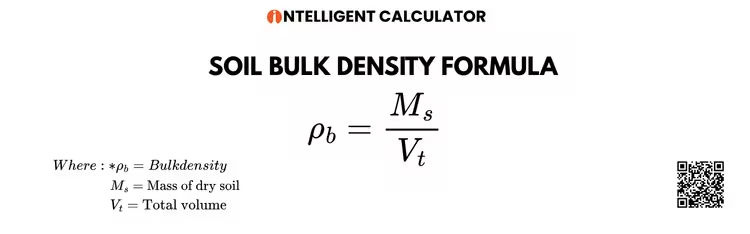
The bulk density formula used in Card 2 of the calculator is:
ρb = Ms ÷ Vt (Mass of dry soil ÷ Total volume)
Different soil types carry very different bulk densities:
- Compost: ~40 lbs/ft³ (lightest, most air pockets)
- Sandy Loam: ~90 lbs/ft³ (fast draining, moderate weight)
- Standard Topsoil: ~85 lbs/ft³ (common residential soil)
- Clay Soil: ~100–110 lbs/ft³ (dense, heaviest option)
When soil becomes fully saturated with water, its weight can increase by up to 35%. A half-ton pickup truck loaded with wet clay soil can easily exceed its legal payload limit of 1,500 lbs after just half a cubic yard. We cover this in the hauling safety section below.
Module 3: Financial Procurement — Bulk vs. Bagged Soil
Once you know your volume, you need to decide how to buy your material. The cost difference between bagged retail and bulk delivery is significant, but there is a break-even threshold you need to calculate first.
The Break-Even Delivery Formula
The math works like this. If retail bags cost $5.49 for 2 cubic feet, you are paying about $74 per cubic yard in bags alone. Bulk delivery typically costs $35–$55 per cubic yard plus a fixed delivery fee of $65–$85.
- If your project requires fewer than 1.5 cubic yards, bagged retail is often comparable in total cost
- At 1.5 to 2 cubic yards and above, bulk delivery becomes significantly cheaper
- At 5+ cubic yards, bulk delivery saves you hundreds of dollars every single time
Cost-saving tips when buying in bulk:
- Consolidate all your project materials into a single delivery order
- Schedule delivery to avoid weekend surcharge fees
- Identify a drop zone near the project site to minimize wheelbarrow labor
- Cover the pile with a heavy utility tarp to prevent wind erosion and rain wash
- Check local HOA rules before placing a pile on your street or curb
Before ordering, clear the drop area of overhead power lines, low tree branches, and soft lawn sections. Heavy delivery vehicles can crack thin concrete driveways and leave deep ruts in wet grass.
Module 4: Soil Texture & The USDA Classification Triangle
The type of soil you are working with controls almost every other property in this guide. Two soils can look identical but drain at completely different rates, hold nutrients differently, and require opposite pH treatments.
Reading the USDA Soil Texture Triangle
The USDA classifies soils into 12 distinct classes based on three particle sizes:
- Sand particles: 0.05–2.0 mm — large, rough, drain very quickly
- Silt particles: 0.002–0.05 mm — medium, smooth, moderate drainage
- Clay particles: <0.002 mm — microscopic, flat, drain very slowly
To classify your soil, you enter the percentage of each particle type into Card 4. The interactive canvas plots your coordinates on the USDA Soil Texture Triangle in real time, placing your soil into one of 12 categories like Loam, Clay Loam, Sandy Loam, or Silty Clay.
Why this matters for the rest of your project:
- Drainage rate (Ksat): Sandy soils drain at 20+ in/hr; clay soils drain at 0.1 in/hr
- Nutrient retention: Clay holds far more nutrients than sand
- pH buffer strength: Clay resists pH changes and needs more lime or sulfur to shift
- Water holding capacity: Clay and organic matter increase available water storage
This single Card 4 classification automatically updates your drainage class in Card 8, your water holding capacity in Card 10, and your pH buffering factor in Card 6. It is the most important data entry in the entire tool.
Module 5 & 6: Soil Chemistry — Organic Matter & pH Buffering
Once you know your soil texture, the next step is understanding its chemical condition. Two factors dominate soil chemistry: Soil Organic Matter and soil pH.
Elevating Soil Organic Matter (SOM) with Compost
Soil Organic Matter is the biological lifeblood of your garden. It feeds microorganisms, improves drainage, holds water, and stores nutrients. Degraded urban soils often have SOM levels as low as 0.5–1.5%. High-performance vegetable gardens need 5% or higher.
Raising SOM requires physical incorporation of compost at a specific depth. If you are tilling to 6 inches and want to raise SOM from 2% to 5%, Card 5 calculates exactly how many cubic yards of pure compost you need to incorporate into that specific volume of existing soil.
Key SOM benefits you gain at higher percentages:
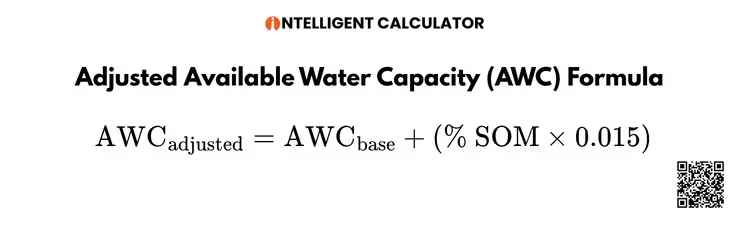
- Every 1% increase in SOM adds 0.015 inches of Available Water Capacity per inch of soil
- Higher SOM increases microbial populations that suppress plant disease naturally
- Organic matter darkens soil color, which increases solar heat absorption in spring
- Humus particles carry strong negative charges that dramatically increase nutrient retention
The Chemistry of Soil pH and the Buffering Capacity of Clay
Soil pH controls which nutrients are chemically available to plant roots. The golden availability window is pH 6.2 to 6.8. Inside this range, Nitrogen, Phosphorus, Potassium, Calcium, and Magnesium are all simultaneously bioavailable. Outside this window, critical nutrients lock up as insoluble compounds that roots simply cannot absorb.
pH correction requires two ingredients:
- Agricultural Lime (Calcium Carbonate) — raises pH in acidic soils
- Elemental Sulfur — lowers pH in alkaline soils
Here is what most guides get completely wrong: the amount of lime or sulfur you need is not fixed. It depends on your soil’s buffering capacity — its ability to resist pH change.
Clay particles carry strong negative electrical charges that absorb hydrogen ions and resist chemical changes. A clay loam soil requires up to 2.8 times more lime or sulfur to achieve the same pH shift as a sandy loam. Card 6 applies this buffering factor multiplier automatically once your soil texture has been classified in Card 4.
Buffering Capacity Scale:
| Soil Type | Buffering Factor | Relative Lime/Sulfur Needed |
|---|---|---|
| Sandy Soil | 1.0× | Lowest |
| Sandy Loam | 1.3× | Low |
| Loam | 1.6× | Moderate |
| Clay Loam | 2.2× | High |
| Heavy Clay | 2.8× | Highest |
Module 7: NPK Fertilizer & Nutrient Deficit Mathematics
A soil test report will tell you whether your Nitrogen (N), Phosphorus (P), and Potassium (K) levels are Low, Medium, or Optimal. But translating that report into actual bags of fertilizer at a specific grade requires careful math.
The Nitrogen-First Governing Rule
Fertilizer bags display three numbers: the N-P-K ratio by weight percentage. A 10-10-10 fertilizer bag contains 10% each of Nitrogen, Phosphorus, and Potassium.
The cardinal rule of fertilizer application is the Nitrogen-First Governing Rule. Because Nitrogen is highly mobile in soil water and leaches rapidly through the root zone, application rates are always calculated to satisfy the Nitrogen deficit first. Once the correct Nitrogen dose is set, you check whether the resulting Phosphorus and Potassium applications might over-saturate the soil.
Steps the Card 7 calculator follows:
- Identify the Nitrogen deficit in lbs per 1,000 sq ft from your soil test
- Calculate the total Nitrogen required for your bed area
- Divide by the bag’s N percentage to find total fertilizer weight needed
- Cross-check that Phosphorus and Potassium applications stay within safe limits
Over-applying Phosphorus is a serious environmental risk. Excess P binds to soil particles and washes into waterways during heavy rain, causing harmful algae blooms in local lakes and streams.
Module 8, 9 & 10: Soil Hydrology, Drainage & Surface Cover
Water management is where soil science becomes most practical. Understanding how water moves through your soil tells you how often to irrigate, whether your plants risk drowning, and how much mulch to apply.
Available Water Capacity (AWC) and Irrigation Scheduling
Available Water Capacity is the amount of water soil can hold between field capacity (fully saturated after drainage) and permanent wilting point (completely dry). It is measured in inches of water per inch of soil depth (in/in).
AWC is not fixed — you can increase it by raising your SOM percentage. The formula is:
AWC_adjusted = AWC_base + (% SOM × 0.015)
Card 8 converts your AWC into practical irrigation scheduling. You input your local evapotranspiration rate (ET, measured in inches per day) and your irrigation system’s flow rate (GPM). The calculator outputs:
- Irrigation run-time in minutes per watering session
- Watering frequency in days before the next session is needed
This eliminates guesswork completely and prevents both under-watering and the costly root rot damage caused by chronic over-watering.
Saturated Hydraulic Conductivity (Ksat) and Drainage Risk
Saturated Hydraulic Conductivity (Ksat) is the speed at which water moves through fully saturated soil. It is expressed in inches per hour (in/hr) and defines your soil’s USDA drainage class.
USDA Drainage Class Reference:
| Ksat (in/hr) | USDA Class | Drainage Description |
|---|---|---|
| >20 in/hr | Excessively Drained | Sandy soils, fast water loss |
| 6–20 in/hr | Well Drained | Ideal loamy conditions |
| 2–6 in/hr | Moderately Well Drained | Good for most vegetables |
| 0.6–2 in/hr | Somewhat Poorly Drained | Risk of brief waterlogging |
| <0.1 in/hr | Poorly Drained | Heavy clay, chronic root rot risk |
When rainfall intensity exceeds your soil’s Ksat, water cannot percolate fast enough and pools on the surface. This creates anaerobic conditions that suffocate root systems and kill beneficial soil organisms within days. Adding organic compost and coarse sand amendments can raise Ksat significantly in borderline clay soils.
Mulch Depth & Weed Suppression Dynamics
Mulch is the final layer of your soil management system. A properly applied 3-inch layer of organic mulch blocks 95% of light from reaching dormant weed seeds, reducing germination dramatically. It also reduces soil moisture evaporation by up to 60% — a massive benefit in hot, dry summers.
For full mulch depth calculations across your beds, use our dedicated mulch calculator, which lets you compare pine bark, hardwood chips, straw, rubber mulch, and other materials.
Key mulch depth targets:
- Weed suppression only: 2–3 inches minimum
- Moisture retention and insulation: 3–4 inches
- Winter root protection: 4–6 inches around perennials
- Tree root zone protection: 3–4 inches, kept away from the trunk
Module 11 & 12: Cation Exchange Capacity & Project Logistics
The final two modules connect the deep science of nutrient chemistry with the very practical reality of moving heavy material safely.
Cation Exchange Capacity (CEC): The Soil’s Nutrient Battery
Cation Exchange Capacity is the total number of positively charged nutrient ions (cations) that your soil can hold at one time. Think of it as the battery size of your soil’s nutrient storage system. A higher CEC means more nutrients are retained and less fertilizer is wasted to leaching.
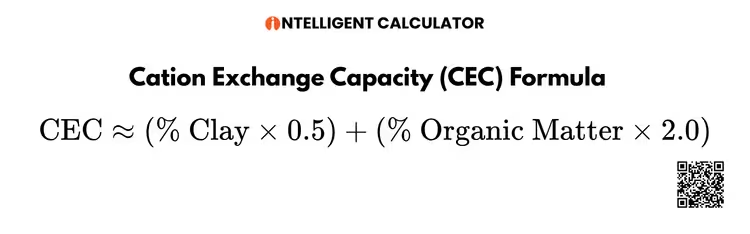
The estimator formula used in Card 11 is:
CEC ≈ (% Clay × 0.5) + (% Organic Matter × 2.0)
This formula reveals two critical facts:
- Clay contributes 0.5 meq/100g per percentage point of clay content
- Organic matter contributes 2.0 meq/100g per percentage point — four times more than clay
This is why adding compost is so powerful. You are not just adding nutrients — you are permanently expanding your soil’s capacity to store and release future nutrients.
CEC Rating Scale:
| CEC (meq/100g) | Rating | Typical Soil |
|---|---|---|
| <6 | Very Low | Pure sand |
| 6–12 | Low | Sandy loam |
| 12–20 | Medium | Loam |
| 20–30 | High | Clay loam |
| >30 | Very High | Heavy clay or rich compost |
pH directly affects CEC efficiency. At acidic pH levels below 5.5, hydrogen ions flood the exchange sites and block nutrient cations from attaching. Raising pH to the 6.2–6.8 window unlocks these sites and makes your existing CEC significantly more effective, even without adding more clay or compost.
Hauling Logistics & Vehicle Payload Safety
This section could save your vehicle’s suspension — or save you from a roadside inspection fine. Wet soil is far heavier than dry soil, and most homeowners dramatically underestimate how much weight they are loading.
Payload Safety Matrix:
| Vehicle Type | Max Safe Payload | Dry Soil Capacity | Wet Soil Warning |
|---|---|---|---|
| Standard Car Trunk | ~300 lbs | ~3 retail bags only | Never haul loose bulk soil |
| Half-Ton Pickup (1500) | ~1,500 lbs | 0.5–0.75 yd³ dry | 0.5 yd³ wet already risky |
| Three-Quarter Ton (2500) | ~2,500 lbs | ~1 yd³ dry | 0.75 yd³ wet near limit |
| One-Ton Truck (3500) | ~3,500 lbs | ~1.5 yd³ dry | Monitor carefully |
| Commercial Dump Truck | 15,000+ lbs | Large bulk orders | Professional delivery standard |
Why wet soil is so dangerous for half-ton pickups:
- Dry sandy loam weighs roughly 90 lbs/ft³ — about 2,430 lbs per cubic yard
- When saturated, that same cubic yard can exceed 3,200 lbs
- A half-ton payload rating of 1,500 lbs is exceeded by less than half a cubic yard of wet topsoil
- Overloaded springs and axles can fail suddenly, causing loss of steering control
Card 12 in the calculator inputs your soil type, moisture state, and volume to calculate total wet weight, number of trips required, and whether your vehicle is at or over its safe payload limit. Always use this before loading your truck.
Environmental Benefits of Precise Soil Management
Precision in soil science is not just about better gardens — it has real environmental consequences. Over-applying fertilizer allows excess Nitrogen and Phosphorus to wash into storm drains and local waterways, creating algae blooms that deplete oxygen and kill aquatic life.
Environmental benefits of calculated soil management:
- Properly distributed topsoil improves natural water filtration and reduces surface runoff
- Uncompacted, well-aerated earth acts as a natural sponge during heavy rainfall events
- Accurate SOM management increases carbon sequestration in woody plant structures
- Minimizing material waste reduces the environmental footprint of manufacturing, packaging, and transport
- Precise Ksat-aware drainage planning prevents waterlogging and anaerobic soil conditions
Well-aerated ground profiles with healthy SOM levels maximize natural carbon sequestration. Balanced soil depths also support diverse microbial communities that break down organic matter, cycle nutrients, and build long-term soil fertility without chemical inputs.
Long-Term Maintenance of Renovated Garden Beds
Completing your initial installation is just the beginning. Soil is a dynamic, living ecosystem that naturally settles, loses nutrients, and changes chemistry over time.
Annual maintenance checklist:
- Spring: Apply a 0.5–1 inch top-dressing of compost to replenish lost SOM
- Spring: Retest soil pH and adjust with lime or sulfur if needed
- Summer: Check mulch depth and replenish to maintain the 3-inch weed barrier
- Fall: Monitor for signs of compaction in high-traffic areas of the garden
- Fall/Winter: Protect exposed beds with cover crops or deep mulch layer
Avoid excessive tilling, which disrupts beneficial fungal networks (mycorrhizae) and brings dormant weed seeds to the surface where light can germinate them. No-till gardening techniques allow natural earthworm activity to incorporate organic top-dressings deep into the profile naturally.
Protecting exposed soil with organic mulch conserves moisture, regulates ground temperature against hard frosts, and prevents wind from eroding your topsoil investment. Consistent, science-backed maintenance preserves everything you have built and keeps your garden beds productive for decades.
Related Calculators on Intelligent Calculator
To continue building topical authority and complete your project planning, explore these companion tools:
- Cubic Yard Calculator — for precise volumetric conversions across any shape
- Mulch Calculator — for comparing mulch types and coverage depths
- Gravel Calculator — for base layer and drainage aggregate volumes
- Sand Calculator — for fine-grade leveling and mortar applications
Frequently Asked Questions
How much soil do I need for a raised bed?
Measure your bed’s length, width, and target depth in feet. Multiply all three together and divide by 27 to get cubic yards. Add 15–20% for settling.
How do I calculate bulk density of soil?
Use the formula: ρb = Mass of dry soil ÷ Total volume. Standard topsoil runs about 85 lbs/ft³ dry. Our cubic yard calculator converts this to weight estimates automatically.
How do I calculate moisture content of soil?
Moisture content = ((Wet Weight – Dry Weight) ÷ Dry Weight) × 100%. Card 2 of the calculator applies a moisture multiplier to your dry bulk density to estimate wet weight for hauling.
What is the USDA Soil Texture Triangle?
It is a triangular chart that maps the intersection of your soil’s sand, silt, and clay percentages to one of 12 official soil classification classes. Card 4 of our tool plots this interactively in real time.
How much lime do I need to raise soil pH?
It depends on your soil’s clay content and buffering capacity. Clay loam soils need up to 2.8 times more lime than sandy soils for the same pH shift. Enter your soil texture in Card 4 first, then use Card 6 to get your precise lime requirement.
Is it safe to haul a full cubic yard of topsoil in a half-ton pickup?
No. One cubic yard of dry topsoil weighs approximately 2,400–2,700 lbs, far exceeding the 1,500 lb payload rating. Haul no more than 0.5 cubic yards at a time, and never load wet or saturated soil. Use Card 12 to calculate safe trip loads.
This guide supports the 12-Card Agronomic Soil Mechanics Engine at Intelligent Calculator, covering soil volume calculations, bulk density physics, USDA texture classification, organic matter amendments, pH buffering chemistry, NPK nutrient management, Available Water Capacity, Saturated Hydraulic Conductivity, Cation Exchange Capacity, and hauling payload logistics.