
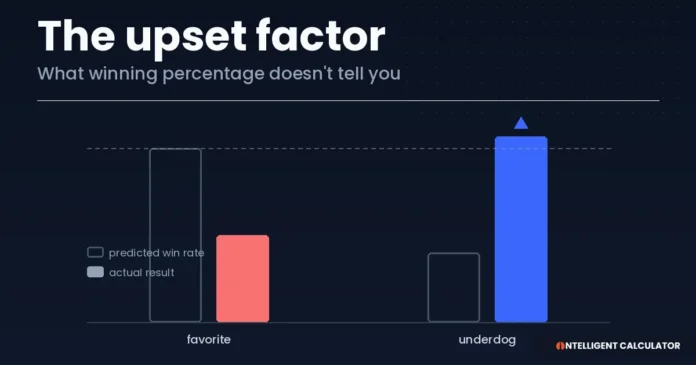

A 9-loss team just beat the league’s best squad. Fans call it a fluke. The numbers tell a different story.
Winning percentage is the most-quoted stat in sports. It is also one of the most misread. A single number — wins divided by games played — gets treated as proof of how good a team really is.
But raw winning percentage hides a lot. It does not show who a team played, when games happened, or how close those games actually were. That hidden layer of data is exactly where upsets come from.
This guide breaks down what winning percentage really measures, why it can mislead you, and how a few deeper calculations expose the truth behind the record. It also walks through the Winning Percentage Calculator, a free tool that runs these deeper numbers for you in seconds.
Quick takeaway: A team’s record tells you what happened. Adjusted metrics tell you why — and they’re often the earliest warning sign of an upset.
Who This Guide Is For
Coaches, analysts, fantasy players, and bettors all rely on win percentage at some point.
This guide is built for three groups:
- Casual fans who want to understand what a record really means
- Fantasy and betting enthusiasts looking for an edge beyond the box score
- Coaches, analysts, and student-athletes who need a fast way to benchmark performance
Whether you’re sizing up your fantasy league or scouting a playoff bracket, the same hidden data applies.
What Winning Percentage Actually Measures
Winning percentage is a simple ratio. It divides total wins by total games played.
The standard formula looks like this:
Winning Percentage = (Wins + 0.5 × Ties) ÷ Total Games
Ties count as half a win because they sit between a win and a loss. A team with 18 wins, 7 losses, and 1 tie plays 26 games total.
Their winning percentage comes out to about 0.712, or 71.2%. That number sounds impressive on its own.
But a winning percentage by itself answers only one question: how often did this team win? It says nothing about who they beat.
Why Raw Win Percentage Lies to You
Two teams can finish with the exact same 0.600 winning percentage. One earned it against the toughest schedule in the league. The other padded its record against weak opponents.
On paper, they look identical. In reality, they are nowhere close.
This gap is the single biggest reason upsets catch people off guard. A team’s seed, ranking, or record gets treated as gospel, while the context behind that record gets ignored.
Pro tip: Before trusting any win percentage, always ask what the opponent’s average win percentage was. That one comparison reveals more than the record itself.
The Schedule Problem
Strength of schedule measures the average win percentage of every opponent a team faced. A team that beat mostly losing teams inflates its record without proving much.
Schedule-adjusted win rate corrects for this. It blends a team’s raw win percentage with the average quality of opponents faced, producing a more honest performance score.
The Close-Game Problem
Blowout wins and nail-biters count the same in a win-loss column. But they are not the same kind of evidence.
A team that wins by 20 points proved dominance. A team that wins by 2 points in the final seconds proved something closer to survival.
Tracking performance specifically in close games — often called clutch performance — shows how a team handles pressure. That number predicts close-game outcomes far better than overall record does.
Anatomy of an Upset: What the Hidden Data Shows
Picture two teams entering a playoff matchup.
Team A finished the season 18-4, a sparkling 0.818 winning percentage. Team B finished 12-10, a modest 0.545.
On paper, Team A should win comfortably. The hidden data tells a different story.
Team A’s average opponent won only 38% of their own games. Most of Team A’s wins came against weak competition.
Team B’s average opponent won 58% of their games — a brutal schedule by comparison. Team B also went 7-3 in close games, a clutch rate that beats Team A’s 4-3 mark in similarly tight contests.
Once you adjust both records for schedule strength, the gap nearly disappears. Team A’s adjusted score lands near 0.66, while Team B’s climbs to roughly 0.60.
That six-point swing is exactly the kind of gap that produces upsets. The favorite was never as dominant as the record suggested.
Six Hidden Metrics That Predict Upsets
Raw win percentage is just the starting point. These six layers, all built into the calculator, reveal the rest of the story.
| Metric | What It Reveals | Why It Matters for Upsets |
|---|---|---|
| Schedule-Adjusted Win Rate | True strength after correcting for opponent quality | Exposes inflated records |
| Home vs. Away Split | How much a team depends on home-court advantage | Road favorites often underperform |
| Clutch Performance Index | Win rate in close, high-pressure games | Predicts who folds under pressure |
| Probability Index | Statistical odds of hitting a target win pace | Flags teams trending up or down |
| Championship Contender Score | Combined schedule difficulty and success probability | Separates real contenders from paper tigers |
| Win-Loss Ratio | Wins per loss, independent of ties | Highlights dominance level, not just frequency |
Each of these factors layers on top of the basic record. Together, they explain why “better” teams lose more often than fans expect.
How to Use the Winning Percentage Calculator
The Winning Percentage Calculator turns every formula above into an instant result. No spreadsheet or math required.
Step 1: Enter Your Basic Record
Start with the Raw Winning Percentage card. Enter wins, losses, and ties.
The calculator instantly returns your winning percentage, total games played, win-loss ratio, and a performance tier — Elite, Contender, Average, or Rebuilding.
Step 2: Adjust for Schedule Strength
Move to the Schedule-Adjusted Win Rate card. Your raw win percentage auto-fills from Step 1.
Enter your average opponent’s win percentage. The tool returns an Adjusted Performance Score and flags your schedule as High, Medium, or Low difficulty.
A positive gap means your raw record overstated your strength. A negative gap means you actually outperformed expectations.
Step 3: Check Your Clutch Factor
The Clutch Performance Index card asks for wins and losses specifically in close games. It returns your clutch win percentage and a 0-to-1 reliability score.
Low reliability with a high overall record is a classic upset warning sign.
Step 4: Review Your Contender Score
The Championship Contender Rating card combines your adjusted performance score with a probability index. It outputs a 1-to-100 contender score and a team status label.
This single number is the closest thing to a true-strength rating the calculator produces.
Assumptions and Limitations
Every formula in this tool relies on a few built-in assumptions. Understanding them helps you read results correctly.
- Ties count as half a win, matching standard sports convention
- Schedule strength assumes opponent records are accurate and recent
- Clutch performance treats all close games as roughly equal pressure, regardless of stakes
- Projections assume current pace continues, which injuries or trades can change instantly
This tool is built for quick, directional analysis. It is not a betting guarantee or a substitute for full scouting reports.
Step-by-Step Example: Spotting an Upset Before It Happens
Here’s a full walkthrough using a real calculator scenario.
The setup: The Riverside Hawks sit at 12 wins, 6 losses, and 2 ties. Their average opponent’s win percentage is 0.500.
Step 1 — Raw win percentage: (12 + 0.5 × 2) ÷ 20 = 0.650, or 65.0%.
Step 2 — Schedule-adjusted score: (0.650 × 0.6) + (0.500 × 0.4) = 0.590, or 59.0%.
The gap between raw and adjusted is +6.0%. That tells us the Hawks’ schedule was a bit easier than league average.
Step 3 — Clutch check: The Hawks went 5-3 in close games, a 62.5% clutch rate against a 65% overall rate.
That’s a small but real drop-off. It suggests slightly weaker performance when games tighten up.
The verdict: The Hawks are good, but not as dominant as their record alone suggests. A team with a tougher schedule and a higher clutch rate would be the more dangerous matchup — exactly the profile of a classic upset team.
Common Mistakes When Reading Win Percentages
Even experienced fans fall into these traps.
- Comparing records across different schedules without adjusting for opponent strength
- Ignoring sample size — a 5-game win streak means less than a 30-game trend
- Treating close wins and blowouts as equal evidence of true ability
- Skipping home/away splits, especially before road playoff games
- Assuming current pace will hold without accounting for injuries or fatigue
Warning: Win percentage trends late in a season carry more weight than early-season numbers, since small samples swing wildly after just one or two games.
Comparison: Raw Win Percentage vs. Adjusted Metrics
| Factor | Raw Win Percentage | Schedule-Adjusted Score | Contender Score |
|---|---|---|---|
| What it measures | Wins ÷ total games | Win rate weighted by opponent quality | Combined strength and consistency |
| Best used for | Quick snapshot | Comparing teams across schedules | Ranking true championship odds |
| Main weakness | Ignores opponent quality | Needs accurate opponent data | Requires multiple inputs |
| Upset-detection value | Low | Medium-High | High |
No single metric tells the full story alone. Using all three together gives the clearest picture of true team strength.
Expert Insight: Why Analysts Trust Adjusted Metrics More
Professional analysts rarely rank teams by raw record alone. Most respected power rankings blend strength of schedule, point differential, and recent form into a single composite score.
This same logic appears in advanced sports analytics, including Pythagorean win expectation models that predict wins based on scoring patterns rather than win-loss totals alone. The principle stays consistent across every method: context beats raw record every time.
That’s the core reason upsets happen so often in single-elimination formats. A slight edge in adjusted metrics can flip an entire matchup that the raw record made look one-sided.
Frequently Asked Questions
What is a good winning percentage in sports?
A winning percentage above 0.600 is generally considered strong across most sports. Anything above 0.700 typically signals an elite team, while under 0.400 suggests a rebuilding season.
Why do ties count as half a win?
Ties sit between a win and a loss in outcome value. Counting them as 0.5 keeps the formula mathematically consistent with true performance.
Can a lower-ranked team really be the stronger team?
Yes. If that team faced a tougher schedule or performed better in close games, its true strength can exceed a higher-ranked team with an easier path to its record.
How accurate is strength of schedule as a predictor?
It’s a strong directional indicator, not a guarantee. It works best combined with clutch performance and recent form, not used alone.
Does home-field advantage really matter that much?
Yes, in most sports the gap between home and away win rates is measurable and consistent. Large home-away splits are a common pre-upset warning sign for road games.
What causes most sports upsets?
Most upsets trace back to an inflated record from a weak schedule, a poor clutch performance history, or a recent form decline that the season-long record hasn’t caught up to yet.
Is winning percentage useful for fantasy sports?
Yes. The same logic applies to fantasy matchups — checking opponent strength of schedule before a playoff week can flag teams whose records are stronger than their underlying performance.
How often should I recalculate these metrics?
Recalculate after every few games, especially late in a season. Recent data matters more than full-season averages when projecting upcoming matchups.
Key Takeaways
Winning percentage is a useful starting point, but never the full story. The real signal lives in the layers underneath it.
- Always check strength of schedule before trusting a record at face value
- Clutch performance reveals how a team handles pressure, not just how often it wins
- Adjusted metrics, not raw records, separate real contenders from inflated ones
- Upsets almost always trace back to a gap between perceived and true team strength
The next time a “weaker” team pulls off a stunning win, it likely was not random at all. The data was there the whole time — it just wasn’t in the win column.
Run your own numbers through the Winning Percentage Calculator to see exactly where your team’s record holds up, and where the hidden data tells a different story.