


Conception happens when a sperm fertilizes an egg inside the fallopian tube. This event forms a single cell called a zygote, which carries a complete set of 46 chromosomes. The zygote divides repeatedly, becomes a blastocyst, and implants into the uterine lining about a week later. This implantation step marks the true start of pregnancy.
Conception matters because it triggers every hormone shift, symptom, and due date calculation that follows. People trying to get pregnant use this timeline to find their fertile window. People trying to avoid pregnancy use the same timeline to plan around it. Healthcare providers use it to set prenatal screening schedules and calculate an estimated due date.
The conception process has four main parts: ovulation, sperm transport, fertilization, and implantation. Each part depends on precise hormone timing and healthy reproductive anatomy. The sections below explain each part, answer the most common questions people ask about conception, and cover the factors that help or block the process.
What Is Conception?
Conception is the moment a sperm cell fertilizes an egg cell, creating a zygote that will grow into an embryo. Doctors also call this event fertilization. It is one step inside a longer process that starts with ovulation and ends when a fertilized egg implants in the uterus.
The egg and sperm each carry 23 chromosomes. When they combine, the zygote holds 46 chromosomes, the same number found in every other human cell. This chromosome count is why conception marks the genetic starting point of a new individual.
Cleveland Clinic and other medical sources describe conception as a multi-step biological chain, not a single instant. The chain includes egg release, sperm travel, fertilization inside the fallopian tube, cell division, and attachment to the uterus. A pregnancy only begins once every step in that chain succeeds.
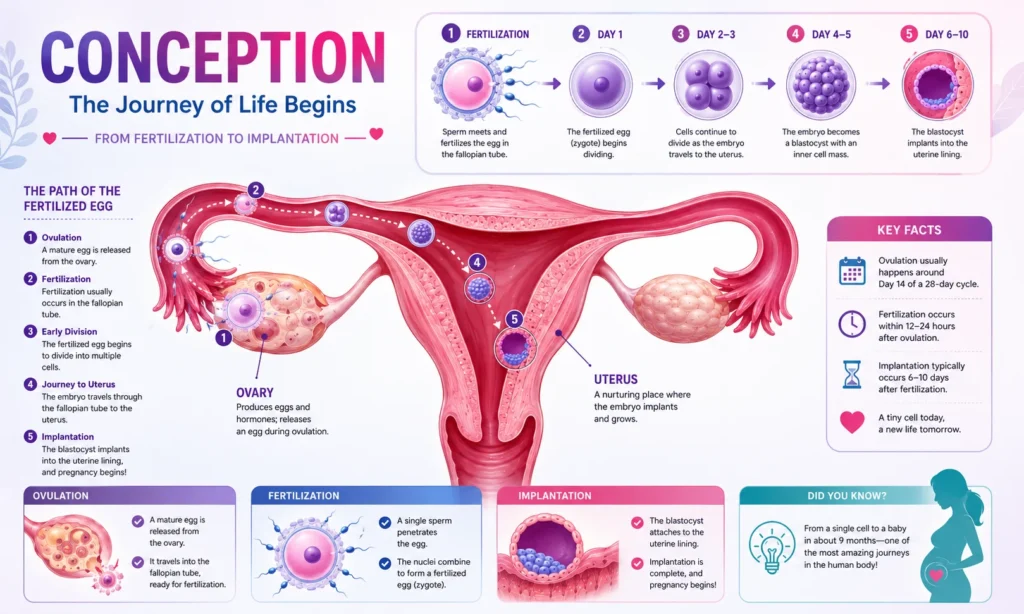
Ovulation
Ovulation is when an ovary releases a mature egg. This release happens around the middle of the menstrual cycle, usually between day 12 and day 16 of a 28-day cycle.
A rise in luteinizing hormone (LH) triggers the ovary to release the egg. Tiny finger-like structures on the fallopian tube, called fimbriae, sweep the egg into the tube. The egg then travels toward the uterus, and sperm can fertilize it during this short trip.
A released egg survives for only 12 to 24 hours. If sperm does not reach it within that window, the egg breaks down and leaves the body during the next period. Use our Ovulation Calculator to estimate your fertile window, predict ovulation, and improve your chances of conception.
Sperm Release and Travel
During ejaculation, a man releases between 40 million and 300 million sperm cells. Every one of these cells has one job: find and fertilize the egg.
Sperm swim from the vagina, through the cervix, across the uterus, and into the fallopian tubes. The vagina is acidic, and cervical mucus blocks most sperm along the way. Fewer than a few hundred sperm ever reach the egg.
Sperm can survive inside the female reproductive tract for up to 5 days. This survival window is the biological reason intercourse days before ovulation can still lead to conception.
Fertilization
Fertilization is the moment a sperm enters an egg and their genetic material combines into one cell. Doctors call this new cell a zygote.
The egg is covered by a protective layer called the zona pellucida. A sperm breaks through this layer using enzymes released from its head in a step called the acrosome reaction. Once one sperm enters, the egg instantly hardens its outer layer to block every other sperm cell.
If no sperm fertilizes the egg within 24 hours of ovulation, the egg dissolves.
Blastocyte Formation
The fertilized egg, or zygote, divides into 2 cells, then 4, then 8, while moving down the fallopian tube. By day 5 or 6, this cluster grows into roughly 100 cells and is now called a blastocyst.
The blastocyst has two parts. The inner cell mass becomes the baby. The outer cell layer becomes the placenta and supporting membranes.
Implantation
Implantation is when the blastocyst attaches to the lining of the uterus. This attachment usually happens 6 to 10 days after fertilization.
Specialized outer cells on the blastocyst burrow into the uterine lining and connect to the mother’s blood supply. Once attached, these cells release human chorionic gonadotropin (hCG), the hormone that home pregnancy tests detect. This hCG surge also stops the next menstrual period, which is often the first sign of pregnancy a person notices.
If implantation does not happen, the blastocyst dissolves and leaves the body during the next period.
Where Does Conception and Fertilization Happen?
Conception and fertilization happen inside the fallopian tube. The fallopian tube is the passage between the ovary and the uterus, and it is where a released egg waits for sperm to arrive.
Fertilization occurs in the outer third of the fallopian tube, an area doctors call the ampulla. In rare cases tied to fertility treatment, fertilization can happen inside a lab dish instead of the body.
How Long Does Fertilization Take?
Sperm can penetrate and fertilize an egg within a few minutes of contact. The complete fertilization process, meaning the full merger of sperm and egg genetic material into one zygote, takes several hours.
When Does Conception Happen?
Conception happens between 12 and 24 hours after ovulation. This short window exists because a released egg only survives for about a day.
Doctors often use ovulation predictor kits or menstrual cycle tracking to estimate this window, since ovulation timing can shift from month to month.
How Long Does It Take to Conceive?
Most couples conceive within 6 to 12 months of trying, if they have regular unprotected sex. Age, sex frequency, and ovulation regularity all affect this timeline.
A healthcare provider can help if conception has not happened after 12 months of regular attempts, or after 6 months for women over age 35. A provider can check for blockages, hormone problems, or sperm quality issues that may be slowing the process.
What Are My Chances of Conceiving?
A healthy couple has about a 1 in 4, or 25%, chance of conceiving in any single menstrual cycle. This percentage drops after age 35, largely because egg quality and quantity decline with age.
Timing intercourse within the fertile window raises these odds. Age, overall health, sperm quality, and how regularly ovulation occurs all shift this percentage up or down.
What Things Prevent Conception From Happening?
Six common issues can stop conception, even when an egg and sperm are both present in the body:
- Irregular ovulation. Some months, the ovary may not release an egg at all.
- Timing outside the fertile window. Sex that happens more than a day after ovulation, or more than 5 days before it, rarely leads to conception.
- Low sperm count. Fewer sperm cells lower the odds that one will reach the egg.
- Poor sperm movement. Sperm that swim slowly or in the wrong direction struggle to reach the fallopian tube.
- Blockages. A blockage in the testicles, ovaries, or fallopian tubes can stop sperm or eggs from traveling.
- Hormonal imbalances. Low or unbalanced hormone levels can prevent ovulation or disrupt implantation.
Can You Feel Conception?
No, most people cannot feel conception. The fusion of sperm and egg happens on a microscopic level, deep inside the fallopian tube, with no nerve signal to register.
Some people notice ovulation signs beforehand, such as a change in vaginal discharge. A smaller group notices mild cramping or light spotting, called implantation bleeding, several days after conception, once the blastocyst attaches to the uterus.
What Are the Different Types of Fertilization?
Fertilization happens in three main ways: natural, assisted, and artificial.
| Fertilization Type | Where It Happens | Medical Help Needed | Common Method |
|---|---|---|---|
| Natural fertilization | Inside the body, in the fallopian tube | None | Unprotected intercourse |
| Assisted fertilization | Inside the body, in the fallopian tube | Some | Intrauterine insemination (IUI) |
| Artificial fertilization | Outside the body, in a lab | Extensive | IVF (in vitro fertilization) or ICSI (intracytoplasmic sperm injection) |
Natural fertilization happens inside the body after sex, when sperm swims up and fertilizes an egg without any medical assistance.
Assisted fertilization still happens inside the body, but a healthcare provider places sperm directly into the uterus to shorten the sperm’s travel distance. Doctors call this method intrauterine insemination (IUI).
Artificial fertilization happens outside the body during fertility treatments. In IVF (in vitro fertilization), doctors combine eggs and sperm in a lab dish. In ICSI (intracytoplasmic sperm injection), a single sperm is injected directly into an egg. Providers then transfer the resulting embryo into the uterus.
The Fertile Window Explained
The fertile window is the 6-day span when sex is most likely to lead to conception. This window includes the 5 days before ovulation and the day of ovulation itself.
Sperm can live inside the female reproductive tract for up to 5 days, waiting for an egg to appear. Once ovulation passes, the window closes fast, because the egg only survives for 12 to 24 hours.
Ovulation predictor kits measure LH levels in urine and can flag this window with more accuracy than calendar counting alone. Tracking basal body temperature and cervical mucus changes offers a lower-cost, hormone-free option, though it requires daily tracking over several cycles to spot a pattern.
Early Signs and Symptoms After Conception
Nobody feels the moment of fertilization. However, once implantation happens, rising hormone levels can trigger early symptoms within 1 to 2 weeks.
- Implantation bleeding. Light spotting that occurs 6 to 12 days after conception, lasting a day or two.
- Mild cramping. Light, low-abdominal pulling caused by early uterine changes.
- Breast tenderness. Estrogen and progesterone increases make breast tissue feel sensitive or swollen.
- Fatigue. A rapid rise in progesterone often causes sudden tiredness.
- Frequent urination. Expanding blood volume makes the kidneys process more fluid.
A missed period remains the clearest early signal for most people, since it follows directly from the hCG surge that implantation triggers.
Common Myths About Conception
Myth: You can only get pregnant on the exact day you ovulate. This is false. Sperm can survive up to 5 days inside the body, so sex during the 5 days before ovulation can still lead to conception.
Myth: Conception happens immediately after sex. This is false. Sperm needs time to travel from the vagina to the fallopian tube, and fertilization can happen anywhere from a few hours to several days after intercourse.
Myth: A positive pregnancy test means conception happened yesterday. This is false. Home pregnancy tests detect hCG, a hormone that only appears after implantation. A positive result usually points to conception at least 10 to 14 days earlier.
Myth: Stress alone stops conception. This is misleading. High stress can disrupt ovulation and hormone balance over time, but it is rarely the sole reason a couple has not conceived.
Ways to Track Ovulation and Conception
| Tracking Method | Accuracy | Cost | Effort Required |
|---|---|---|---|
| Calendar counting | Low | Free | Low |
| Basal body temperature | Moderate | Low | Daily tracking |
| Cervical mucus monitoring | Moderate | Free | Daily observation |
| Ovulation predictor kits | High | Moderate | Daily testing near ovulation |
| Fertility monitors/apps with hormone tracking | High | Higher | Moderate |
| Ultrasound monitoring (medical) | Highest | High | Clinic visits |
Ovulation predictor kits and hormone-tracking monitors give the clearest short-term picture of the fertile window. Ultrasound monitoring, used mainly during fertility treatment, gives a provider a direct view of egg development and is the most accurate option available.
Additional Common Questions
Is the Conception Date the Day I Got Pregnant?
Yes, the conception date is the day fertilization occurred, but pinpointing that exact day is hard with natural conception. Because ovulation timing can vary, healthcare providers usually calculate a due date from the first day of the last menstrual period instead of the conception date itself.
People who conceive through IVF are an exception. Since the embryo transfer date is known, providers can identify the exact conception date without estimation.
Does Age Affect Conception?
Yes, age strongly affects the chances of conception. Egg quantity and quality decline gradually through the 20s and 30s, then drop faster after age 35.
Sperm quality also declines with age, though more gradually than egg quality. A couple in their 20s has a higher monthly chance of conceiving than a couple in their late 30s or 40s.
Can You Conceive With Irregular Periods?
Yes, conception can happen with irregular periods, though tracking the fertile window becomes harder. Irregular cycles make it difficult to predict ovulation using calendar methods alone.
Ovulation predictor kits, hormone tracking, or guidance from a healthcare provider can help identify the fertile window even when cycle length varies month to month.
What Is the Difference Between Fertilization and Implantation?
Fertilization is the joining of a sperm and egg inside the fallopian tube. Implantation is the attachment of the resulting blastocyst to the uterine wall about a week later. Fertilization creates the zygote. Implantation establishes the pregnancy.
How Soon Can You Take a Pregnancy Test After Conception?
Most pregnancy tests give an accurate result about 12 to 14 days after conception, once implantation has released enough hCG to detect. Testing earlier than this raises the chance of a false negative, since hCG levels may still be too low to register.
What Prevents Conception the Most Often?
Irregular ovulation and mistimed intercourse cause more conception delays than any other single factor. Low sperm count, blockages, and hormone imbalances also play a role, but timing issues affect the largest share of couples trying to conceive.
A Note From Medical Experts
Reproductive endocrinologists consistently point to timing and consistency as the two biggest levers a couple can control. Tracking ovulation across several cycles, rather than relying on a single calendar guess, gives couples a clearer view of their personal fertile window. Providers also recommend a fertility evaluation after 12 months of trying, or 6 months for women over 35, since early testing can catch treatable issues like hormone imbalances or blockages before they cause long delays.
Conclusion
Conception happens when a sperm fertilizes an egg in the fallopian tube, forming a zygote that grows into a blastocyst and implants in the uterus to start a pregnancy. This process depends on precise timing between ovulation, sperm survival, and the short life span of the egg.
The fertile window spans 6 days: the 5 days before ovulation and the day of ovulation itself. Conception occurs 12 to 24 hours after ovulation, and implantation follows 6 to 10 days after fertilization.
Most couples conceive within 6 to 12 months of regular, unprotected sex, with each cycle carrying about a 25% chance of success. Ovulation tracking, healthy timing, and early medical guidance all improve those odds. Anyone facing conception delays beyond these timelines should talk to a healthcare provider, who can check for blockages, hormone issues, or sperm and egg health problems that may be slowing the process.