
Last updated: Nov 03, 2026
French Drain Calculator
| Item | Value | Basis |
|---|---|---|
| Minimum pipe slope | 1% (1/8 in per ft) | Consistent across installation guides |
| Recommended slope | 2% (1/4 in per ft) | Engineering guides |
| #57 stone density | 1.40 tons per yd³ | Supplier ordering figure; range 1.35 to 1.50 |
| Stone price (bulk) | $35 to $55 per ton | 2026 supplier guides, before delivery |
| Exterior drain, installed | $10 to $65 per ft | 2026 cost guides |
| Interior drain, installed | $40 to $100 per ft | 2026 cost guides |
| Standard trench | 8 to 12 in wide, 18 to 24 in deep | Residential practice |
| Fabric overlap | 6 to 12 in | Installation guides |
| Deep trench safety | 5 ft or more needs protection | OSHA 29 CFR 1926.652 |
French Drain Calculator: Gravel, Pipe, Fabric and Cost
A French drain calculator turns trench length, width, and depth into a shopping list: gravel in cubic yards and tons, plus pipe, filter fabric, slope, and cost. A 50 ft trench, 12 in wide and 18 in deep, with 4 in Schedule 40 pipe and 10 percent waste, needs about 2.83 cubic yards, or 3.96 short tons, of washed #57 stone.
This French drain gravel calculator serves homeowners planning a yard drain or driveway drain, landscapers pricing a job, and anyone checking a contractor quote. It also settles the DIY versus hire question. Weeping tile (Canada) and land drain (UK and Ireland) are other names for the same system, so the same numbers apply.
A French drain fails quietly when its slope is under 1 percent, its stone contains fines, or its outlet has nowhere to go. The water simply returns, and the trench gets dug twice. Good numbers up front prevent that.
|
Before you dig Call 811 (US) or your local utility locate service first. Plan the outlet before the trench. Trenches 5 ft deep or more need shoring or sloped walls under OSHA 29 CFR 1926.652, and cave-in risk rises past 4 ft. Check city, county, and HOA (homeowners association) discharge rules. |
What Is a French Drain and How Does It Work?
A French drain is a stone-filled trench, usually with a perforated pipe, that moves subsurface water to an outlet. Water enters the stone, flows into the pipe, and runs downhill. A French drain lowers groundwater and moves soil water away from lawns, walls, and foundations. Think of it as a buried gutter for the soil.
Main parts of a French drain
- Perforated pipe: a pipe with holes or slots that lets water in.
- Drainage stone: clean, washed, angular stone with open space between pieces.
- Filter fabric (geotextile): cloth that keeps soil out of the stone.
- Outlet: where the water leaves, such as daylight, a pop-up emitter, a catch basin, or a dry well.
- Cleanout: an access port at the high end of the pipe that allows flushing later.
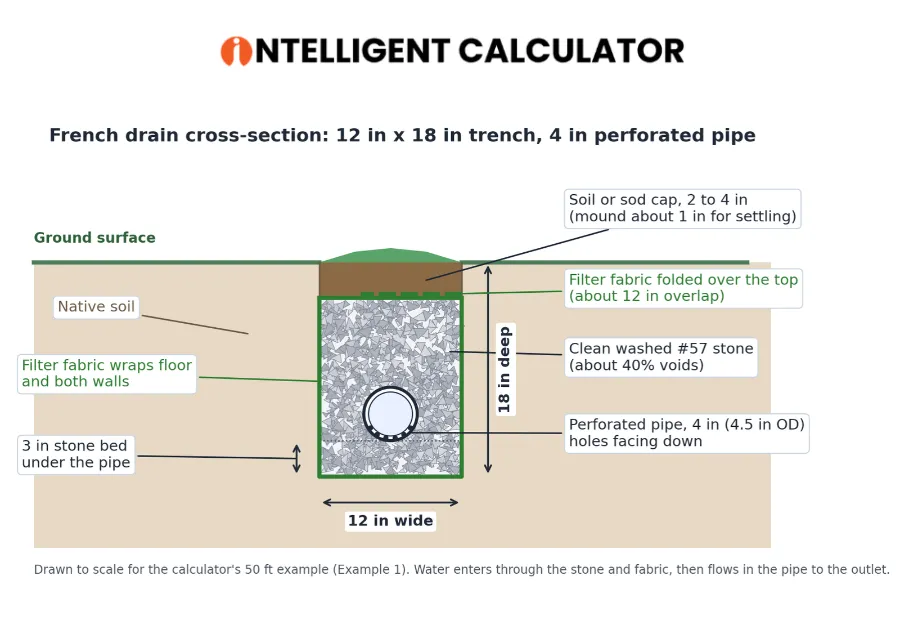
Figure 1. A French drain is a fabric-lined trench with a perforated pipe resting on a 3 inch stone bed.
Other names: weeping tile, land drain, yard drain
Weeping tile is the Canadian name for a French drain. A land drain or field drain is the usual UK and Ireland term. A yard drain or drainage trench describes the same buried stone-and-pipe idea. A pipeless French drain uses stone only. It works for small, shallow wet spots, while longer runs need pipe to move water reliably.
Before you buy stone, confirm that a French drain actually fits the problem.
Signs You Need a French Drain (and When You Do Not)
Standing water that lingers for days after rain, a soggy lawn, and damp soil against a wall are the main signs of a drainage problem. Only some of them call for a French drain, because the cause decides the fix.
| Symptom | Likely cause | Best fix |
| Soggy lawn days after rain | Groundwater or a low spot | French drain, or regrading for a low spot |
| Water pooling against a wall | Surface runoff or poor grading | Regrade, swale, or downspout extension |
| Damp or wet basement wall | Failed footing or wall drainage | Footing or wall drain; professional design |
| Roof water running toward the house | Gutter discharge | Solid downspout line, not a French drain |
A soggy lawn points to groundwater, while pooling at a wall usually points to surface runoff, and only the first is a clear fit for a French drain.
A simple soil check before you dig
University of Maryland Extension describes a percolation test: dig a hole 12 inches deep and about 12 inches across, fill it with water, and fill it again the next day. All of the water should drain within eight hours. A much slower result means slow soil. Will a French drain work in clay? The stone and pipe still carry water to a daylight outlet, but a dry well outlet may drain too slowly, and fabric becomes essential.
French drain vs trench drain vs curtain drain
| Option | What it is | Best for | Limits |
| French drain | Buried stone and perforated pipe | Subsurface water, soggy lawns | Needs slope and an outlet |
| Trench drain (channel drain) | Surface grate over a channel | Patios and driveways | Does not collect soil water |
| Curtain drain | French drain placed uphill of a house | Intercepting groundwater | Needs room and an outlet |
| Footing drain | Pipe beside the foundation footing | Basement water | Deep; professional work |
| Retaining wall drain | Drain behind a wall | Relieving hydrostatic pressure | Confirm design with an engineer |
| Swale | Shallow grass channel | Surface runoff across a yard | Takes yard space |
| Solid downspout line | Closed pipe for roof water | Roof runoff | Does not drain soil |
| Dry well | Underground storage pit | Storing storm water on site | Needs soil that absorbs water |
| Regrading | Reshaping the ground | Water running toward a house | Needs the right slope; may need a pro |
| Sump pump | Pit and pump | Basement water | Professional work; pump tie-in |
A trench drain is a surface grate over a channel, while a French drain is buried stone and pipe, so the two are not interchangeable. Hydrostatic pressure is the force of water pushing against a wall, and a retaining wall drain relieves it. If you are planning the wall itself, the retaining wall calculator sizes the wall.
If a French drain is the right fix, the next question is how much stone it needs.
How Much Gravel Do You Need for a French Drain? Quick Reference Table
A standard 12 in by 18 in French drain trench needs about 5.7 cubic yards, or 7.9 tons, of washed #57 stone per 100 feet. That figure includes 10 percent waste. These values use the calculator defaults: 4 in Schedule 40 PVC pipe, washed #57 stone at 1.40 tons per cubic yard, and a full fabric wrap with a 12 in overlap and 10 percent trimming waste.
| Trench (L x W x D) | Gravel to order | Weight | 50 lb bags | Fabric |
| 25 ft x 12 in x 18 in | 1.42 yd³ | 1.98 tons | 80 | 165 ft² |
| 50 ft x 12 in x 18 in | 2.83 yd³ | 3.96 tons | 159 | 330 ft² |
| 100 ft x 12 in x 18 in | 5.66 yd³ | 7.93 tons | 318 | 660 ft² |
| 50 ft x 12 in x 24 in | 3.85 yd³ | 5.39 tons | 216 | 385 ft² |
| 100 ft x 12 in x 24 in | 7.70 yd³ | 10.78 tons | 432 | 770 ft² |
| 100 ft x 18 in x 30 in | 14.83 yd³ | 20.76 tons | 831 | 990 ft² |
Gravel per foot of French drain: divide any row by its length. The 12 x 18 in trench uses about 0.057 yd³, or 0.08 tons, per foot. Tons of #57 stone for 50 feet: a 12 x 18 in trench needs 3.96 tons, or about 159 bags. A 12 x 24 in trench of the same length needs 5.39 tons.
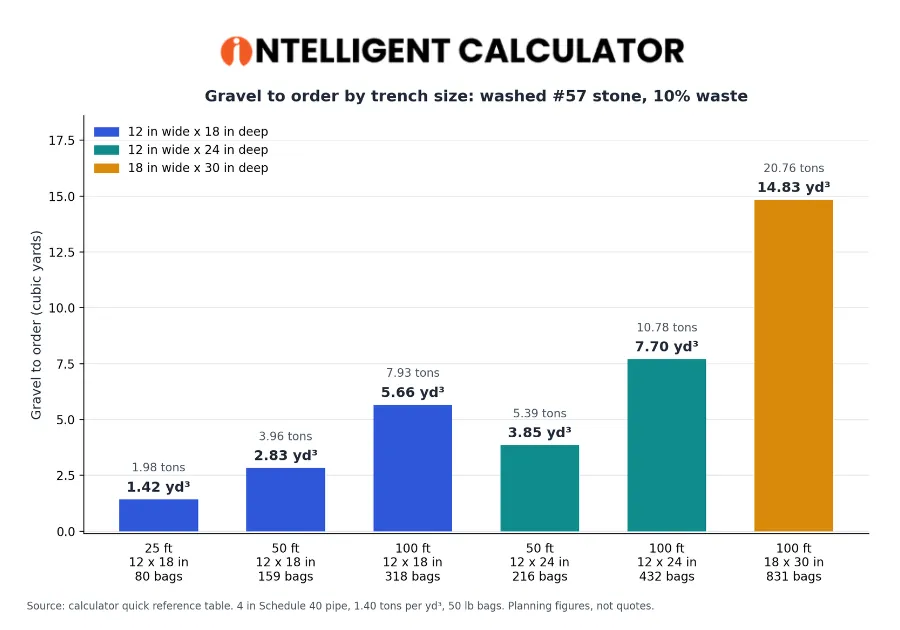
Figure 2. Gravel to order by trench size. Depth and width raise the total faster than length alone.
If your trench is not a standard size, the cubic yard calculator and the square feet to cubic yards calculator convert any bed size into yards. The general gravel calculator covers other jobs, while this page owns the French drain case.
How to Use the French Drain Calculator
The French drain calculator has 12 linked cards. Each card works alone, and each shows results plus a chart under that card when you press Calculate. Results from one card suggest starting values in the next. Those fields are marked Auto-filled, and auto-fill never overwrites a value you typed.
Most length, area, volume, and weight fields switch between feet, inches, yards, metres, centimetres, and millimetres. Each card also takes a currency, such as $, £, €, or Rs.
| Card | Question it answers | Why the number matters |
| 1. Trench and Gravel | How much stone do I order? | Stone is the largest material cost and is sold by weight |
| 2. Pipe Length, Slope and Fall | How much pipe, and how deep at the outlet? | Fall decides whether water flows at all |
| 3. Filter Fabric (Geotextile) | How much fabric and how many rolls? | Fabric keeps soil out of the stone |
| 4. Cost Estimator | What will it cost against 2026 prices? | A market check exposes a high quote or a missed item |
| 5. Runoff and Design Flow | How much water arrives? (Rational Method) | Flow sets the pipe size |
| 6. Pipe Capacity (Manning) | Can the pipe carry that flow? | An undersized pipe backs up |
| 7. Excavation, Spoil and Labor | How much soil, and how many dig hours? | Digging is the largest labor cost |
| 8. DIY vs Hybrid vs Contractor | Which path costs less? | The break-even hourly value shows when hiring wins |
| 9. Stone and Fabric Selector | Which stone scores best? | Stone choice sets flow and clogging risk |
| 10. Dry Well and Outlet Sizing | How much storage, and how long to drain? | An outlet that fills is a failed outlet |
| 11. Sensitivity and Scenario | Which input moves my budget most? | Shows where a price check pays off |
| 12. Readiness Check and Order Sheet | Am I ready to dig? | Gathers the order into one sheet |
The first four cards ask for the most input. Card 1 takes trench length, width, and depth, plus a pipe from 23 options (2 in to 15 in; corrugated, dual-wall, Schedule 40, and SDR 35), a stone from 27 options (including #57, #67, river gravel, pea gravel, and UK drainstone), a soil cap, a waste allowance (default 10 percent), stone moisture (dry, damp +5 percent, wet +12 percent), and price per ton. It returns gravel to order, weight in short tons and metric tonnes, 50 lb bags, stone cost, the space the pipe displaces, and the water the stone voids can hold. It warns when the trench is too narrow for the pipe. For a check on displacement, use the pipe volume calculator.
Card 2 returns total fall, outlet depth, pipe to buy, sections, joints, and fall per 10 feet for string-line stakes. Card 3 returns strip width, fabric area, rolls, and cost for three wrap methods. Card 4 adds stone, pipe, fabric, outlet hardware, digging, rental, permits, contingency, and sales tax, then tells you whether your DIY total is below, inside, or above the market range. Every price is editable.
Which Stone Is Best for a French Drain?
Clean, washed, angular crushed stone about 3/4 to 1 inch in size is the best French drain stone. It is sold as #57 stone, where the “57” is a size number from ASTM D448, the standard that sizes coarse aggregate. Clean stone has big gaps between pieces, and water moves through those gaps. This is called an open-graded mix.
Void ratio of #57 stone
Void ratio, also called porosity, is the share of stone volume that is open space. Clean #57 holds about 40 percent voids, and the calculator uses 37 to 43 percent for clean stone. One cubic yard of #57 can hold roughly 80 gallons of water.
| Stone | Verdict | Why |
| #57 washed crushed stone | Best all-round | Angular, open voids, resists clogging |
| #67 or #8 washed stone | Good | Smaller pieces, still open-graded |
| Washed river gravel (river rock) | Good for visible drains | Rounded; shifts more, lower interlock |
| Pea gravel | Works with limits | Rounded, compacts, holds less water |
| UK drainstone (20 to 40 mm) | Good | Common UK term for clean aggregate |
| Crusher run, DGA, 2A modified | Avoid | Dense-graded; fines fill the gaps |
| Stone dust or screenings | Avoid | Packs tight and blocks flow |
Only clean, open-graded stone keeps French drain voids open, and the dense-graded options at the bottom of the table do not. DGA means dense-graded aggregate. For rounded options, see the river rock calculator. For angular stone in other sizes, use the crushed stone calculator.
Why crusher run fails
Crusher run is a dense-graded mix of stone and fine dust. It compacts well, which suits a driveway base. In a drain, those fines fill the voids and slow the water to a crawl.
Pea gravel vs #57 stone for a French drain
The calculator rates pea gravel below angular stone for interlock and flow, and it flags the choice. Published advice disagrees. HelloGravel’s French drain gravel guide calls pea gravel a poor choice and limits it to a thin decorative top layer, yet another HelloGravel page offers a pea gravel quantity guide for French drains. Gravel Monkey’s 2026 guide lists pea gravel as decorative only. Because pea gravel is rounded and packs tighter, #57 stone is the safer choice.
Filter Fabric: Which Type and How Much?
In silty or clay soil, wrap the stone in non-woven, needle-punched filter fabric. Without it, fine soil washes into the stone and the drain clogs from the outside in. Geotextile is the engineered cloth made for this job.
- Non-woven, needle-punched: thick and felt-like. This is the usual choice around drains.
- Woven slit-film: thin and tape-like. It can clog, which is called blinding, in silty soil.
Pick fabric by its data sheet, not its name. The apparent opening size (ASTM D4751) and water permeability (ASTM D4491) should suit your soil. AASHTO M288 is the US geosynthetic specification that covers drainage geotextiles, so ask a supplier whether a fabric meets it. Retail weed barrier is not drain fabric, because it clogs and tears.
| Wrap method | Strip width | Best for |
| Full wrap (stone fully enclosed) | 2D + 2W + overlap | Most yard drains in fine soil |
| U-liner with cover strip | 2D + W + overlap | Drains with a soil or sod cap |
| Open-top liner | 2D + W | Surface-water drains where stone reaches the surface |
For an 18 in deep, 12 in wide trench with a 12 in overlap, a full wrap strip is 2(1.5) + 2(1) + 1 = 6 ft wide. Many installers wrap the whole stone envelope instead of relying on a thin pipe filter sock, because a sock alone can fill with silt.
Pipe Choice, Size, Slope, and Hole Direction
Pipe types compared
| Pipe | Interior | Notes |
| Corrugated single-wall perforated | Ribbed | Cheapest; roughness n about 0.022; lower capacity |
| Corrugated with filter sock | Ribbed | Sock can clog in fine soil |
| Dual-wall perforated | Smooth | Better flow; n about 0.012 |
| Schedule 40 PVC perforated | Smooth, rigid | Strong; n about 0.011 |
| SDR 35 PVC perforated (ASTM D3034) | Smooth, thinner wall | Common for drain and sewer work |
Smooth-interior pipe such as Schedule 40 PVC (Manning roughness n about 0.011) carries about twice the flow of single-wall corrugated pipe (n about 0.022) at the same size and slope, because flow is roughly proportional to 1/n. SDR means standard dimension ratio, and OD means outside diameter. Where the pipe leaves the drain zone, switch to a solid, non-perforated pipe. Card 2 has a field for this.
4 in or 6 in pipe: which size do you need?
Use 4 in pipe for soil water in most yard drains, and step up to 6 in pipe when Card 6 shows the 4 in pipe near its limit. Flow capacity grows with pipe diameter to about the 8/3 power, so 6 in Schedule 40 carries roughly three times the flow of 4 in Schedule 40 at the same slope. Roof water belongs in a solid downspout line either way.
| Pipe (full, theoretical) | At 1% slope | At 2% slope |
| 4 in corrugated (n = 0.022) | 50 gpm | 71 gpm |
| 4 in Schedule 40 PVC (n = 0.011) | 103 gpm | 145 gpm |
| 6 in Schedule 40 PVC (n = 0.011) | 306 gpm | 433 gpm |
Doubling the slope raises capacity by about 41 percent, because capacity grows with the square root of slope. Card 6 then applies a default 75 percent maximum fullness and an 80 percent perforation and silt derating, both editable, so real capacity is lower than these full-pipe values.
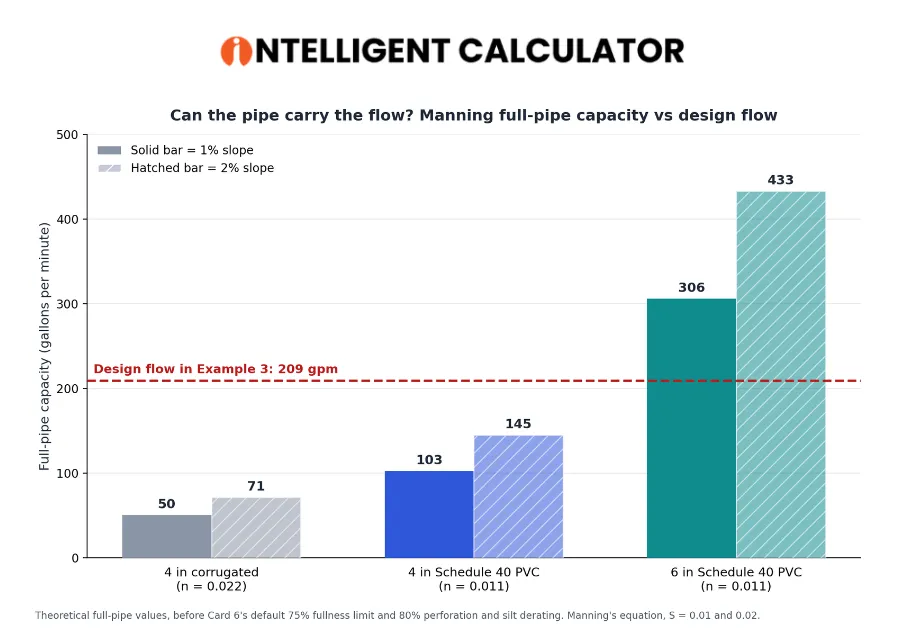
Figure 3. Only the 6 in Schedule 40 pipe clears the 209 gpm design flow in Example 3, and only before derating.
How much slope does a French drain need?
A French drain needs at least 1 percent slope, about 1/8 inch of fall per foot. Many guides suggest 2 percent (1/4 inch per foot) when the site allows.
| Slope | Fall per 10 ft | Fall over 50 ft | Fall over 100 ft |
| 1% | 1.2 in | 6 in | 12 in |
| 1/8 in per ft (1.04%) | 1.25 in | 6.25 in | 12.5 in |
| 2% | 2.4 in | 12 in | 24 in |
| 1/4 in per ft (2.08%) | 2.5 in | 12.5 in | 25 in |
At 1 percent slope a 50 ft run falls 6 inches and a 100 ft run falls 12 inches, while at 2 percent the 100 ft run falls 24 inches. Flatter pipe collects silt and may hold standing water, so the calculator flags anything under 1 percent. For other grade maths, try the slope calculator.
French drain pipe holes up or down
For a standard perforated yard drain, lay the holes down unless your pipe maker says otherwise. Two sources agree. The UK pipe supplier JD Pipes says the most effective method is holes facing down, because water seeps up from the trench bottom into the pipe. A US Department of Veterans Affairs foundation drainage specification also says to lay perforated pipe with perforations down. Some systems, such as leach fields, point holes up for distribution instead, so follow the instructions printed on your pipe. In every case, surround the pipe fully with clean stone.
How Deep and How Wide Should a French Drain Be?
Yard drains are typically 18 to 24 inches deep and 8 to 12 inches wide, while foundation drains run 36 to 96 inches deep and need professional design.
| Project | Typical depth | Note |
| Yard low spot or lawn | 18 to 24 in | Shallow, DIY-friendly |
| Driveway or patio edge | 18 to 30 in | Check surface load and cover |
| Behind a retaining wall | 24 to 48 in | Confirm with an engineer |
| Foundation or footing | 36 to 96 in | Deep; professional design advised |
| Downspout discharge line | 12 to 24 in | Solid pipe to the outlet |
| Sports field or garden bed | 12 to 24 in | Shallow; sometimes with a sand slit |
Trench width is the pipe diameter plus about 4 inches, so a 4 in pipe (4.5 in OD) needs at least 9 inches, and 12 inches is more comfortable. The pipe also needs a 3 in stone bed under it, because skipping the bed leaves the pipe on soil and weakens flow and support. If you cap the drain with topsoil or sod, the soil calculator and the sod calculator size the cap.
Worked Examples
Example 1: A 50 ft yard drain (imperial)
A homeowner has a soggy low spot. The trench is 50 ft long, 12 in wide, and 18 in deep.
- Trench volume = 50 x 1 x 1.5 = 75 ft³.
- Pipe volume (4.5 in OD) = pi x (4.5 / 24)² x 50, about 52 ft³. The volume calculator repeats this check.
- Net gravel = 75 – 5.52 = 48 ft³ (2.57 yd³).
- Add 10 percent waste: 76.43 ft³ = 83 yd³.
- Weight = 2.83 x 1.40 = 96 tons.
- Fabric strip = 2(1.5) + 2(1) + 1 = 6 ft. Area = 6 x 50 x 1.1 = 330 ft².
Materials cost at planning prices of $45 per ton, $100 delivery, $2.50 per ft for 60 ft of pipe, and $0.13 per ft² of fabric:
| Item | Cost |
| Stone (3.96 t x $45 + $100) | $278 |
| Pipe (60 ft) | $150 |
| Fabric (330 ft²) | $43 |
| Materials total | about $471 |
Add a $25 pop-up emitter and one day of mini-excavator rental at $350. With 10 percent contingency, the DIY cash budget lands near $930, or about $18.60 per foot. That is below the $25 to $65 per foot range Card 4 uses for a standard yard drain. Your own time is not counted.
Example 2: A 100 ft run with slope and pipe
A 100 ft drain starts 18 in deep and falls at 1/4 in per foot (2.08 percent). It has 20 ft of solid pipe to the outlet, 8 percent pipe waste, and 10 ft sections.
- Fall = 100 x 2.08% = 2.08 ft = 25 in.
- Outlet depth = 18 + 25 = 43 in (about 3.6 ft).
- Sloped length = sqrt(100² + 2.08²) + 20, about 120.0 ft.
- Pipe to buy = 120.0 x 1.08, about 6 ft, which is 13 sections of 10 ft.
The outlet end is more than 3.5 ft deep, so the calculator warns that cave-in risk rises past 4 ft. A gentler slope may be safer. Figure 4 in the install section shows this run.
Example 3: Does the pipe have enough capacity?
A homeowner wants to drain a 5,000 ft² paved and roofed area. The roof runoff coefficient C is 0.90. Rainfall intensity is 3 in/hr, and the safety factor is 1.5. Get your own intensity from the NOAA Atlas 14 Precipitation Frequency Data Server by choosing your location, storm duration, and return period.
- Area = 5,000 / 43,560 = 0.115 acres. (Need acre maths? See acres to square feet.)
- Q = 0.90 x 3 x 0.115, about 31 cfs, or about 139 gpm.
- Design flow = 139 x 1.5, about 209 gpm.
Compare 209 gpm with the pipe capacities in Figure 3. At 1 percent slope, 4 in corrugated pipe (about 50 gpm) and 4 in Schedule 40 (about 103 gpm) are far too small. The 6 in Schedule 40 pipe (about 306 gpm) clears it only before derating. This result is a warning sign: roof water should go into a solid downspout line, not a perforated French drain. A French drain is for groundwater and soil water. Card 10 sizes a dry well for stored storm water, and the tank volume calculator or cylinder volume calculator checks round pits.
The Formulas Behind the Calculator
Every result uses standard geometry or a named engineering equation. Nothing is hidden. In these formulas, L is length (ft), W is width (ft), D is depth (ft), and OD is pipe outside diameter (in).
Trench and gravel (Card 1)
Trench volume (ft3) = L x W x D
Pipe volume (ft3) = pi x (OD / 24)^2 x L
Net gravel (ft3) = L x W x (D – cap) – pipe volume
Order volume (yd3) = net gravel x (1 + waste) / 27
Tons = order yd3 x density x moisture factor
Bags (50 lb) = tons x 2,000 / 50
Slope, fall, and fabric (Cards 2 and 3)
Fall (ft) = run x slope
Outlet depth = starting depth + fall
Sloped length = sqrt(run^2 + fall^2) + outlet run
Pipe to buy = sloped length x (1 + waste)
Full wrap strip (ft) = 2D + 2W + overlap
Fabric area = strip x L x (1 + waste)
Flow and storage (Cards 5, 6, and 10)
Rational Method: Q (cfs) = C x i x A (C runoff coefficient, i in/hr, A acres)
1 cfs = 448.83 gpm
Manning: Q (cfs) = (1.486 / n) x A x R^(2/3) x S^(1/2)
(n roughness, A flow area ft2, R hydraulic radius ft, S slope ft/ft)
Storage (gal) = pit volume (ft3) x void ratio x 7.48
For unit work, try the cubic feet converter or the cubic feet to gallons converter. Assumptions to know about:
- Stone density defaults to 1.40 tons per cubic yard for #57. Suppliers quote about 1.35 to 1.50.
- The trench is treated as a clean rectangle. Real trenches have uneven walls, which is why the 10 percent waste default exists.
- The model assumes stone fills the trench except for the pipe and any soil cap.
- Cost fields are planning prices, not quotes.
What Does a French Drain Cost in 2026?
LawnStarter’s 2026 guide puts exterior French drains at about $10 to $65 per linear foot installed, and Lawn Love’s 2026 guide gives $10 to $75. Both put interior basement drains at about $40 to $100 per foot. These figures are planning ranges, not quotes.
| Type | Installed cost per linear foot | Source |
| Exterior yard drain | about $10 to $65 (up to $75) | LawnStarter; Lawn Love, 2026 |
| Interior basement drain | about $40 to $100 | LawnStarter; Lawn Love, 2026 |
| Bulk washed stone (material only) | about $35 to $55 per ton, before delivery | HelloGravel |
Cost varies a lot by region, access, and depth. Lawn Love’s own 25 ft DIY example (10 in wide, 18 in deep, one catch basin) comes to $528, or $21.12 per foot, which is close to the $18.60 per foot in Example 1.
What moves the price most?
- Trench size. Depth and width change stone and dig volume together.
- Digging method. Card 7 uses 0.4 yd³ per hour by hand and 4 yd³ per hour with a rental mini-excavator. The 50 ft example removes about 2.8 yd³, which is roughly 7 hours by hand or under 1 hour by machine at those default rates.
- Rock, heavy clay, and roots can cut dig speed by half or more.
- Outlet hardware. An emitter, catch basin, or dry well adds cost and is often forgotten.
Card 11 draws a tornado chart showing which input changes your budget most.
DIY, hybrid, or hire a contractor?
The DIY versus contractor cost check in Card 8 compares three paths. DIY is your cash cost plus your time at an hourly value you set. Hybrid means you buy materials and hire the labor. Contractor uses the market midpoint for your project type. The card also gives a break-even hourly value, the point where your time is worth more than the contractor’s labor price. If your DIY cash budget already exceeds the contractor midpoint, recheck your quantities. Run the numbers in the French drain calculator with your own local quotes.
Ordering Stone: Bulk, Bags, and Trucks
Order stone by the ton, not the cubic yard, because quarries weigh trucks and a tonnage quote is what you pay.
- Bulk is far cheaper than bags. The 50 ft example needs 159 bags, and bags cost much more per ton.
- Wet stone weighs more. Card 1 adds 5 percent for damp stone and 12 percent for wet stone, while supplier rules of thumb run 10 to 15 percent for wet stone. Ask your supplier for their own conversion.
- Round up to the next half ton. Keep a small pile for settling.
- Plan the dump spot. A truck carries roughly 15 tons, and moving a pile by wheelbarrow adds hours.
Card 12 turns your results into a one-page order sheet.
Metric and UK Terms
In metric and UK work, #57 stone becomes clean 20 mm or 20 to 40 mm drainstone, cubic yards become cubic metres (meters in US spelling), and short tons become metric tonnes.
| US term | UK / metric term |
| #57 stone | Clean 20 mm or 20 to 40 mm drainstone |
| Cubic yards | Cubic metres |
| Short tons | Metric tonnes |
| Geotextile fabric | Geotextile membrane |
| Dry well | Soakaway |
| Pop-up emitter / outlet to daylight | Outfall to ditch or surface water drain |
| French drain | Land drain or field drain (UK); weeping tile (Canada) |
Example: a trench is 30 m long, 0.30 m wide, and 0.45 m deep, with 100 mm pipe. Switch the unit menus to m and read the metric tonnes line in Card 1. Trench volume is 30 x 0.30 x 0.45 = 4.05 m³. After subtracting the pipe and adding 10 percent waste, the order volume is about 4.1 m³, which weighs about 6.8 tonnes at #57 density (1.40 short tons per yd³). With 20 mm drainstone at a slightly lower density (1.30), the weight is about 6.3 tonnes.
Always ask your UK supplier for their own conversion. For quick conversions, try feet to metres, metres to feet, yards to metres, inches to centimetres, or pounds to kilograms.
How to Install a French Drain: Order of Work
A French drain goes in as seven steps in a fixed order: locate utilities, plan the outlet and slope, dig from the outlet up, line the trench, bed and lay the pipe, fill and cap, then test. Each step below names the calculator card that supports it. Enter your trench into the French drain calculator first to get the material list.
Tools and materials list
- Dig tools: flat shovel, trenching spade, wheelbarrow, and a mini-excavator if rented.
- Measuring tools: tape, string line, line level, and stakes.
- Materials: washed #57 stone, perforated pipe, solid outlet pipe, filter fabric, pop-up emitter, fittings, and a cleanout cap.
- Safety gear: gloves, eye protection, and boots.
For the 50 ft example, buy about 2.83 cubic yards of washed #57 stone (about 3.96 tons), about 60 ft of pipe, and 330 ft² of fabric. Enter your trench to get the gravel and pipe quantities for your own size. Card 4 covers the budget and Card 12 the order sheet.
Step 1: Call before you dig and mark the route
Call 811 and wait for the utility marks before breaking ground. Dig by hand near marked lines. Keep the route clear of septic fields, tree roots, and property lines, and confirm local discharge rules before you mark the outlet. Route the drain toward daylight and away from foundations, never onto a neighbor’s lot.
Step 2: Plan the outlet and slope
Fall equals run times slope. A 100 ft run at 1 percent falls 12 inches, and at 2 percent it falls 24 inches. A steep slope on a long run puts the outlet end deep: a 100 ft run at 2.08 percent that starts 18 inches deep ends about 43 inches deep, which raises cave-in risk. Stake the high end and the outlet end, tie a string line at the planned fall, and check it with a line level.
Choose the outlet type now. Options are daylight, a pop-up emitter, a catch basin, a dry well, or a pump tie-in. Add a rodent guard or flap gate at the pipe end, and use the concrete calculator for an outfall pad or headwall. Supporting tool: Card 2.
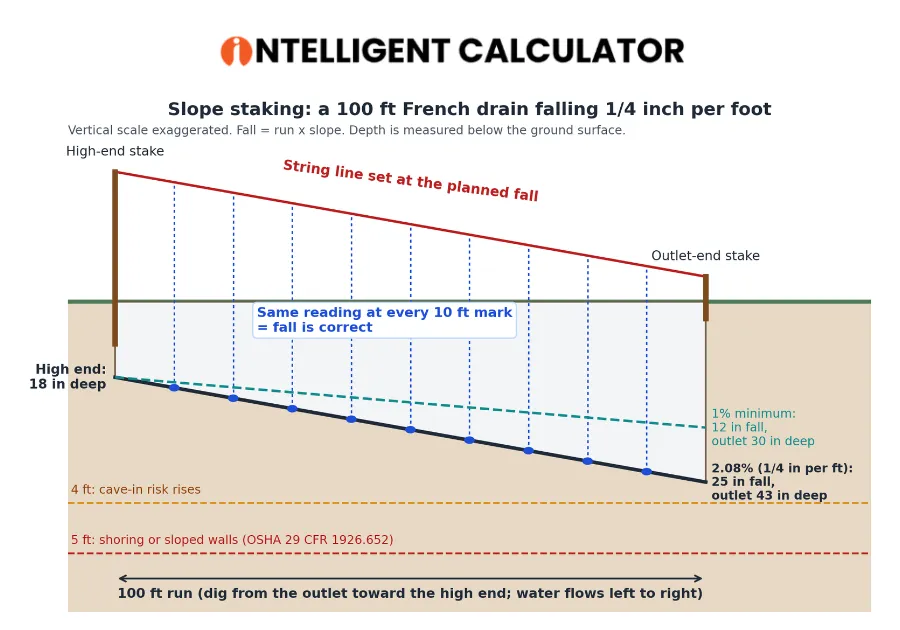
Figure 4. Measure down from the string line every 10 feet to keep the planned fall.
Step 3: Dig the trench from the outlet up
Dig from the outlet toward the high end, because the water direction is then always clear and slope errors show up early. Use a width of pipe diameter plus about 4 inches, with 8 to 12 inches typical for a yard drain and 18 to 24 inches typical depth. Check the trench floor against the string line every 10 ft. Loose soil takes more room than the hole, so plan a tarp and a spoil pile. Stop if you hit standing water, and use shoring at 5 ft or deeper. Supporting tool: Card 7.
Step 4: Line the trench with fabric
Lay non-woven filter fabric across the floor and up both walls, leaving enough to fold over the top. The full-wrap strip is 2 x depth + 2 x width + overlap, which is 6 ft for an 18 in deep, 12 in wide trench with a 12 in overlap. Never use retail weed barrier. Supporting tool: Card 3.
Step 5: Add the stone bed and lay the pipe
Spread a 3 in bed of washed stone so the pipe sits off the soil floor. Lay the pipe with the holes down unless the pipe maker says otherwise, and use solid pipe past the drain zone to the outlet. Set a cleanout at the high end so you can flush the pipe later. Place joints and fittings per the maker’s instructions. Supporting tool: Card 2.
Step 6: Fill, wrap, and cap
Fill stone to the planned depth, fold the fabric over with the overlap, and add an optional soil or sod cap of 2 to 4 inches. Mound the cap about an inch so settling does not leave a dip. The soil calculator and sod calculator size the cap. Supporting tool: Card 1.
Step 7: Test the drain
Run a hose at the high end for several minutes and watch the outlet. A steady flow means the drain works, while a trickle means a problem. If the outlet stays dry, check four things: a flat or reversed slope, a crushed pipe, clogged fabric, and a frozen or blocked outlet. Supporting tool: Card 12.
How Long Does a French Drain Last, and How Do You Maintain It?
A well-built French drain with clean stone, fabric, correct slope, and a working outlet can last decades. HelloGravel’s guide states 30 to 40 years with little maintenance, which is a vendor estimate rather than a tested figure. The usual failure modes are silt, roots, a crushed pipe, and a frozen or blocked outlet.
| When | What to do |
| After the first heavy rain | Check that water flows from the outlet within minutes to hours |
| Every spring | Check the outlet, clear the emitter, and look for roots near the drain |
| Every autumn | Clear leaves from the emitter and confirm the outlet drains before freezing weather |
| After large storms | Check the outlet and look for sinkholes above the trench |
| When flow slows | Flush clean water through the cleanout at the high end |
Call a professional for standing water at the outlet, sinkholes above the trench, or repeated clogging. A cleanout at the high end makes each of these checks cheaper.
Common French Drain Mistakes
| Mistake | Why it fails | Fix |
| Crusher run, stone dust, or pea gravel with fines | Fines fill the voids and block flow. | Use clean, washed, angular #57 stone. |
| Pipe laid flat or backward | A reverse slope collects silt. | Dig to at least 1 percent fall toward the outlet. |
| No fabric in silt or clay, or weed barrier | Soil washes into the stone and clogs it. | Wrap in non-woven geotextile. |
| No bedding, or a trench too narrow | The pipe rests on soil and cannot be surrounded by stone. | Add a 3 in bed and a trench at least 9 in wide. |
| No outlet plan, or discharge at a foundation | Water backs up or returns to the house. | Plan daylight, an emitter, or a dry well first. |
| Roof water in perforated pipe | Flow can exceed pipe capacity. | Use a solid downspout line. |
| No utility locate | Hitting a gas, power, or water line is dangerous. | Call 811 before you dig. |
Safety, Utilities, Permits, and Special Cases
Call before you dig. Contact 811 in the US or your local locate service. Hitting a gas, power, or water line is dangerous and costly.
Deep trenches. Trenches 5 ft or deeper normally need shoring or sloped walls under OSHA 29 CFR 1926.652, and cave-in risk rises quickly past 4 ft. Consider a professional or a gentler slope.
Foundation and retaining wall drains. These run deep and carry structural risk. Wrongly sized drainage can cause flooding or foundation problems, so get an engineer or licensed drainage contractor to confirm the design.
Permits, HOAs, and local rules. Rules on discharge, outlets, and digging vary by region. Check your city, county, and HOA before you start.
Poor soil and high groundwater. Clay drains slowly, so outlets and dry wells need extra care. If you hit standing groundwater in the trench, stop and reassess.
Frost and frozen ground. Frozen ground cuts dig speed to about a quarter of normal in the calculator. Plan outlets so water cannot freeze in place. The calculator does not model frost depth, so check local guidance.
Trees and septic systems. Roots slow digging and can enter perforated pipe. Keep drains away from septic fields and follow local setbacks.
Limits of This Calculator
This calculator gives planning estimates. It does not replace a site survey, an engineer’s design, or a written quote.
- It does not know your soil, groundwater, or local rainfall unless you enter them.
- Rainfall intensity should come from local data, such as NOAA Atlas 14 in the US.
- Infiltration rates come from texture-class averages. Real soil varies.
- Prices are editable planning figures, not quotes.
- It does not check local code, frost depth, or permits.
|
Important notice This calculator gives planning estimates. It is not engineering advice. For deep, foundation, or retaining-wall drains, consult a licensed drainage contractor or civil engineer and your local building office. |
Frequently Asked Questions
How much gravel do I need for a French drain?
Multiply trench length by width by depth, subtract the pipe volume, add 10 percent for waste, then convert to tons. A 50 ft trench, 12 in wide and 18 in deep, with a 4 in pipe needs about 2.83 cubic yards, or roughly 4 tons, of washed #57 stone.
How many yards of gravel per 100 feet of French drain?
A standard 12 in by 18 in trench needs about 5.7 cubic yards, or 7.9 tons, per 100 feet. A 12 in by 24 in trench needs about 7.7 cubic yards. Both include 10 percent waste.
How many bags of gravel per foot of French drain?
A 12 in by 18 in trench needs about 3.2 bags of 50 lb stone per foot, or 159 bags for 50 feet. Bulk delivery costs far less per ton than bags, so bags suit only small repairs.
How deep should a French drain be?
Yard drains are usually 18 to 24 inches deep. Retaining wall drains run 24 to 48 inches. Foundation footing drains go deeper, often 3 to 8 feet, which is professional work. Always keep the pipe on a 3 inch stone bed.
How much slope does a French drain need?
At least 1 percent, which is about 1/8 inch of fall per foot or 1 inch per 8 feet. Many guides recommend 2 percent (1/4 inch per foot) when the site allows it. A 100 ft drain at 1 percent drops 12 inches.
What size and type of gravel is best for a French drain?
Clean, washed, angular crushed stone of about 3/4 to 1 inch is best, commonly sold as #57 stone. Avoid crusher run, dense-graded aggregate, and stone dust. Their fines fill the voids and block flow.
Do I need filter fabric, and should it be woven or non-woven?
In silty or clayey soil, yes. Non-woven needle-punched geotextile is the usual choice around drains, while woven slit-film can clog. Choose by the fabric data sheet for your soil and confirm with the maker.
Can I use pea gravel in a French drain?
Pea gravel is rounded, packs tighter, and holds less water than angular stone. HelloGravel and Gravel Monkey both limit it to a decorative top layer. Use clean angular #57 stone for long-term drainage capacity.
How many feet of pipe do I need for a French drain?
Use the run length, add any solid pipe to the outlet, and add about 5 to 8 percent for cuts. A sloped run is slightly longer than a flat one. For a 100 ft run with 20 ft of outlet pipe and 8 percent waste, buy about 130 ft.
How much does a French drain cost per foot in 2026?
LawnStarter reports about $10 to $65 per linear foot installed for exterior drains, and Lawn Love reports $10 to $75. Both report $40 to $100 per foot for interior basement systems. DIY material costs are far lower but exclude your time.
Which way do the pipe holes face in a French drain?
Face the holes down for a standard perforated yard drain unless the pipe maker says otherwise. A UK pipe supplier (JD Pipes) and a US Department of Veterans Affairs drainage specification both say holes down. Follow the instructions printed on your pipe.
Is 6 inch pipe better than 4 inch pipe for a French drain?
Only when the flow demands it. A 6 in Schedule 40 pipe carries about three times the flow of a 4 in pipe at the same slope, but many yard drains handle soil water with 4 in pipe. Roof water belongs in a solid downspout line.
What is the difference between a French drain and a trench drain?
A French drain is buried stone and perforated pipe that collects soil water. A trench drain, also called a channel drain, is a surface grate over a channel that collects surface water. The two are not interchangeable.
What is weeping tile, and what is a land drain?
Weeping tile is the Canadian name for a French drain. In the UK and Ireland the same system is usually called a land drain or field drain. The same trench, stone, and pipe calculations apply.
How long does a French drain last?
A well-built French drain can last decades. HelloGravel states 30 to 40 years with correct stone and fabric, which is a vendor estimate rather than a tested figure. Silt, roots, a crushed pipe, or a blocked outlet shorten that life.
How do I clean or flush a French drain?
Clear the outlet or emitter first. Then run clean water from a hose into the cleanout at the high end and watch the outlet. If flow stays slow or the outlet stays dry, call a drainage professional.
Can I connect a downspout to a French drain?
Send roof water to a solid downspout line, not into the perforated pipe. Roof flow can exceed the capacity of a 4 in pipe, as Example 3 shows, and the overflow saturates the soil around the drain.
How far from my house should a French drain be?
No single distance fits every site. Keep the outlet well away from the foundation and confirm setbacks with your local building office. A footing drain sits beside the footing and is professional work.
Do I need a permit to install a French drain?
Rules on discharge, outlets, and digging vary by city, county, and HOA. Check with your local building office before you dig. Call 811 for the utility locate whether or not a permit is required.
Can a French drain freeze?
Water sitting in the stone or pipe can freeze, and a frozen or blocked outlet stops flow. Plan a free-draining outlet and check it before winter. The calculator does not model frost depth, so check local guidance.
How do I know if my French drain is working?
After a heavy rain, check the outlet. Water should flow out within minutes to hours, and the soil above the drain should not stay soggy. If the outlet stays dry while the yard stays wet, the pipe may be clogged or the slope may be wrong.
What is a pipeless French drain?
A pipeless French drain is a stone-filled trench with no pipe. It suits small, shallow wet spots. For longer runs or larger flows, add a perforated pipe on a proper slope.
How do I calculate a French drain in metres and tonnes?
Switch the unit menus to m, cm, or mm, and read the metric tonnes line in Card 1. For UK work, 20 to 40 mm clean aggregate sold as drainstone has a similar density to the options listed.
Sources and Methodology
Quantities use standard geometry. Flow uses the Rational Method and Manning’s equation. Infiltration values for sand through clay are texture-class averages from Rawls, Brakensiek, and Miller (1983), “Green-Ampt infiltration parameters from soils data,” Journal of Hydraulic Engineering 109(1). Gravel, till, fill, and hardpan values are planning estimates. Stone ratings in Card 9 are planning judgments, not lab results. Rounding is applied to displayed values only. Assumptions: 1.40 tons per yd³ density, 10 percent waste, a rectangular trench.
Related Calculators and Next Steps
A French drain works only when the numbers are right: the right stone, enough pipe, correct slope, and a working outlet matter more than trench size alone. Enter your trench size into the French drain calculator, work down the cards, use the Card 12 order sheet, and call 811 before you dig. Call a professional for deep or structural drains.
These calculators convert yard and hardscape dimensions into cubic yards, tons, and cost for gravel, stone, soil, sod, and drainage materials:
- Crushed stone calculator for angular drainage stone
- Gravel calculator for general gravel jobs
- River rock calculator for decorative rounded stone
- Slope calculator for grade and fall
- Retaining wall calculator for wall drainage planning
- Soil calculator and sod calculator for the cap over the drain